
Biggest companies by free cash flow (2026)
The 100 companies below have a combined market cap of $44.3T; the best performer of 2026 is SNDK (+653.1% YTD). Cash actually generated after capex — the strictest of the size rankings. Not investment advice.
End of day 2026-10-01 · 100 entries · digits update live during market hours
Top 100 by TTM free cash flow
Save as watchlist
Technical analysis0
Addendum charts0
Overlay lines0
Columns (13 shown)
| # Company | CategoryCategory | 1Y1Y chart | |||||||||||
|---|---|---|---|---|---|---|---|---|---|---|---|---|---|
| AAPLApple | Technology | $330.47 | -0.77% | +1.6% | +12.2% | +21.5% | +29.3% | +131.6% | $137B | 35.3 | $10B | $4.82T | |
| NVDANVIDIA | Technology | $230.97 | +1.13% | +6.2% | +16.8% | +23.8% | +23.3% | +1013.0% | $127B | 43.8 | $7B | $5.57T | |
| MSFTMicrosoft | Technology | $513.11 | +0.04% | +2.4% | +33.4% | +6.0% | -1.3% | +77.4% | $67B | 56.9 | $116B | $3.81T | |
| GOOGLAlphabet | Communication Services | $338.26 | -1.69% | +1.0% | -6.4% | +8.1% | +38.1% | +147.7% | $53B | 77.7 | $132B | $4.14T | |
| METAMeta Platforms | Communication Services | $725.70 | +0.07% | +25.5% | +18.4% | +10.0% | +1.2% | +111.6% | $41B | 45.1 | $89B | $1.85T | |
| AVGOBroadcom | Technology | $343.80 | -2.10% | -7.0% | -7.0% | -0.7% | +3.1% | +605.1% | $39B | 41.7 | $1B | $1.64T | |
| COFCapital One Financial | Financials | $194.48 | +0.73% | -8.0% | -5.0% | -19.8% | -8.9% | +16.8% | $30B | 4.0 | $2B | $119B | |
| CVXChevron | Energy | $207.19 | +1.46% | -1.9% | +25.0% | +35.9% | +34.0% | +98.5% | $27B | 15.2 | $18B | $409B | |
| MUMicron Technology | Technology | $1,097.68 | +3.06% | +17.6% | +6.3% | +284.5% | +502.5% | +1445.8% | $26B | 47.4 | $25B | $1.24T | |
| BRK-BBerkshire Hathaway | Financials | $500.91 | +0.59% | -0.4% | +0.2% | -0.4% | +0.5% | +81.5% | $24B | 44.3 | $22B | $1.07T | |
| UNHUnitedHealth Group | Healthcare | $365.13 | -0.53% | -7.8% | -14.4% | +10.6% | +4.9% | -6.9% | $24B | 13.9 | $3B | $328B | |
| JNJJohnson & Johnson | Healthcare | $258.74 | -2.27% | -4.6% | +1.8% | +25.0% | +39.0% | +61.2% | $22B | 28.0 | $5B | $624B | |
| VZVerizon Communications | Communication Services | $45.97 | +0.22% | -8.6% | +9.5% | +12.9% | +4.9% | -15.3% | $22B | 8.9 | $17B | $191B | |
| VVisa | Financials | $359.97 | +0.18% | -3.4% | +2.5% | +2.6% | +3.5% | +56.1% | $21B | 32.0 | $2B | $672B | |
| CMCSAComcast | Communication Services | $21.69 | -0.32% | -17.5% | -8.6% | -22.5% | -25.2% | -59.5% | $20B | 3.8 | $12B | $77B | |
| TMUST-Mobile US | Communication Services | $161.71 | -0.84% | -11.2% | -6.5% | -20.3% | -30.7% | +27.6% | $18B | 9.4 | $10B | $173B | |
| ABBVAbbVie | Healthcare | $260.03 | -0.60% | -0.0% | +3.5% | +13.8% | +6.4% | +138.3% | $18B | 25.2 | $1B | $459B | |
| MAMastercard | Financials | $550.50 | -0.18% | -5.4% | +5.3% | -3.7% | -4.1% | +52.7% | $17B | 28.9 | $735M | $482B | |
| MRKMerck | Healthcare | $143.81 | -1.03% | -4.0% | +14.7% | +36.6% | +59.6% | +76.7% | $16B | 22.1 | $4B | $355B | |
| PGRProgressive | Financials | $211.03 | +1.79% | -4.3% | -6.4% | -7.4% | -14.4% | +132.0% | $16B | 7.7 | $388M | $123B | |
| CRMSalesforce | Technology | $236.70 | +3.11% | -8.3% | +45.0% | -10.7% | +0.4% | -14.0% | $15B | 12.9 | $596M | $195B | |
| PGProcter & Gamble | Consumer Staples | $143.99 | -0.89% | -1.5% | -2.4% | +0.4% | -6.0% | +3.1% | $15B | 22.1 | $4B | $335B | |
| HDHome Depot | Consumer Discretionary | $282.50 | -0.70% | -11.7% | -19.5% | -17.9% | -28.9% | -14.4% | $15B | 18.7 | $4B | $282B | |
| AXPAmerican Express | Financials | $302.14 | -0.64% | -6.8% | -13.2% | -18.3% | -8.1% | +73.7% | $15B | 13.6 | $3B | $204B | |
| GMGeneral Motors | Consumer Discretionary | $79.32 | +3.01% | -7.4% | +5.0% | -2.5% | +29.3% | +49.3% | $14B | 4.8 | $9B | $70B | |
| KOCoca-Cola | Consumer Staples | $86.12 | +0.05% | -2.2% | +5.9% | +23.2% | +28.9% | +62.4% | $14B | 25.9 | $2B | $371B | |
| IBMInternational Business Machines | Technology | $225.75 | +2.65% | -2.5% | -21.2% | -23.8% | -21.2% | +64.7% | $14B | 15.4 | $1B | $213B | |
| WMTWalmart | Consumer Staples | $104.28 | +0.35% | -1.6% | -4.2% | -6.4% | +2.3% | +128.2% | $14B | 61.2 | $29B | $827B | |
| GILDGilead Sciences | Healthcare | $147.50 | -1.04% | -1.6% | +17.1% | +20.2% | +32.7% | +115.1% | $13B | 14.1 | $609M | $183B | |
| MPCMarathon Petroleum | Energy | $420.22 | +6.27% | +9.7% | +58.6% | +158.3% | +118.5% | +561.0% | $13B | 9.1 | $4B | $118B | |
| CSCOCisco Systems | Technology | $108.74 | +1.03% | -0.9% | -7.1% | +41.2% | +58.2% | +97.2% | $13B | 33.6 | $1B | $429B | |
| PMPhilip Morris International | Consumer Staples | $188.17 | -1.39% | +0.6% | +5.9% | +17.3% | +17.0% | +95.9% | $13B | 23.1 | $2B | $293B | |
| ACNAccenture | Technology | $212.54 | +15.91% | +12.9% | +61.9% | -20.9% | -12.9% | -34.6% | $13B | 10.4 | $600M | $131B | |
| ASMLASML Holding | Technology | $1,808.72 | -0.16% | +8.6% | -1.9% | +69.0% | +80.3% | +143.8% | $13B | 55.6 | $2B | $697B | |
| GEVGE Vernova | Industrials | $987.45 | +3.89% | +9.9% | -13.0% | +51.1% | +62.9% | — | $12B | 21.1 | $2B | $263B | |
| MELIMercadoLibre | Consumer Discretionary | $1,684.55 | -2.54% | -14.2% | -3.3% | -16.3% | -22.6% | +1.1% | $12B | 6.9 | $1B | $85B | |
| ALLAllstate | Financials | $224.47 | +1.18% | -13.0% | -7.7% | +7.8% | +6.5% | +75.7% | $12B | 4.6 | $220M | $57B | |
| CVSCVS Health | Healthcare | $85.20 | -0.57% | -12.7% | -18.7% | +7.4% | +10.8% | +1.3% | $12B | 9.3 | $3B | $109B | |
| SNDKSandisk | Technology | $1,786.91 | +2.70% | +16.3% | -12.0% | +653.1% | +1376.0% | — | $11B | 22.8 | $177M | $262B | |
| BMYBristol-Myers Squibb | Healthcare | $61.45 | -1.53% | -8.2% | +8.9% | +13.9% | +29.6% | +3.3% | $11B | 11.0 | $1B | $126B | |
| RTXRTX | Industrials | $185.03 | -0.33% | -9.8% | -3.5% | +0.9% | +10.7% | +111.5% | $11B | 21.9 | $3B | $249B | |
| HDBHDFC Bank | Financials | $22.95 | +2.71% | +0.0% | -10.2% | -37.2% | -32.1% | -37.7% | $11B | 10.4 | $563M | $118B | |
| NFLXNetflix | Communication Services | $67.85 | -2.49% | -16.0% | -8.5% | -27.6% | -42.1% | +10.7% | $11B | 25.3 | $819M | $283B | |
| PFEPfizer | Healthcare | $28.12 | -1.40% | -1.5% | +17.8% | +12.9% | +3.3% | -34.5% | $11B | 14.6 | $2B | $160B | |
| SCHWCharles Schwab | Financials | $98.41 | +0.68% | -9.2% | +2.7% | -1.5% | +6.6% | +32.2% | $11B | 15.8 | $628M | $170B | |
| CATCaterpillar | Industrials | $826.35 | +1.92% | +6.1% | -16.6% | +44.2% | +71.9% | +325.2% | $11B | 35.5 | $3B | $380B | |
| ADBEAdobe | Technology | $241.27 | +0.55% | -15.7% | +14.4% | -31.1% | -29.8% | -58.2% | $11B | 8.9 | $214M | $94B | |
| QCOMQUALCOMM | Technology | $181.96 | -1.13% | +9.3% | +0.1% | +6.5% | +9.4% | +41.5% | $10B | 18.3 | $2B | $191B | |
| AMGNAmgen | Healthcare | $407.33 | -3.36% | -7.0% | +12.7% | +24.4% | +36.4% | +90.4% | $10B | 21.6 | $2B | $220B | |
| UBERUber Technologies | Industrials | $67.90 | -0.90% | -9.8% | -6.6% | -16.9% | -29.7% | +44.3% | $10B | 13.7 | $308M | $139B | |
| NEMNewmont | Materials | $114.67 | -0.58% | -6.5% | +22.9% | +14.8% | +33.4% | +114.1% | $10B | 12.4 | $3B | $121B | |
| BKNGBooking Holdings | Consumer Discretionary | $160.29 | -1.61% | -18.1% | -12.2% | -25.2% | -25.1% | +63.2% | $10B | 12.6 | $320M | $120B | |
| PEPPepsiCo | Consumer Staples | $125.62 | -0.87% | -10.2% | -11.0% | -12.5% | -12.3% | -16.8% | $9B | 18.5 | $4B | $171B | |
| MOAltria Group | Consumer Staples | $66.96 | -0.57% | -3.8% | -6.4% | +16.1% | +1.0% | +46.0% | $9B | 12.3 | $296M | $112B | |
| CNCCentene | Healthcare | $60.97 | -1.85% | -6.5% | -10.8% | +48.2% | +70.6% | -3.3% | $9B | 3.4 | $798M | $30B | |
| COSTCostco Wholesale | Consumer Staples | $914.99 | +0.51% | -2.7% | -1.1% | +6.1% | -0.3% | +104.1% | $9B | 46.1 | $6B | $406B | |
| LMTLockheed Martin | Industrials | $505.54 | -0.73% | -7.2% | -3.1% | +4.5% | +1.3% | +45.3% | $9B | 13.4 | $2B | $117B | |
| INTUIntuit | Technology | $282.66 | +2.52% | -18.0% | +5.9% | -57.3% | -58.4% | -48.0% | $9B | 8.7 | $175M | $76B | |
| DELLDell Technologies | Technology | $541.70 | +0.70% | +27.5% | +27.4% | +330.4% | +261.9% | +910.4% | $9B | 40.2 | $4B | $344B | |
| AMDAdvanced Micro Devices | Technology | $615.64 | +0.63% | +34.0% | +13.8% | +187.5% | +275.4% | +501.0% | $8B | 120 | $2B | $1.01T | |
| GEGE Aerospace | Industrials | $312.46 | +0.05% | -5.6% | -16.7% | +1.4% | +3.8% | +373.8% | $8B | 38.6 | $1B | $324B | |
| DISWalt Disney | Communication Services | $101.34 | -3.39% | -4.6% | +5.9% | -10.9% | -10.3% | -42.4% | $8B | 21.1 | $9B | $175B | |
| AMPAmeriprise Financial | Financials | $494.81 | +0.50% | -8.8% | +3.2% | +0.9% | +1.7% | +84.3% | $8B | 5.4 | $154M | $44B | |
| ABTAbbott Laboratories | Healthcare | $96.70 | -2.16% | -11.2% | +4.9% | -22.8% | -27.6% | -17.5% | $8B | 21.4 | $2B | $167B | |
| MCDMcDonald's | Consumer Discretionary | $231.84 | +0.39% | -11.2% | -14.0% | -24.1% | -22.9% | -4.6% | $8B | 21.1 | $4B | $164B | |
| WSEWise Group | Industrials | $11.41 | +0.18% | -11.7% | -7.3% | — | — | — | $8B | — | $20M | — | |
| TMOThermo Fisher Scientific | Healthcare | $652.48 | -3.34% | +8.7% | +27.1% | +12.6% | +22.9% | +13.9% | $7B | 33.0 | $2B | $241B | |
| FFord Motor | Consumer Discretionary | $12.28 | +1.82% | -11.3% | -10.0% | -6.5% | +0.0% | -13.3% | $7B | 6.7 | $10B | $49B | |
| NTESNetEase ADR | Technology | $120.63 | -0.44% | +0.4% | -7.0% | -12.4% | -19.6% | +43.9% | $7B | 10.8 | $152M | $77B | |
| LOWLowe's Companies | Consumer Discretionary | $182.37 | -1.04% | -8.8% | -17.8% | -24.4% | -26.5% | -10.5% | $7B | 14.6 | $2B | $102B | |
| PYPLPayPal Holdings | Financials | $53.07 | +1.03% | +1.3% | +20.4% | -9.1% | -20.4% | -80.0% | $7B | 6.9 | $889M | $45B | |
| UNPUnion Pacific | Industrials | $272.46 | +0.12% | -6.3% | -1.9% | +17.8% | +16.1% | +35.0% | $7B | 24.9 | $4B | $162B | |
| FANGDiamondback Energy | Energy | $185.47 | +0.90% | -8.7% | +7.9% | +23.4% | +29.2% | +87.6% | $6B | 8.0 | $4B | $52B | |
| GDGeneral Dynamics | Industrials | $332.74 | +0.27% | -9.9% | -8.3% | -1.2% | -2.4% | +67.9% | $6B | 14.0 | $1B | $90B | |
| MCKMcKesson | Healthcare | $899.36 | +5.33% | -0.9% | +17.0% | +9.6% | +17.5% | +349.4% | $6B | 16.3 | $437M | $105B | |
| ELVElevance Health | Healthcare | $381.79 | -1.81% | -5.3% | -8.3% | +8.9% | +14.7% | +1.5% | $6B | 13.2 | $1B | $83B | |
| MDTMedtronic plc. | Healthcare | $86.48 | +0.22% | -6.1% | +9.1% | -10.0% | -8.8% | -32.1% | $6B | 18.0 | $2B | $111B | |
| ACGLArch Capital Group | Financials | $94.26 | +2.06% | -4.4% | -4.4% | -1.7% | +4.4% | +146.9% | $6B | 5.3 | $45M | $32B | |
| DEDeere | Industrials | $667.44 | -0.61% | -1.3% | +6.3% | +43.3% | +47.7% | +95.0% | $6B | 29.9 | $1B | $180B | |
| HCAHCA Healthcare | Healthcare | $423.40 | -0.78% | +2.4% | +7.7% | -9.3% | -0.6% | +70.9% | $6B | 15.3 | $5B | $92B | |
| TJXTJX Companies | Consumer Discretionary | $133.61 | +0.98% | +0.2% | -11.7% | -13.0% | -7.4% | +100.6% | $6B | 25.0 | $2B | $147B | |
| HIGHartford Insurance Group | Financials | $125.80 | +2.81% | -8.3% | -6.1% | -8.8% | -5.4% | +77.1% | $6B | 5.8 | $7M | $34B | |
| TSLATesla | Consumer Discretionary | $354.19 | -0.17% | -0.6% | -16.7% | -21.3% | -22.9% | +37.0% | $6B | 243 | $13B | $1.40T | |
| AMATApplied Materials | Technology | $529.27 | +3.50% | +19.8% | -18.7% | +106.0% | +143.1% | +309.9% | $6B | 74.7 | $3B | $420B | |
| SPGIS&P Global | Financials | $388.12 | -1.61% | -11.8% | -6.5% | -21.5% | -14.8% | -4.2% | $6B | 20.5 | $156M | $114B | |
| BXBlackstone | Financials | $112.27 | +0.16% | -17.9% | -6.1% | -27.2% | -33.2% | -3.0% | $5B | 15.4 | $112M | $84B | |
| DHRDanaher | Healthcare | $211.74 | -4.43% | +2.3% | +9.3% | -7.5% | -0.5% | -21.0% | $5B | 27.2 | $1B | $149B | |
| UPSUnited Parcel Service | Industrials | $93.91 | +0.50% | -8.5% | -14.3% | -5.3% | +11.3% | -48.3% | $5B | 14.6 | $3B | $80B | |
| TXNTexas Instruments | Technology | $281.25 | +0.41% | +11.0% | -5.7% | +62.1% | +55.9% | +45.2% | $5B | 48.0 | $3B | $257B | |
| FUTUFutu Holdings ADR | Financials | $106.41 | -3.74% | -10.8% | +6.5% | -35.2% | -39.7% | +17.6% | $5B | 2.8 | $7M | $15B | |
| ETEnergy Transfer | Utilities | $20.09 | +1.62% | -6.2% | +5.5% | +21.9% | +18.3% | +106.2% | $5B | 13.3 | $7B | $69B | |
| FDXFedEx | Industrials | $287.07 | +0.69% | -11.6% | -8.5% | +23.3% | +48.7% | +60.1% | $5B | 13.3 | $4B | $68B | |
| SCCOSouthern Copper | Materials | $199.28 | -1.66% | -1.2% | +18.0% | +41.4% | +66.7% | +270.9% | $5B | 32.6 | $2B | $166B | |
| ICEIntercontinental Exchange | Financials | $151.47 | -0.37% | -5.1% | +19.5% | -6.5% | -6.9% | +31.3% | $5B | 16.7 | $436M | $85B | |
| LINLinde | Materials | $469.59 | -1.07% | -3.6% | -12.0% | +10.1% | +0.6% | +57.6% | $5B | 43.5 | $6B | $216B | |
| ADIAnalog Devices | Technology | $404.55 | +1.98% | +14.1% | +4.0% | +49.2% | +69.1% | +141.7% | $5B | 39.7 | $608M | $196B | |
| LRCXLam Research | Technology | $339.80 | +3.44% | +17.2% | -13.1% | +98.7% | +138.2% | +496.9% | $5B | 86.9 | $966M | $425B | |
| SLBSLB | Energy | $48.67 | -0.10% | -14.9% | +7.9% | +26.8% | +38.7% | +60.3% | $5B | 15.0 | $2B | $72B | |
| OXYOccidental Petroleum | Energy | $57.84 | +4.55% | -5.1% | +20.7% | +40.7% | +21.2% | +85.7% | $5B | 12.1 | $6B | $58B | |
| MRSHMarsh | Financials | $171.85 | +0.66% | -8.4% | -0.2% | -7.4% | -14.6% | +11.5% | $5B | 17.2 | $311M | $82B |
Methodology
Free cash flow is operating cash flow minus capital expenditures, both trailing twelve months from SEC cash-flow statements. It is the strictest of the size rankings: it cannot be flattered by non-cash accounting, and it charges a company for the capex it needs to keep running.
Performance columns are price returns: the change in the split-adjusted share price, the way quote screens report it, through the latest print during the session. Dividends are not reinvested. Fundamentals come from company filings via our EDGAR pipeline. Past performance does not predict future returns; this is not investment advice.
FAQ#
- Which company generates the most free cash flow?
- Apple Inc. (AAPL) generates the most free cash flow of any US-listed company — about $137B over the trailing twelve months.
- What are the top 10 companies by free cash flow?
- The 10 biggest free-cash-flow generators (TTM): 1. AAPL $137B, 2. NVDA $127B, 3. MSFT $67B, 4. GOOGL $53B, 5. META $41B, 6. AVGO $39B, 7. COF $30B, 8. CVX $27B, 9. MU $26B, 10. BRK-B $24B.
- Why does free cash flow matter?
- Free cash flow is operating cash flow minus capital expenditures — the cash left after running and maintaining the business. Many investors treat it as harder to manipulate than net income, and it's what funds buybacks, dividends and debt paydown. Note that heavy investment phases (like AI datacenter build-outs) depress FCF even at very profitable companies.
More lists
Biggest capex spenders
100 stocksThe largest capital-expenditure budgets in absolute dollars — where the AI build-out actually shows up.
Biggest buyback programs
100 stocksThe most cash spent repurchasing stock over the trailing year, net of shares issued.
Biggest companies by market cap
100 stocksThe top 100 by market cap — and the trillion-dollar club.
Biggest companies by revenue
100 stocksRanked by actual sales from SEC filings. A very different top 10.
Most profitable companies
100 stocksThe top 100 by bottom-line profit. Revenue is vanity; this is the scoreboard.
Biggest ETFs
50 ETFsThe 50 largest ETFs by assets, with what they cost to own.
Explore visualizations
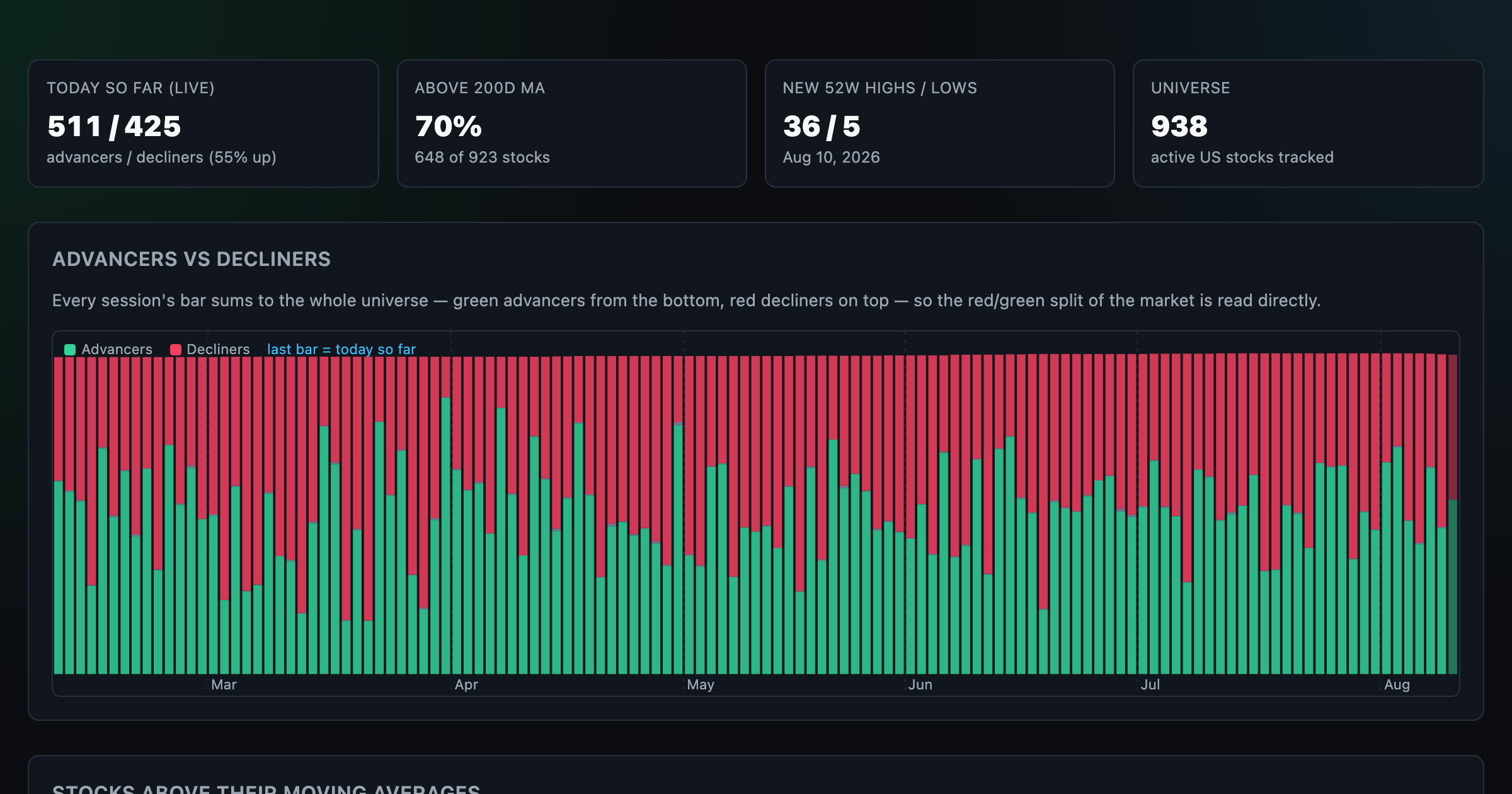
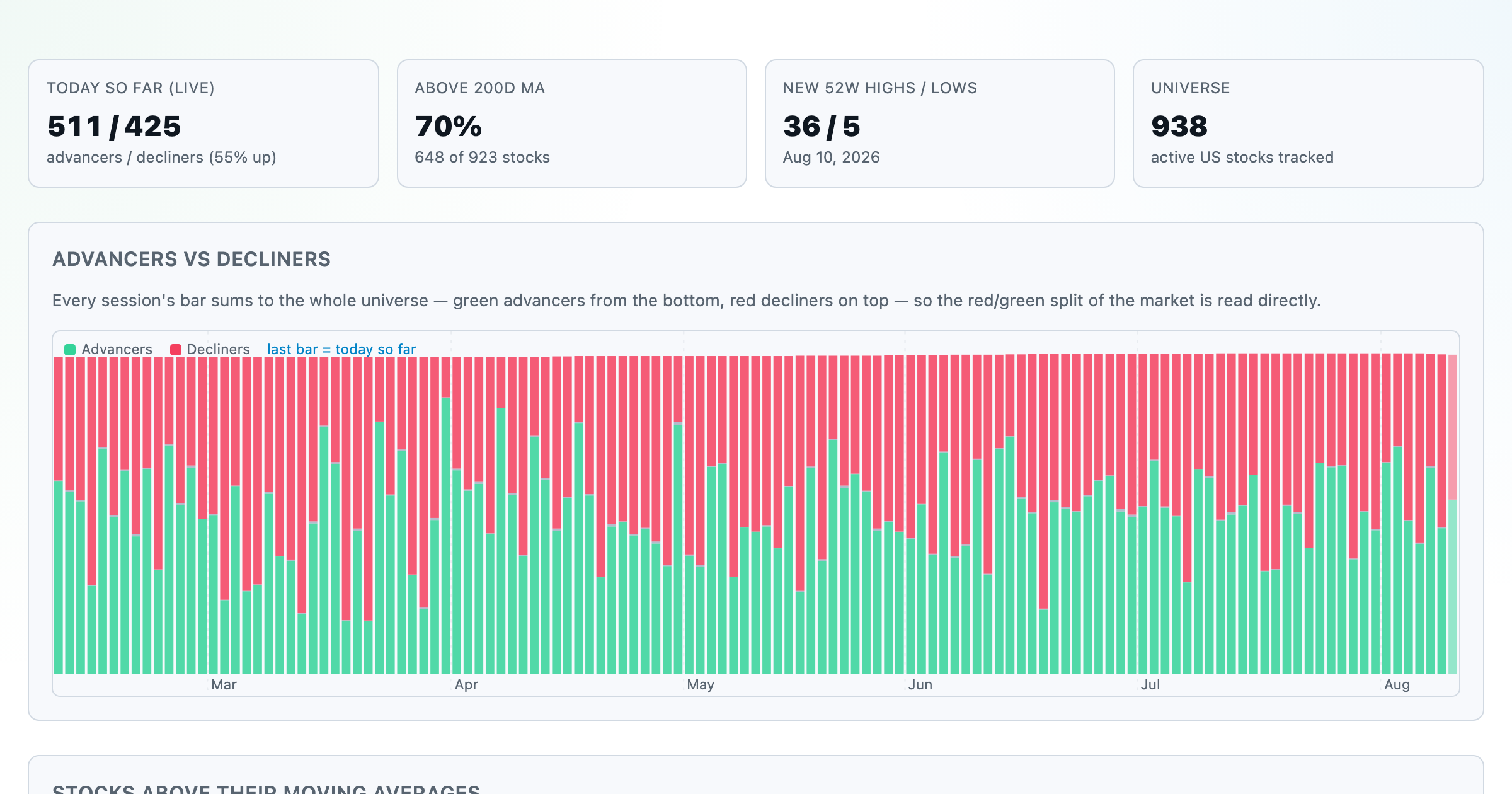
Advancers vs decliners over time, % of stocks above their moving averages, new highs vs lows, and breadth across every trailing window.
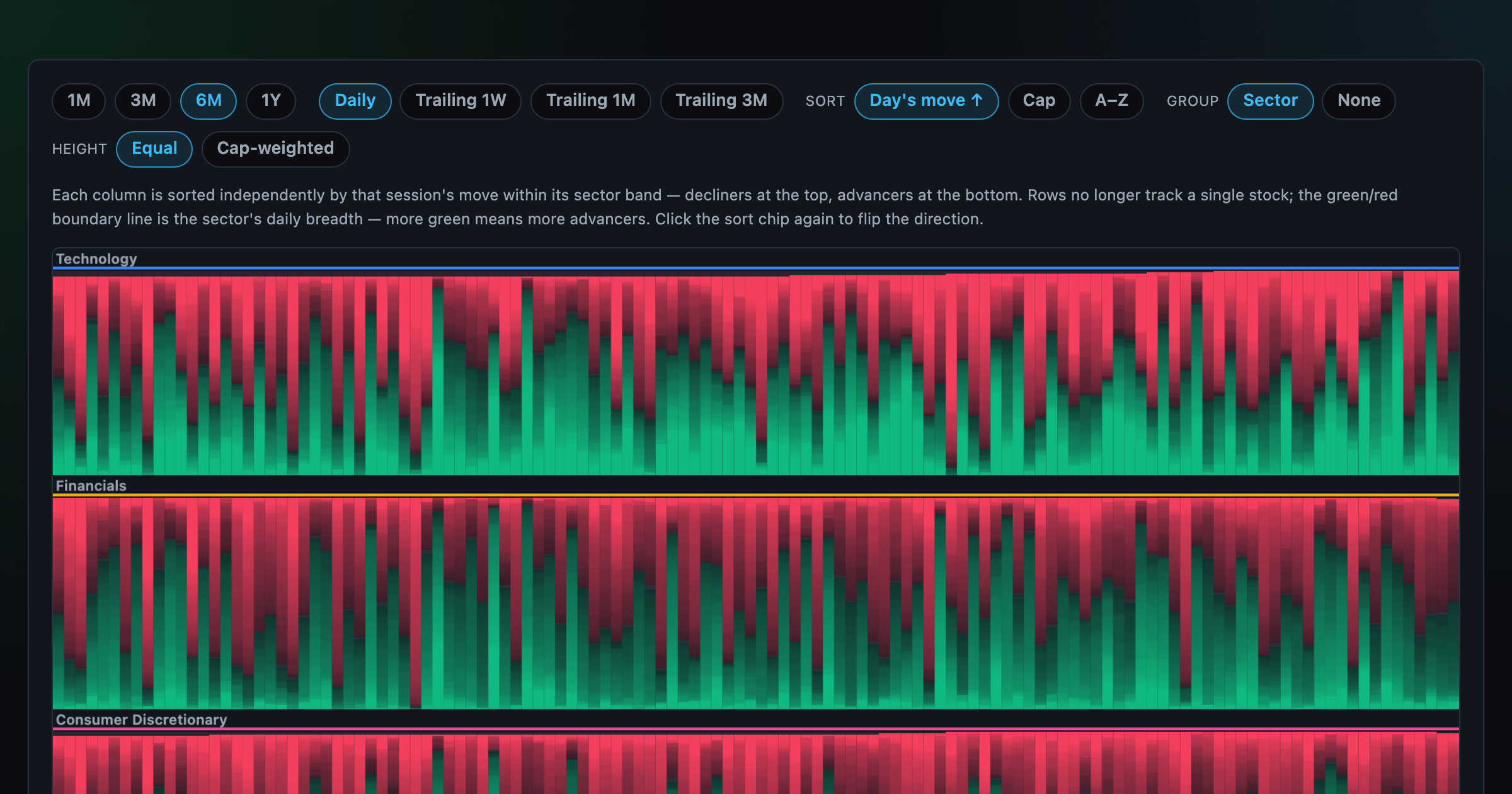
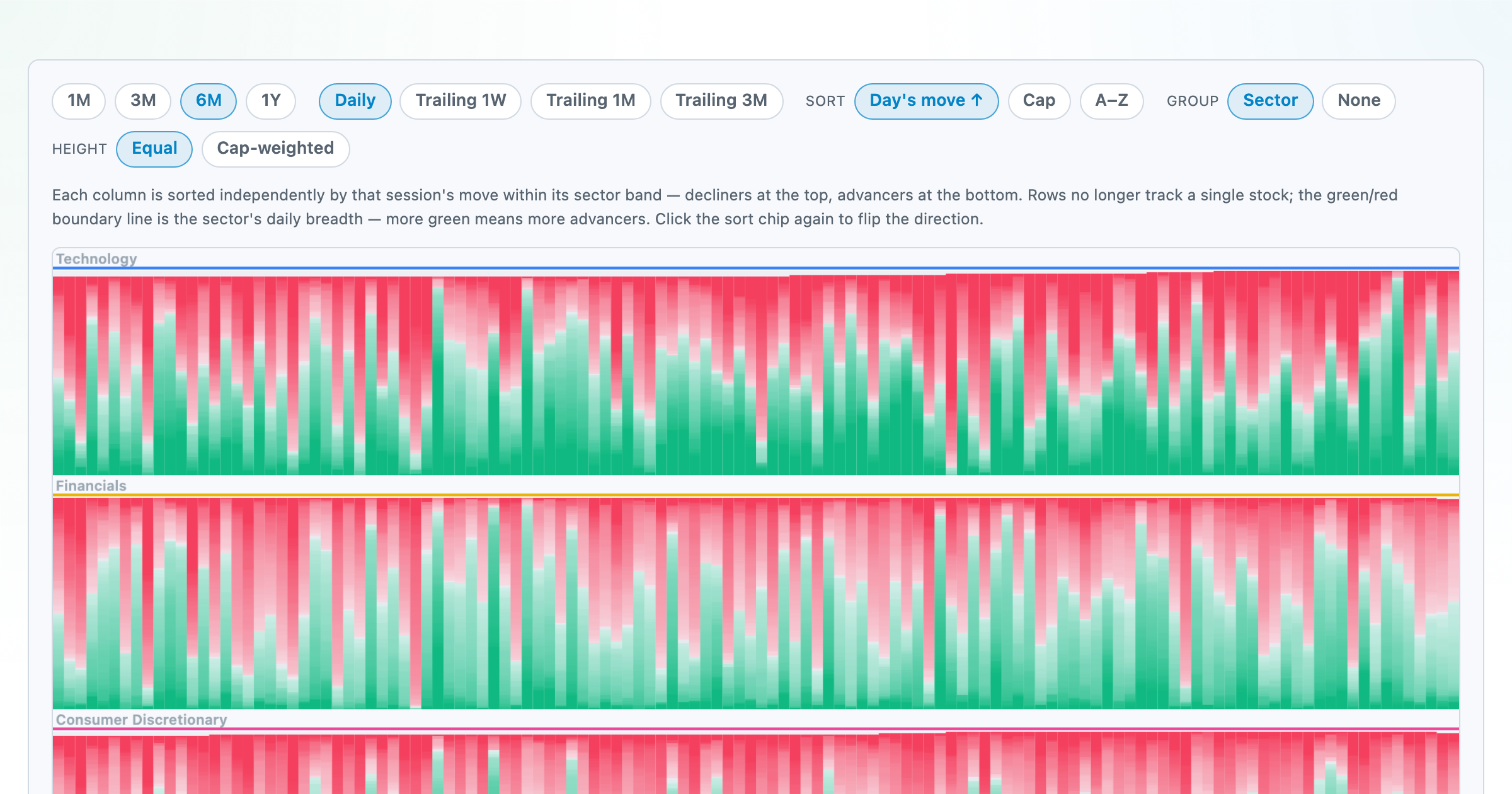
Every stock as a row, every day as a column — market selloffs are vertical stripes, sector routs are blocks.
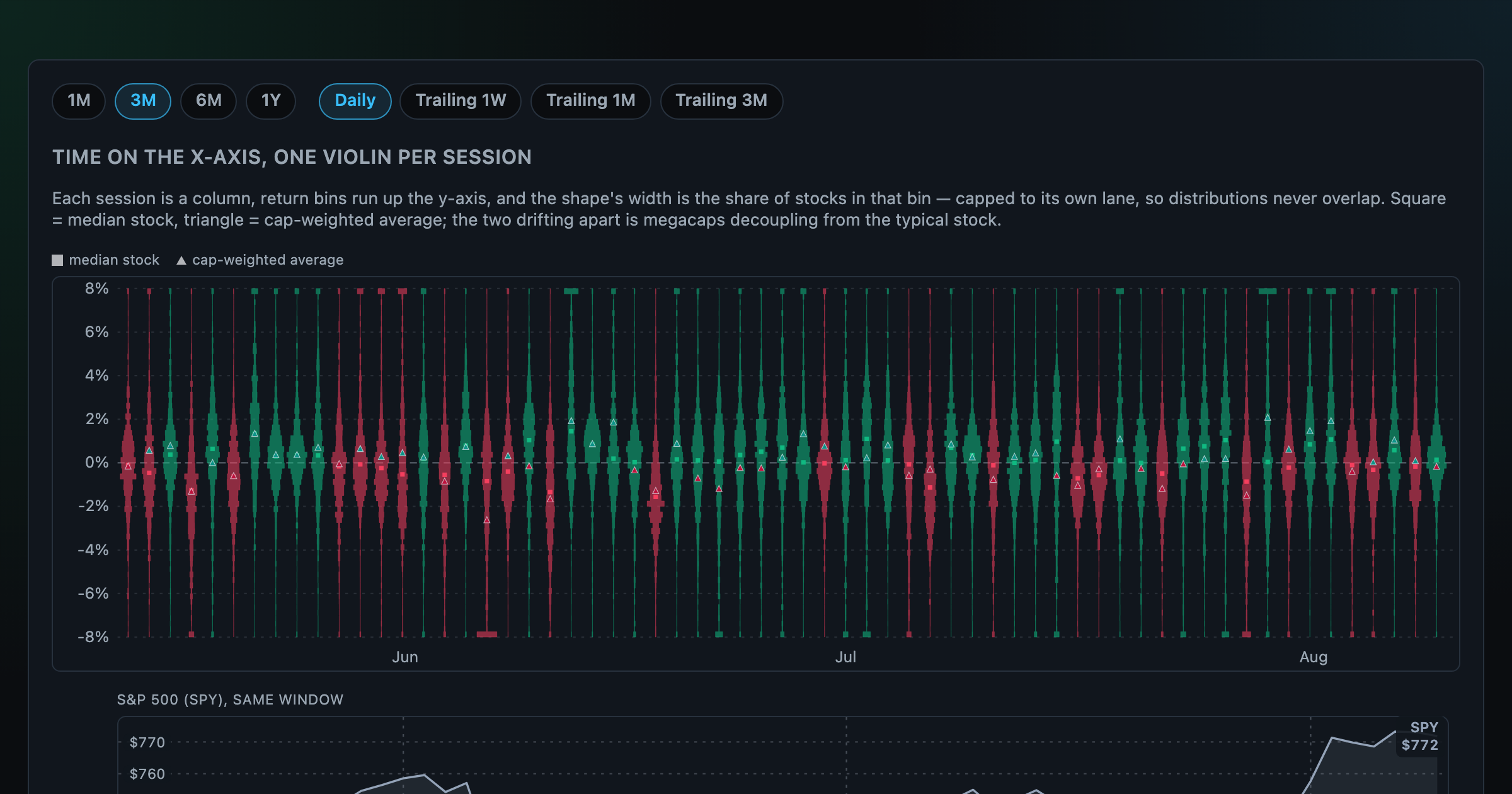
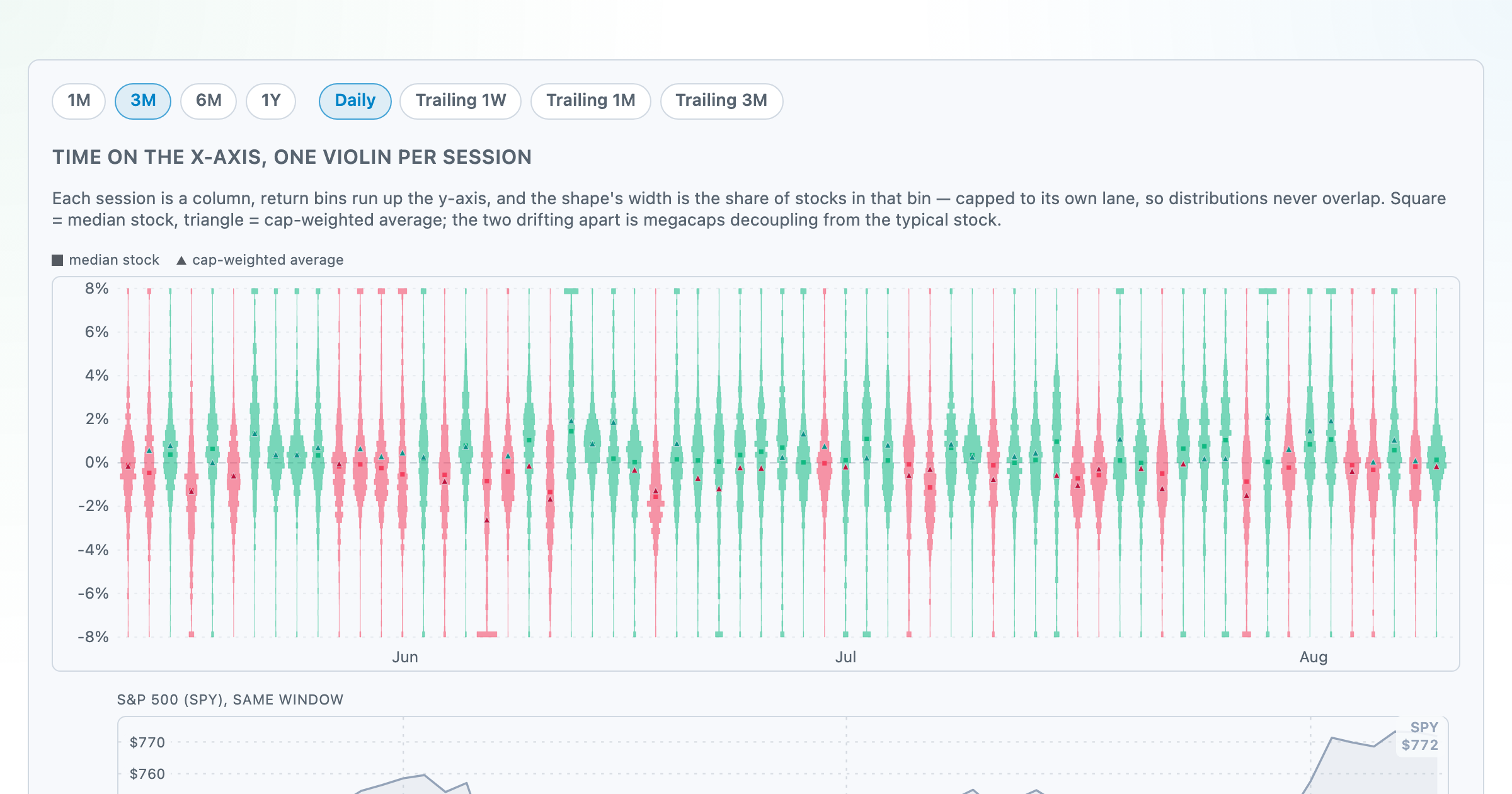
Each session's full distribution of stock returns as an upright violin, with the S&P 500 on the same axis — shifts, dispersion, and fat tails at a glance.