
Market valuation
Is the market expensive? The clearest gauge is CAPE — price divided by a decade of inflation-adjusted earnings, so a single good or bad year can't distort it. Here it is for the S&P 500 back to 1871, with what each valuation level has historically meant for the next ten years. Pick the earnings window below.
CAPE averages inflation-adjusted earnings over the window to smooth the business cycle. 10 years = Robert Shiller's classic CAPE; shorter windows track a normal P/E, longer ones smooth more.
As of Sep 2026, the S&P 500's 10-year CAPE was 39.7 — the 99th percentile since 1880. When valuations were near this level, the next 10 years returned a median +0.3%/yr real (p10 -3.5%, p90 +5.2%) — 84 comparable months.
Valuation through history. The dashed line is the long-run average; the readout follows your pointer. Peaks mark euphoria (1929, 2000, 2021), troughs mark despair (1932, 1982, 2009).
Each dot is one month: its CAPE (x) vs the real return that followed over the chosen horizon (y). The blue line is the average by valuation level — historically the strongest cheap-vs-expensive signal there is. The dashed line is today.
The other side of valuation: what the index pays out. Yields were 4–6% for most of the 20th century and have compressed as prices rose and buybacks replaced dividends.
How these numbers are put together — and where ours differs from the canonical figure.
CAPE = the S&P 500's real (inflation-adjusted) price ÷ its average real earnings over the chosen window. A 10-year window is Robert Shiller's classic CAPE; we let you pick others. Forward returns are real total returns (dividends reinvested).
Data. Price, earnings, dividends and CPI back to 1871 come from Shiller's public dataset, which carries S&P's published earnings to the last quarter S&P has closed; from there earnings are held against each later month's close, as a trailing multiple is, and CPI continues on the Federal Reserve's series (FRED), chained to Shiller's at the overlap so the line never jumps.
Caveat. This is our reconstruction — close to, but not identical to, the official Shiller CAPE (our aggregate earnings differ slightly in method and timing from the index's as-reported figure). Treat it as directionally accurate, not the canonical decimal. Latest complete window: Sep 2026 (bounded by company filing lag).
The scatter's readout. 1630 dots is too many to give each its own styled tooltip, so every dot carries a native title instead — hover and hold for its month, CAPE and outcome.
Valuation is a long-horizon signal with wide error bars — useless for timing, informative for expectations. For informational purposes only; not investment advice.
FAQ#
- What is the CAPE ratio?
- CAPE (cyclically-adjusted price-to-earnings), also called the Shiller P/E or PE10, divides the S&P 500's price by the average of its inflation-adjusted earnings over the past 10 years. Averaging a decade of earnings smooths out the business cycle so booms and busts don't distort the ratio.
- Does a high CAPE mean a crash is coming?
- No. CAPE has essentially no power to predict short-term moves or time the market — expensive markets can stay expensive for years. What it has historically tracked is the next 10–15 years of real returns: higher starting valuations have, on average, been followed by lower long-run returns, with wide error bars.
- Why let me change the earnings window?
- Shiller's CAPE uses a 10-year earnings average. A 1-year window is essentially a normal trailing P/E; longer windows (15–20 years) smooth even more. Comparing windows shows how much the smoothing choice matters to the picture.
More visualizations
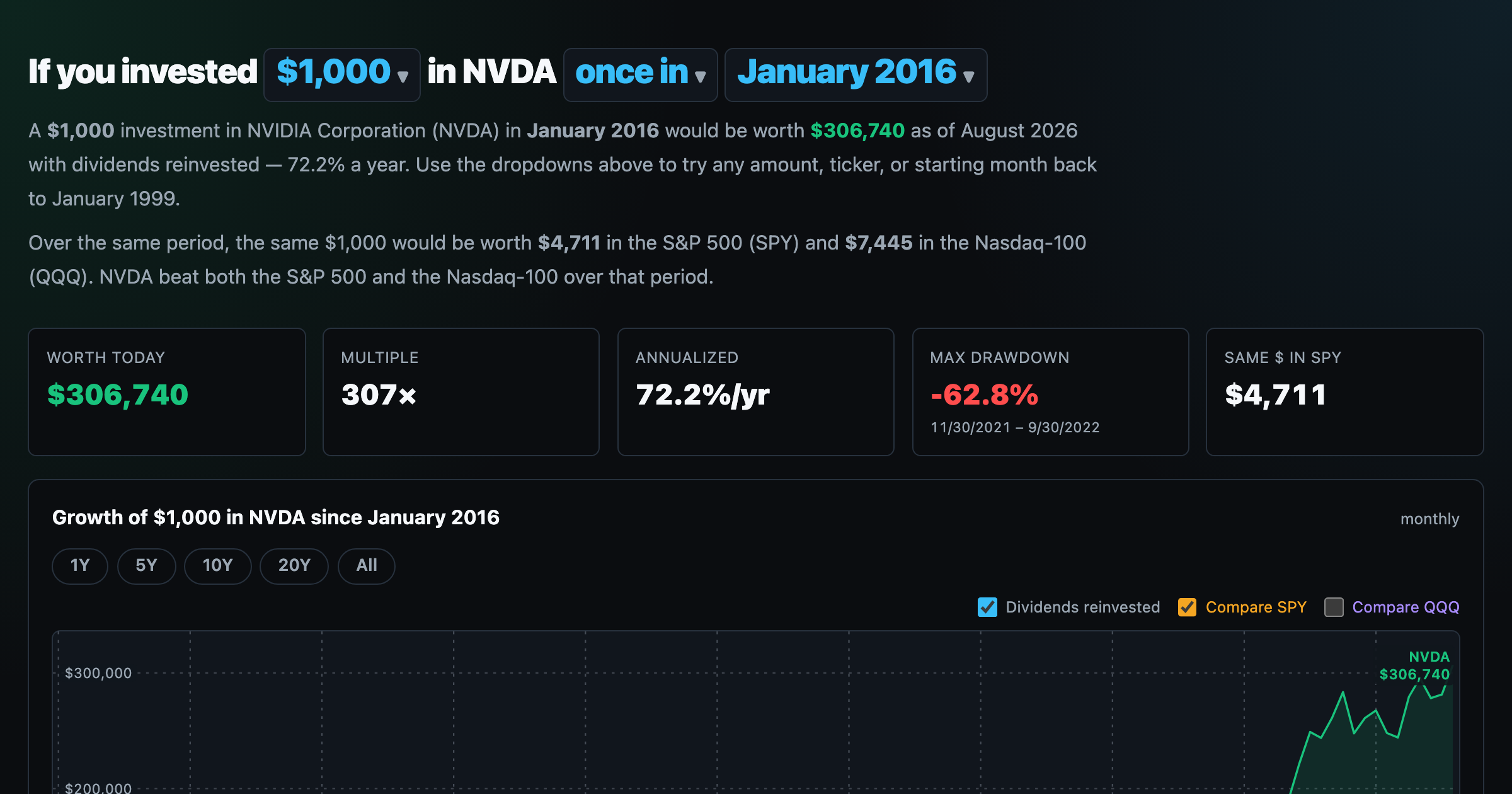
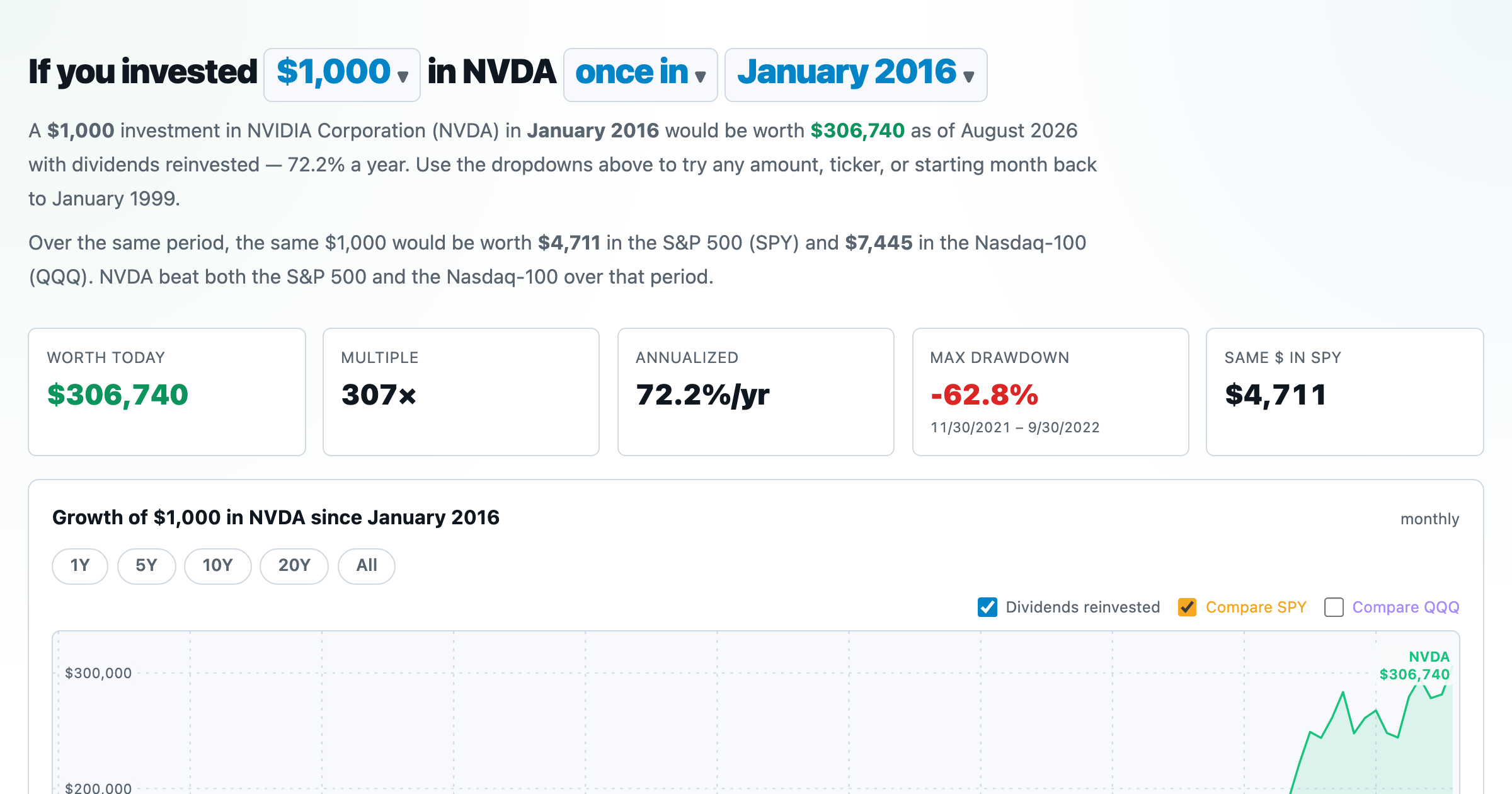
What $1,000 in any stock or ETF would be worth today.
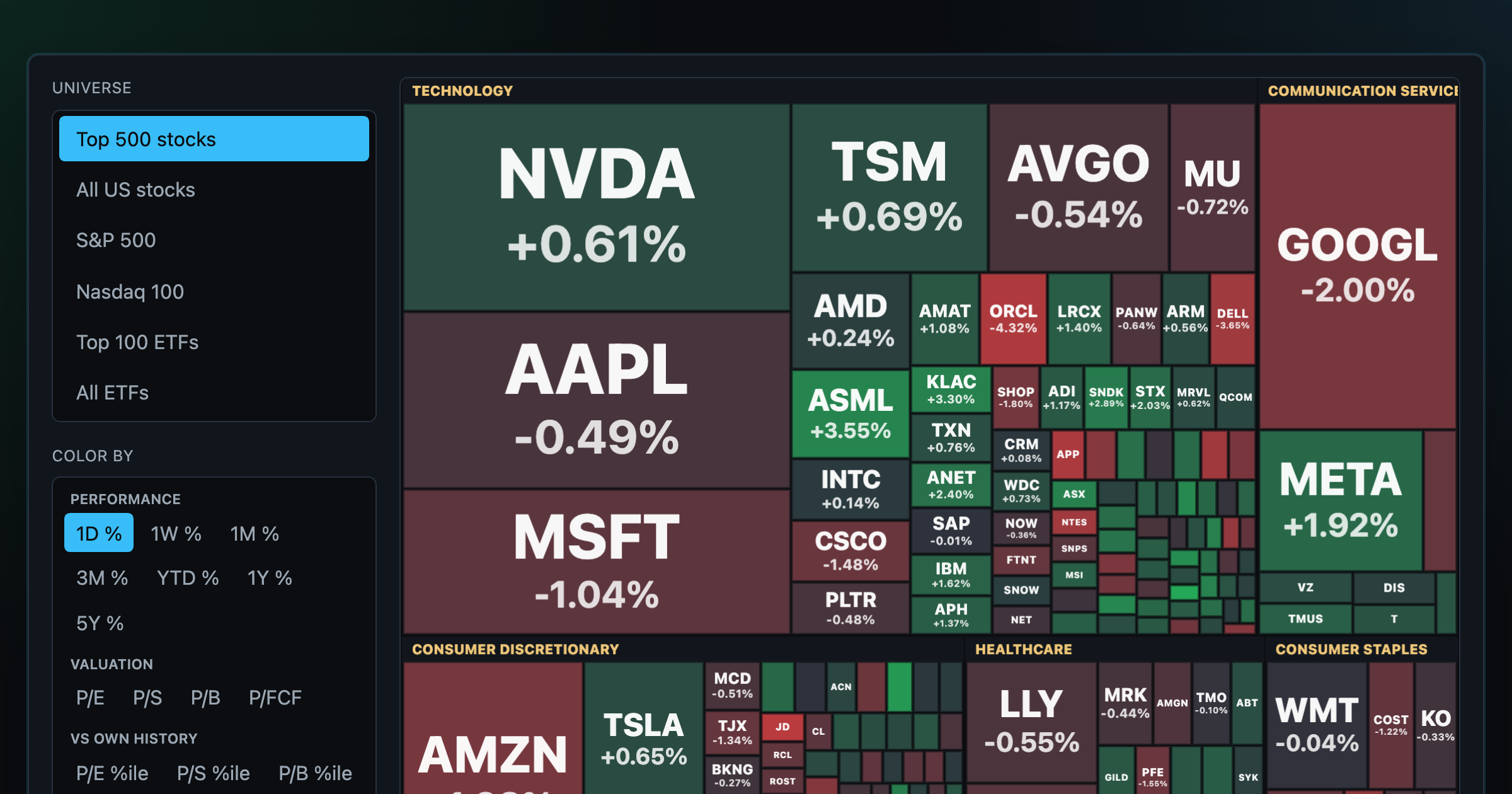
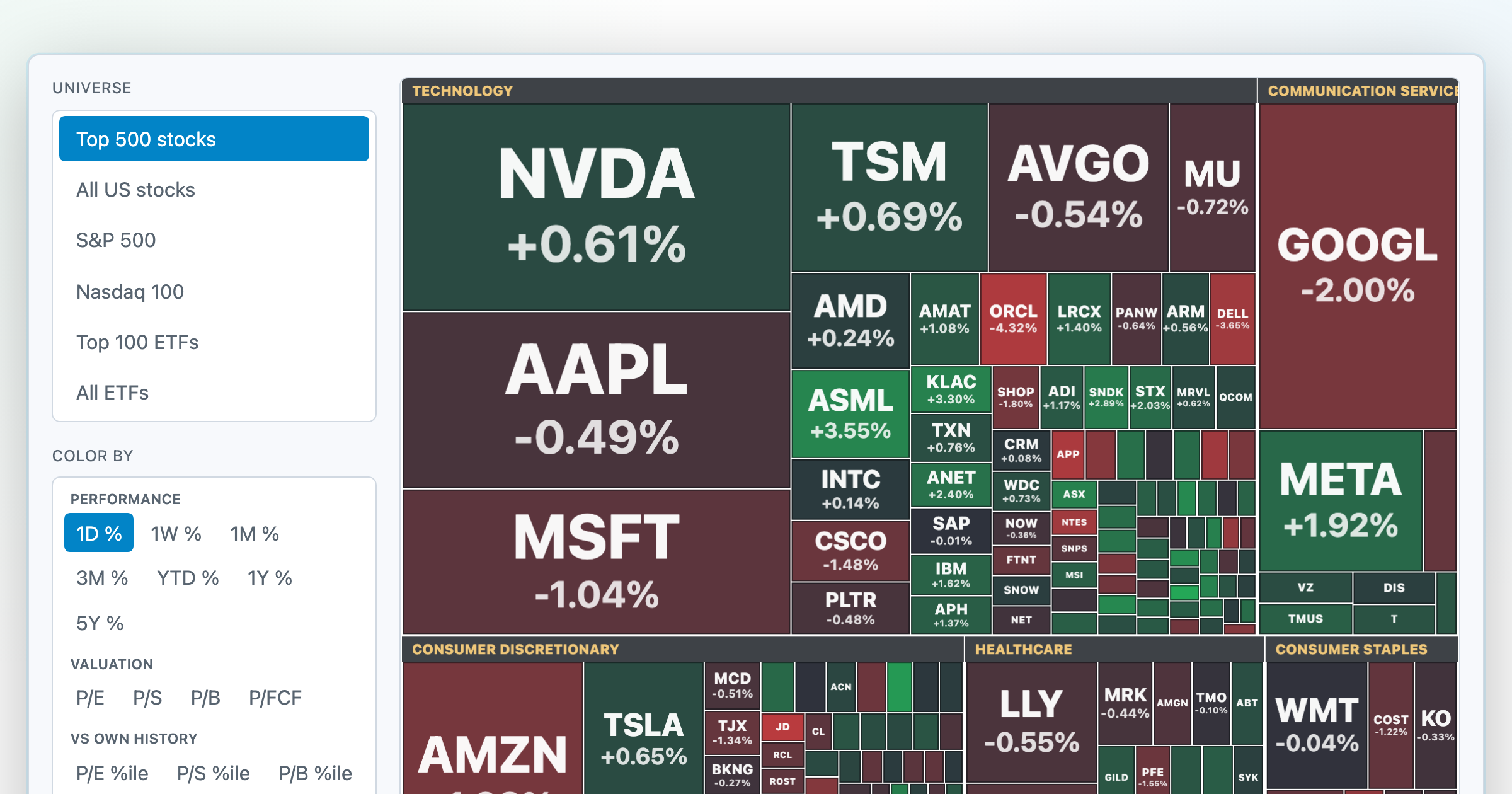
Every S&P 500 company sized by market cap — color by return or valuation.
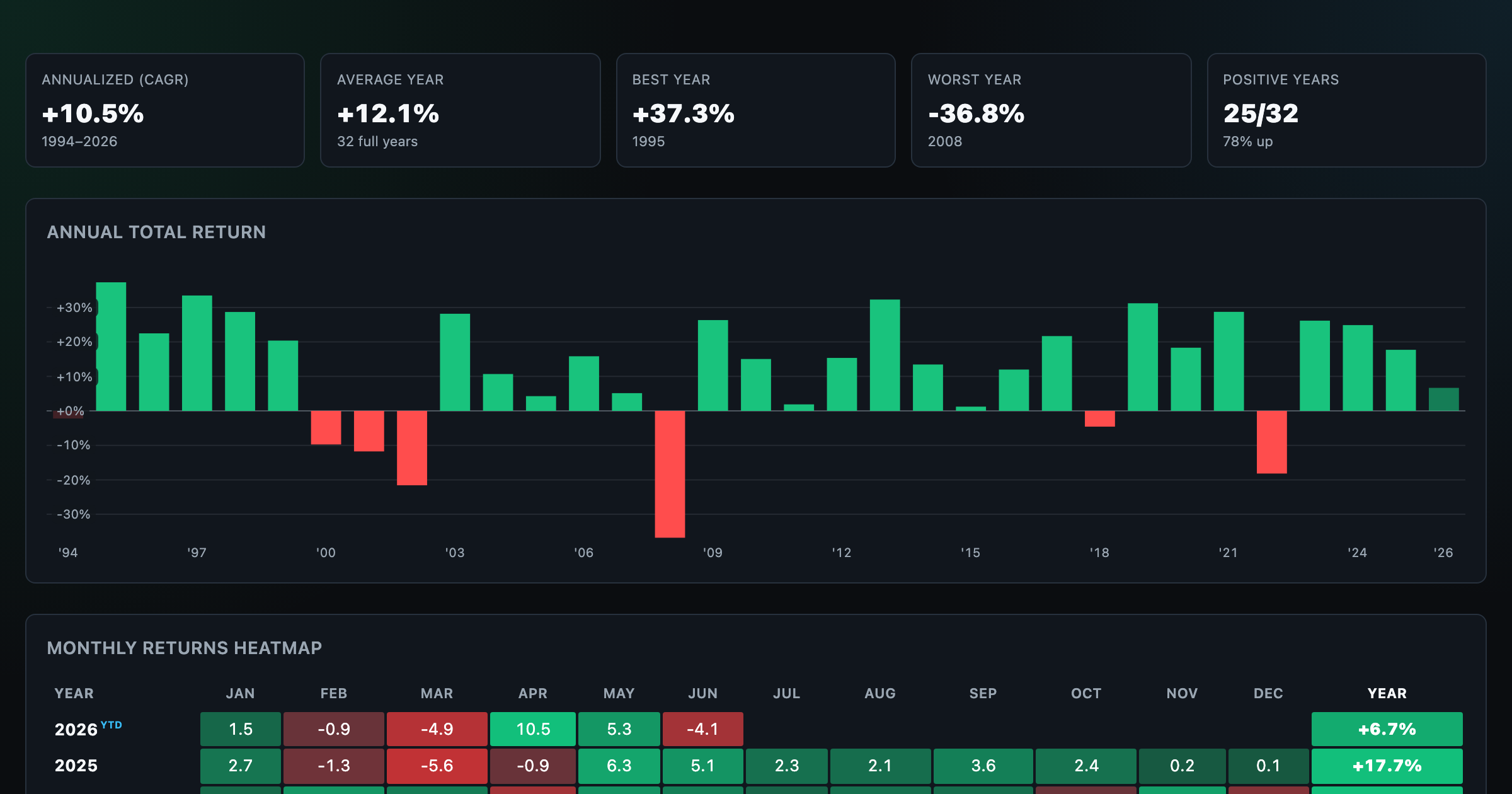
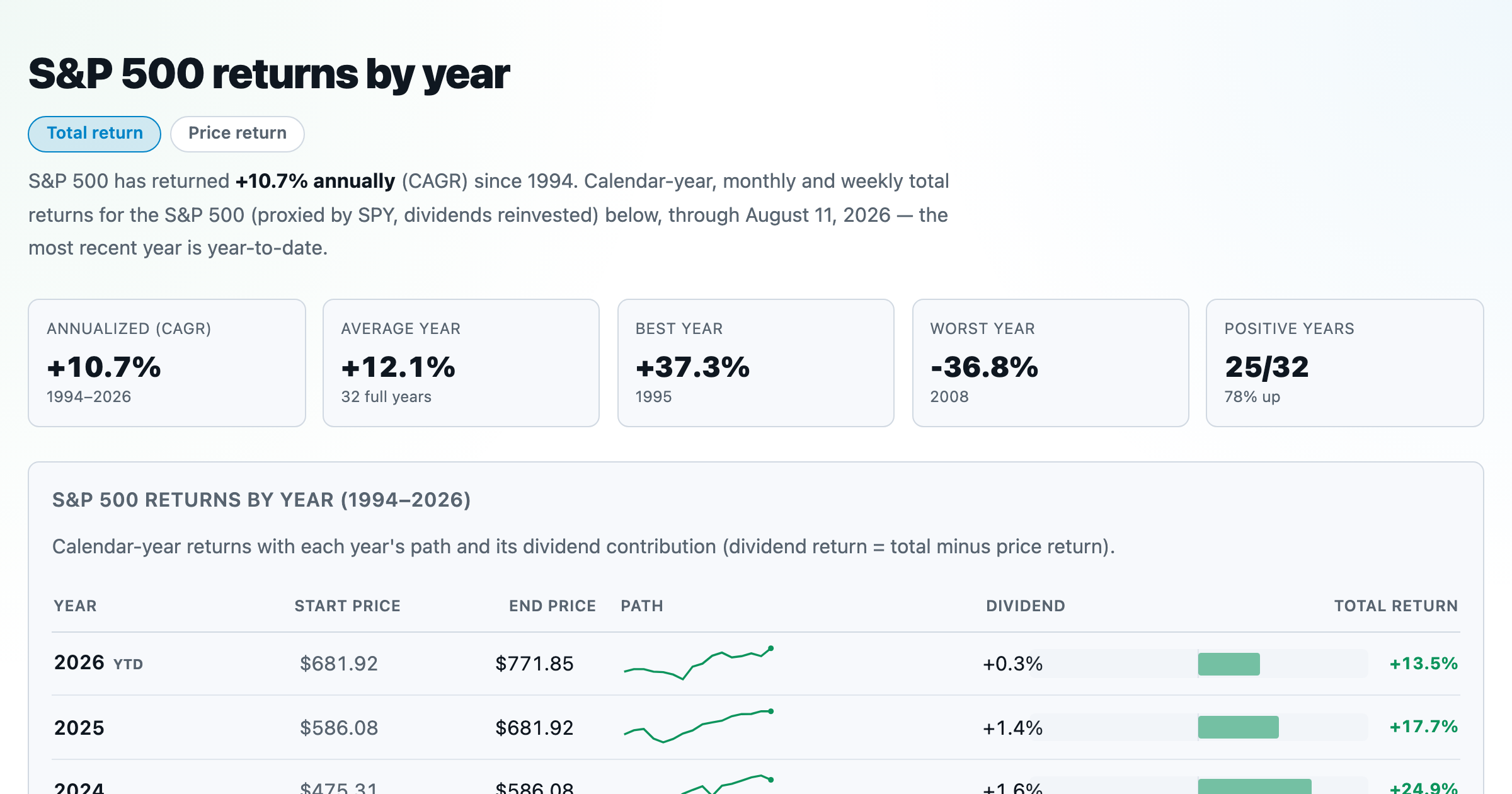
S&P 500 returns by year, month, week and trailing period — total or price return.
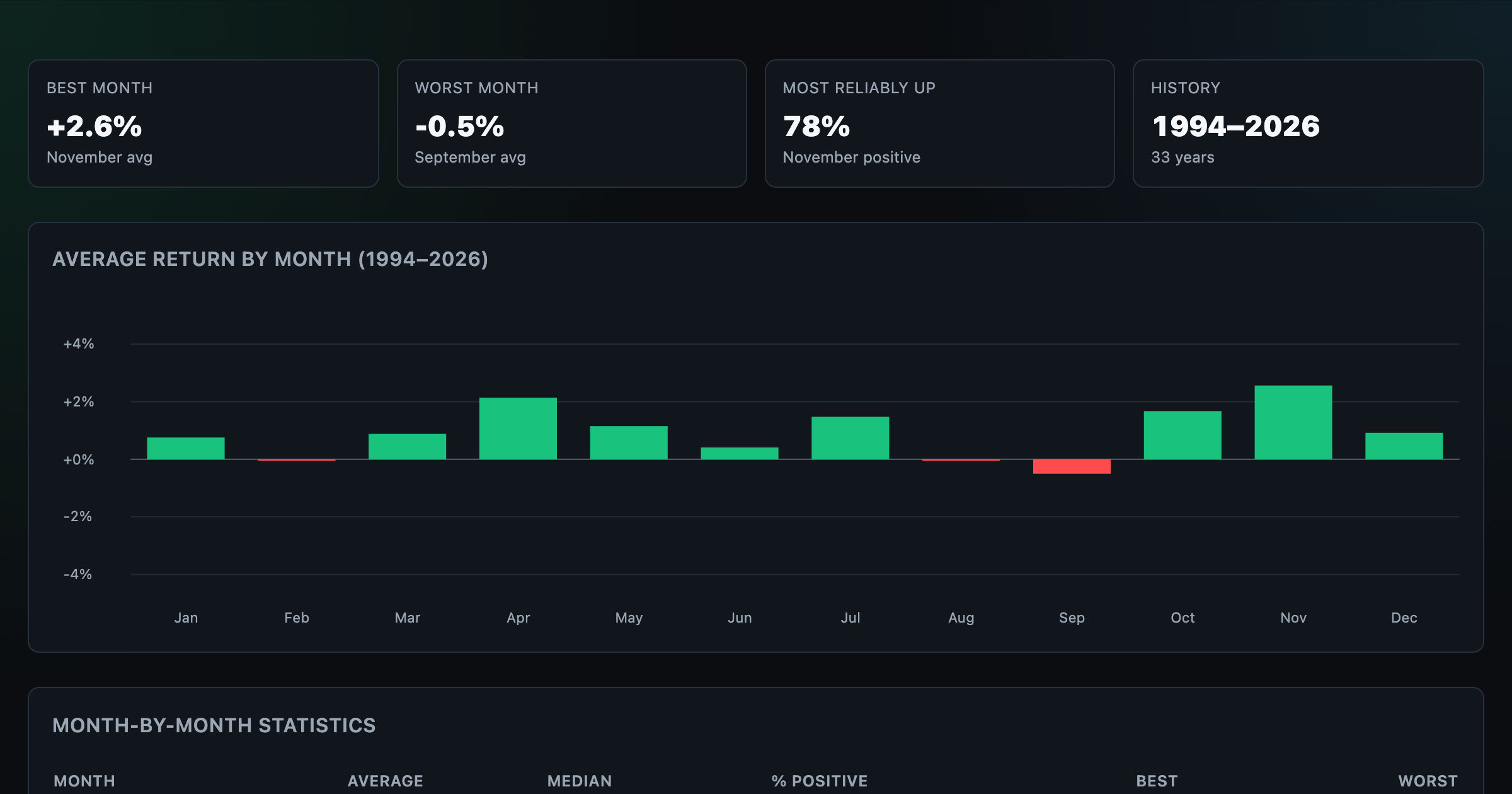
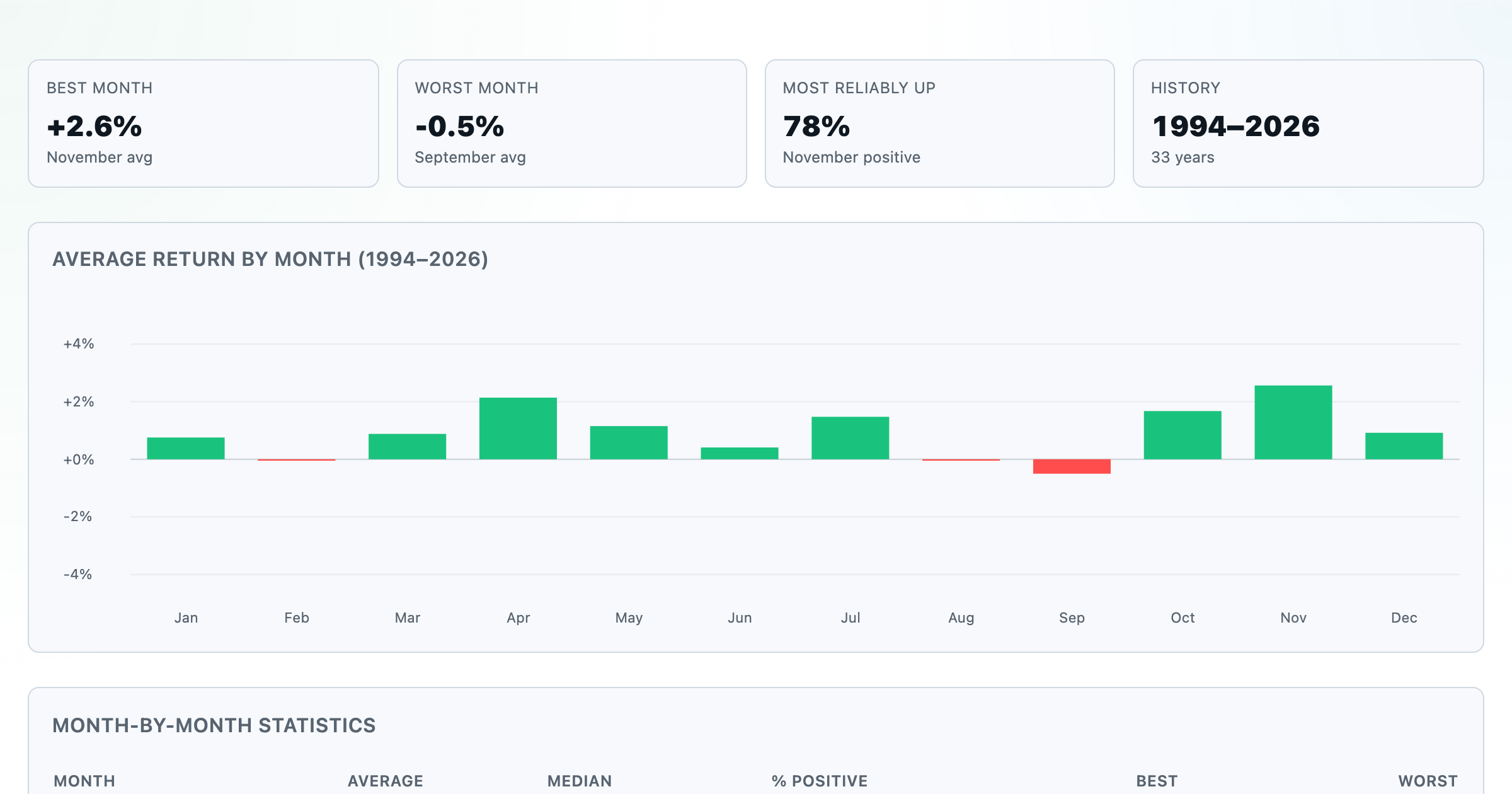
Which month is best for stocks? Average return of every calendar month, for any ticker.
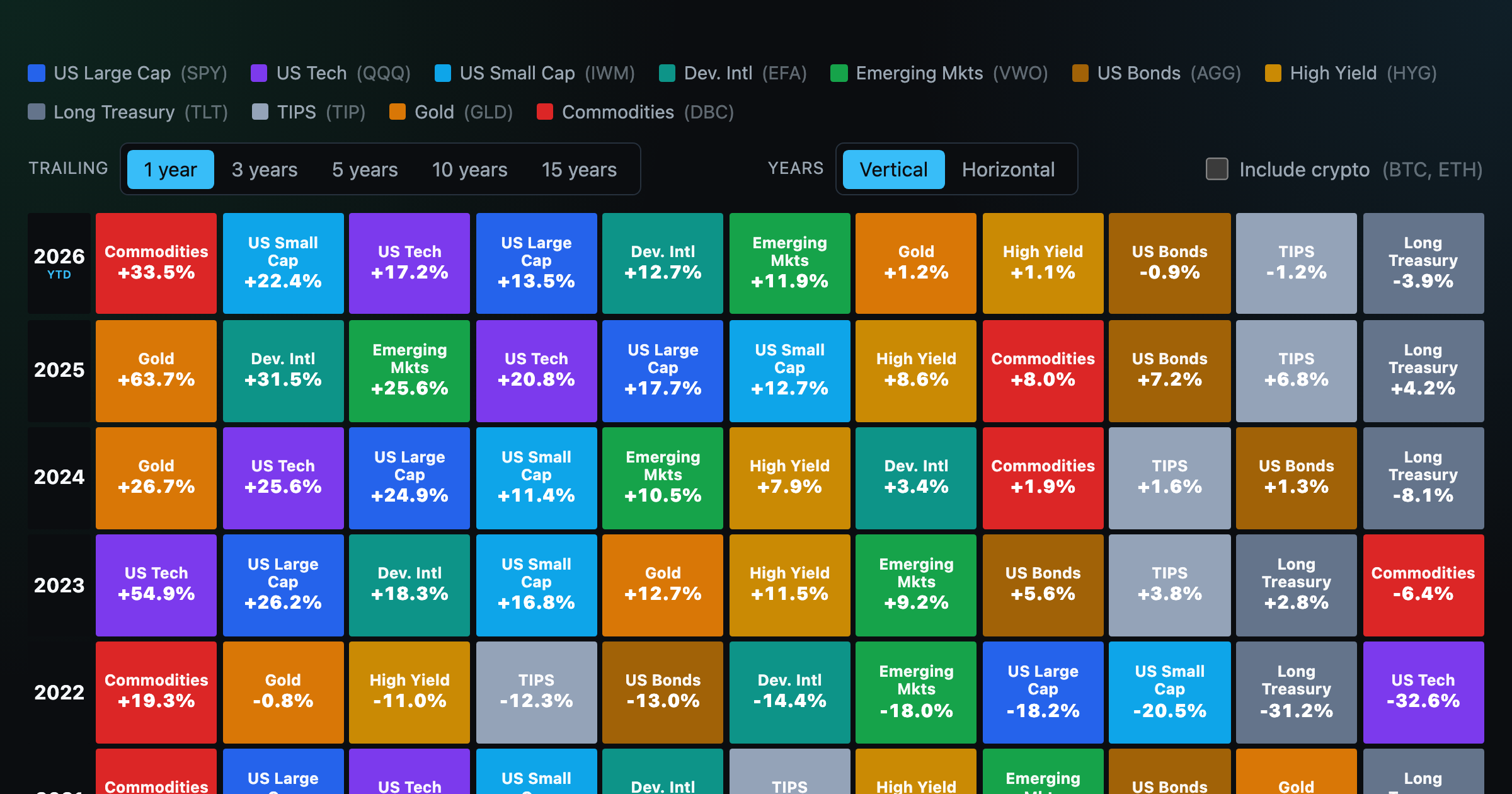
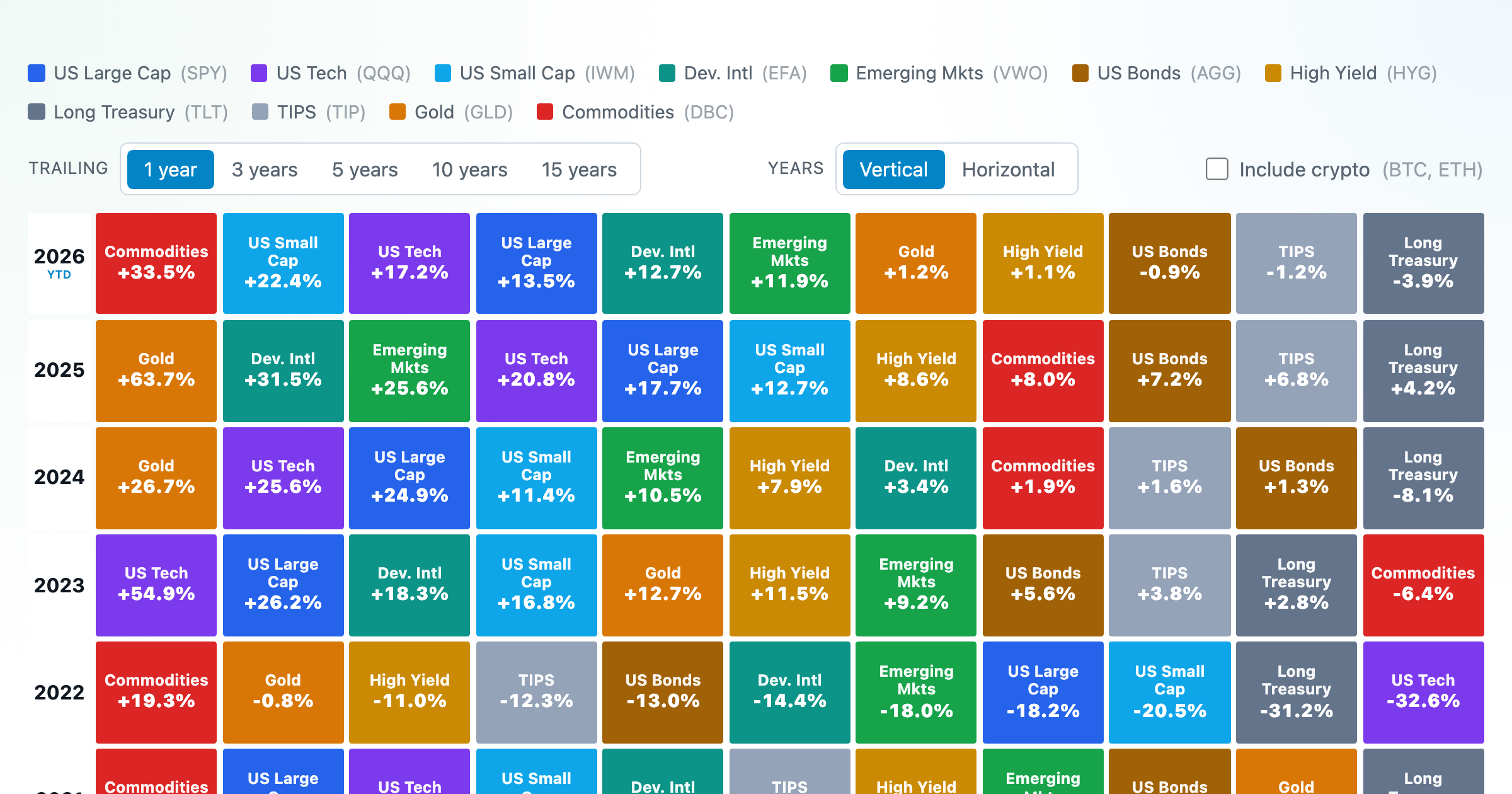
Asset-class returns ranked year by year — the Callan chart / asset allocation quilt.
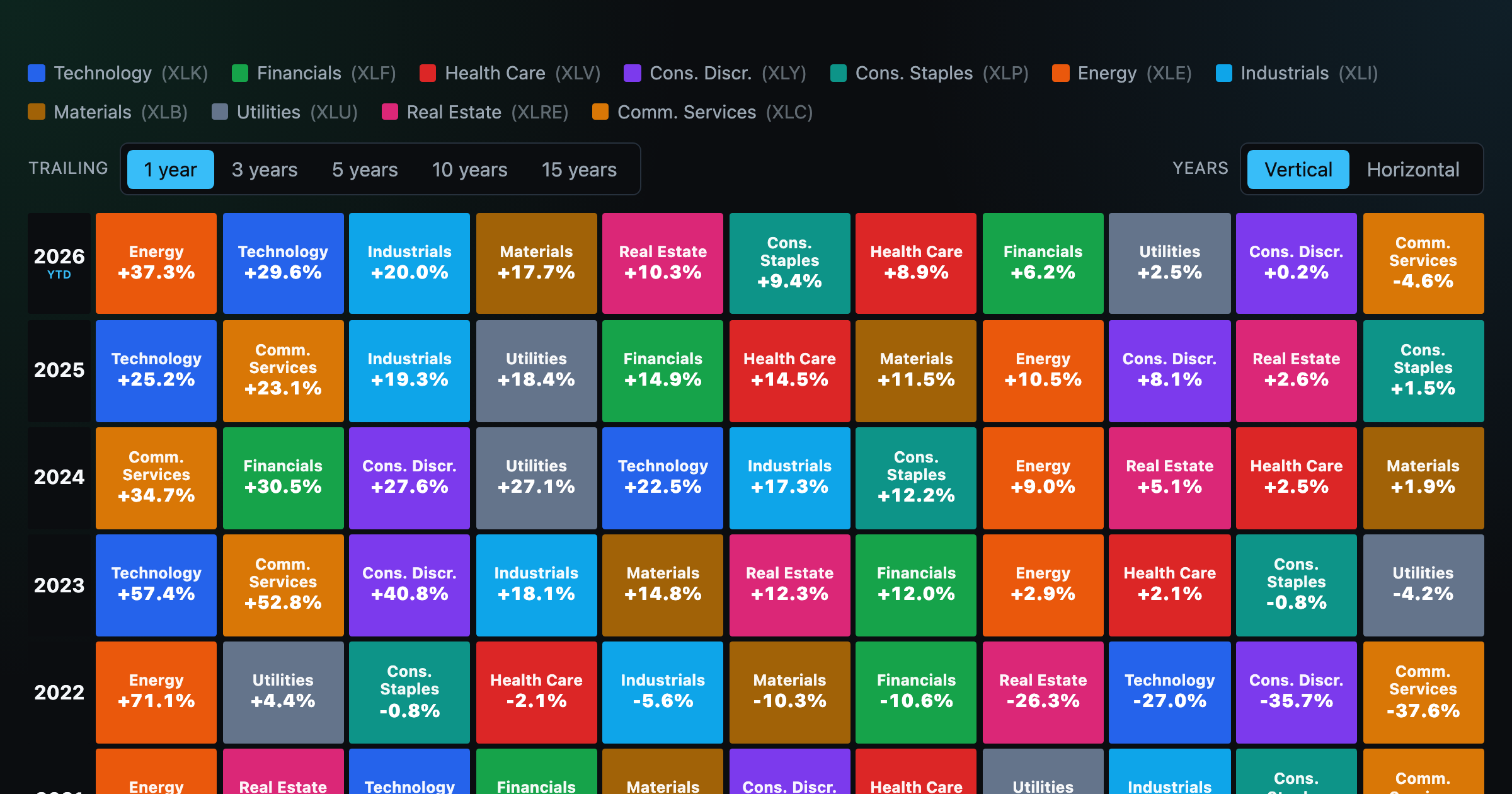
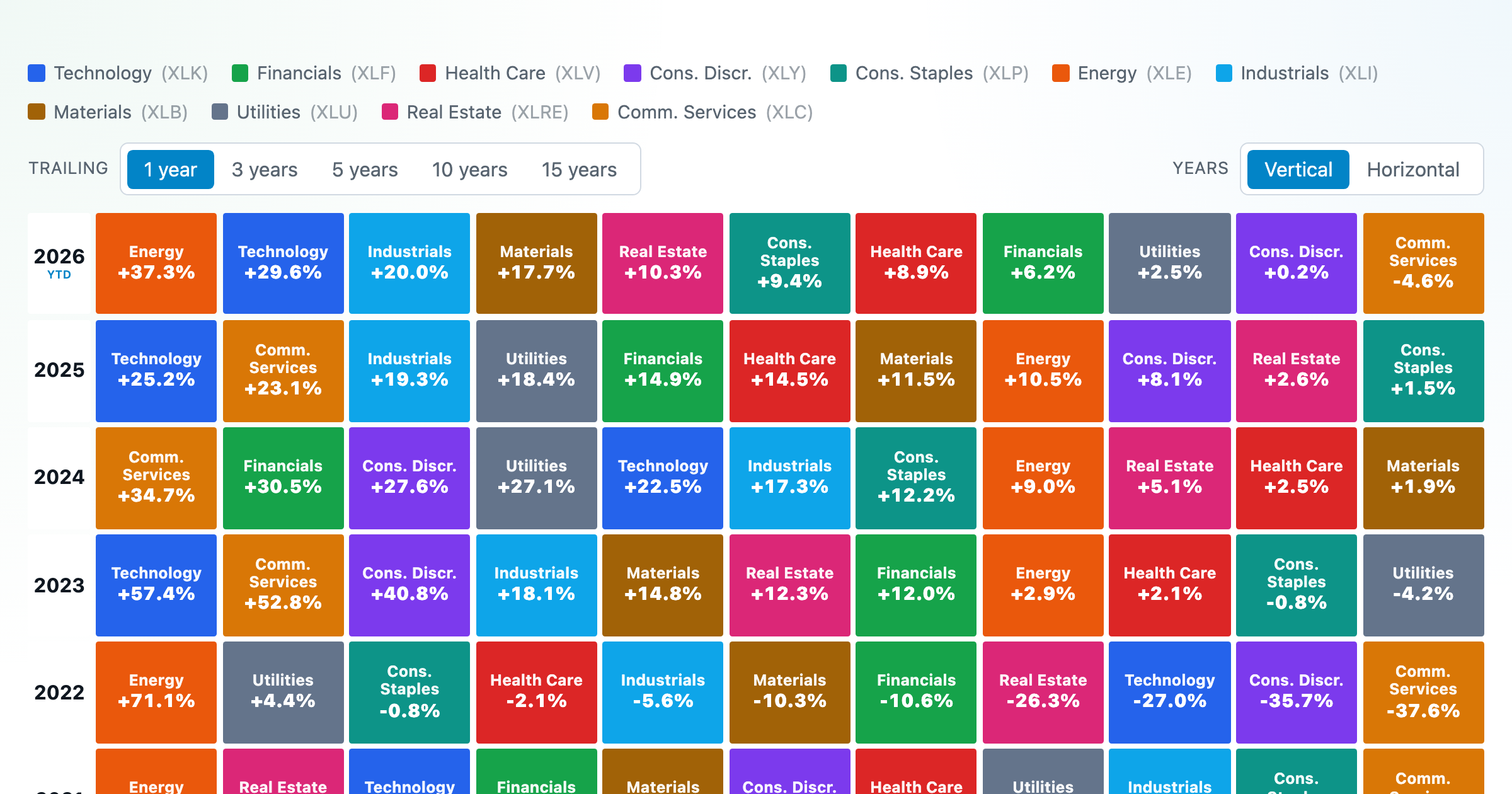
The 11 S&P 500 sectors ranked year by year — a sector quilt chart, back to 1999.
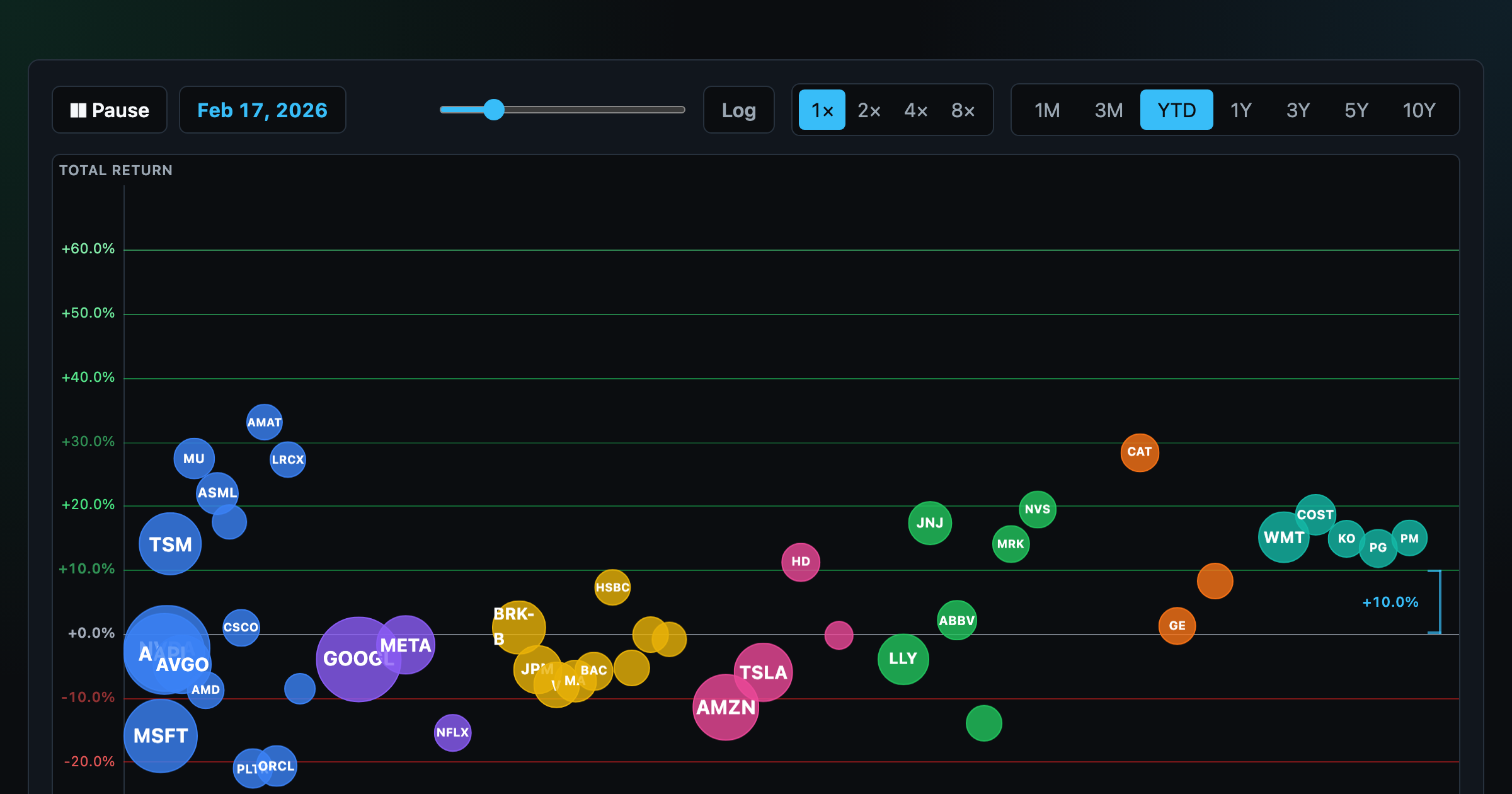
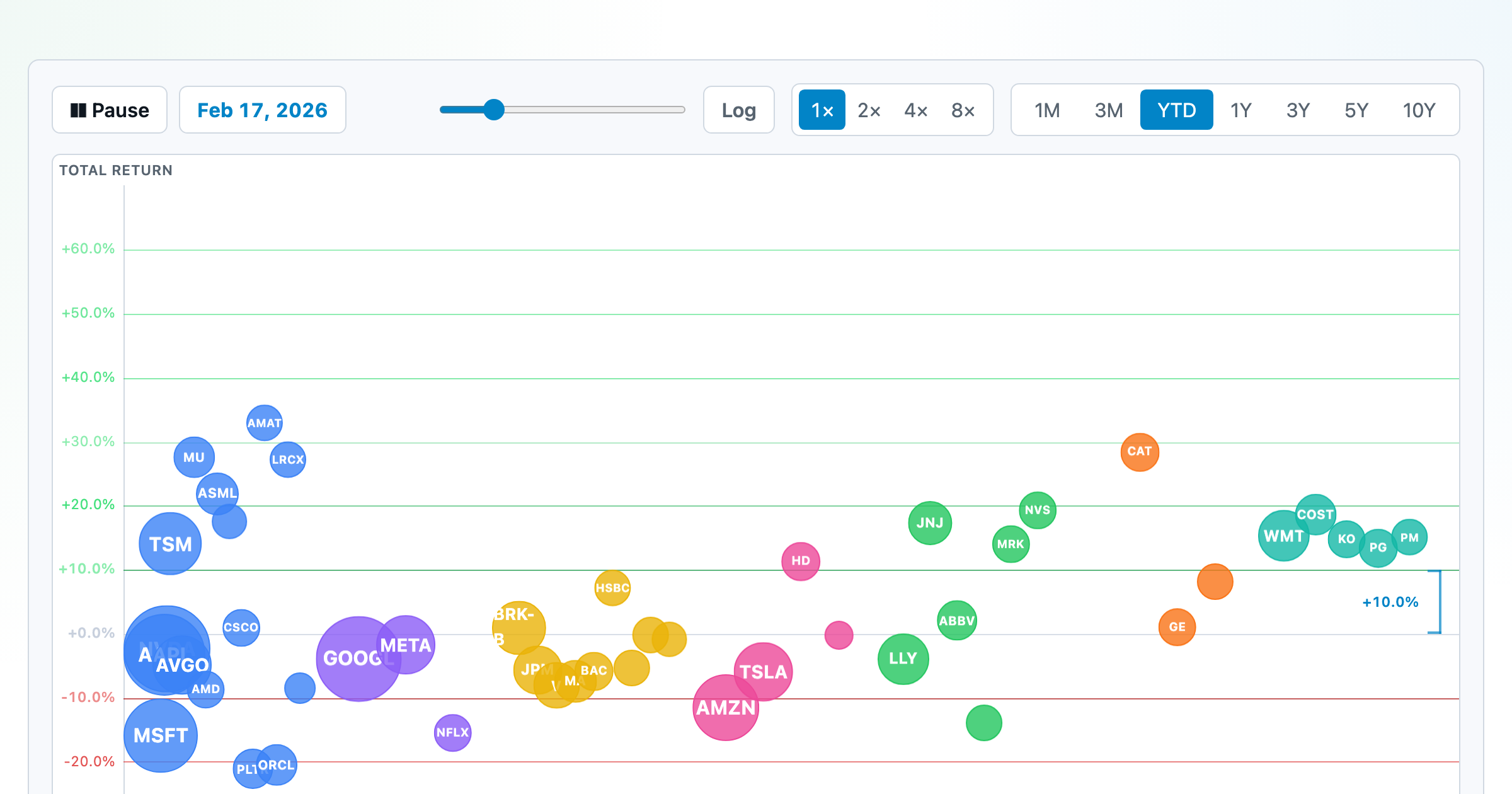
The biggest US companies as animated bubbles, rising and falling with their total return over time.
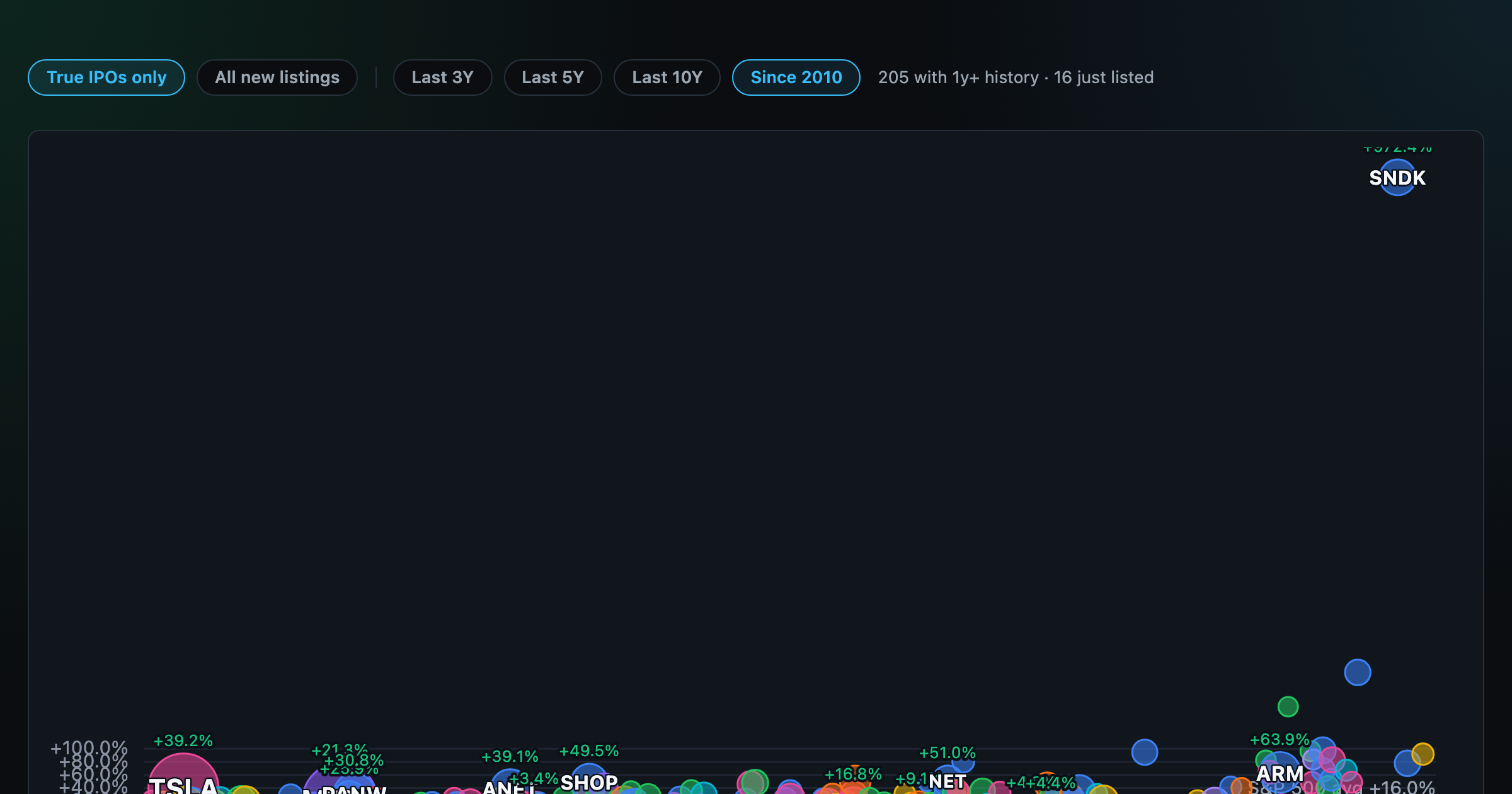
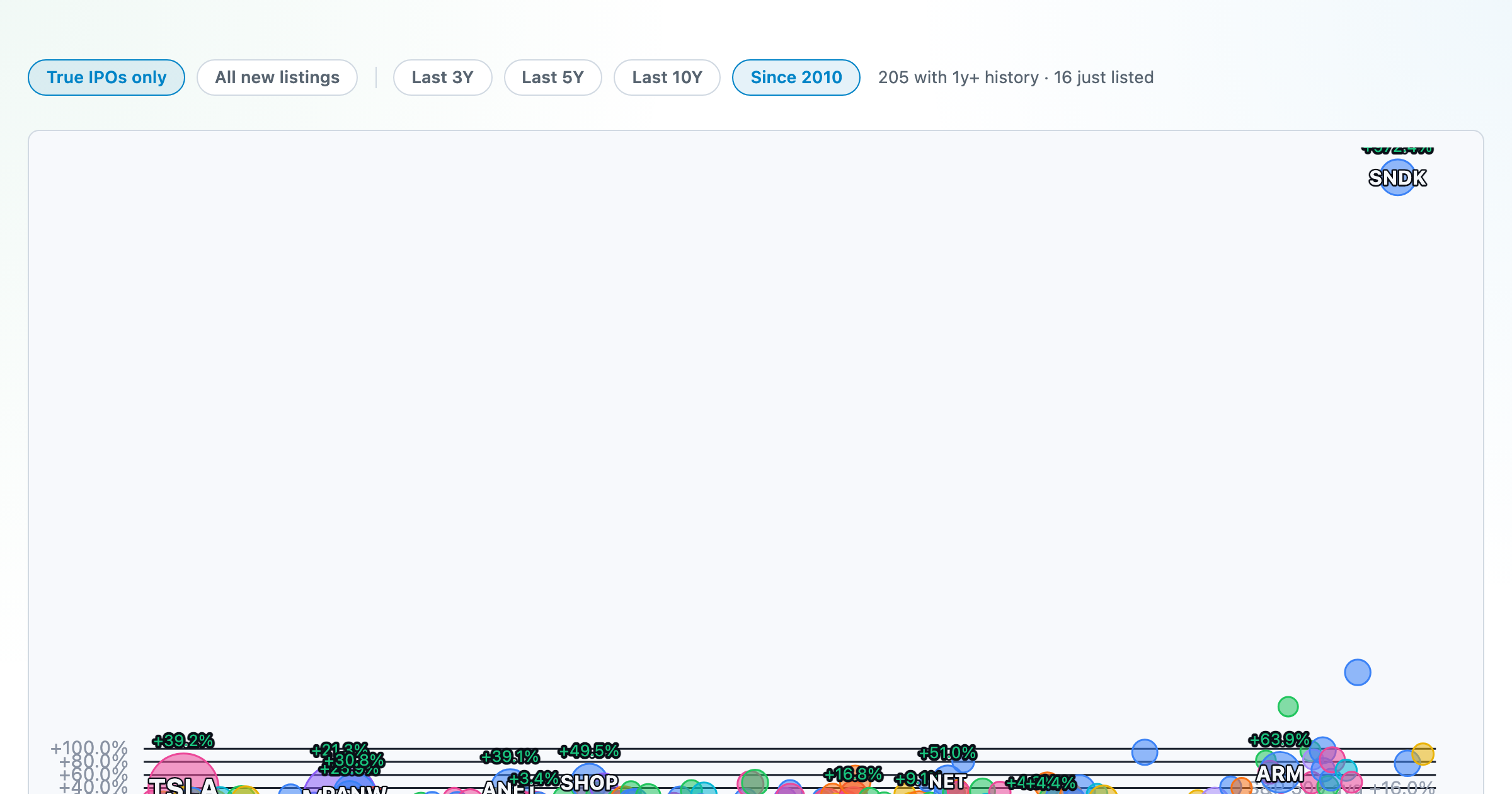
How recent stock-market debuts have performed since listing — annualized, vs the S&P 500, by IPO vs spin-off.
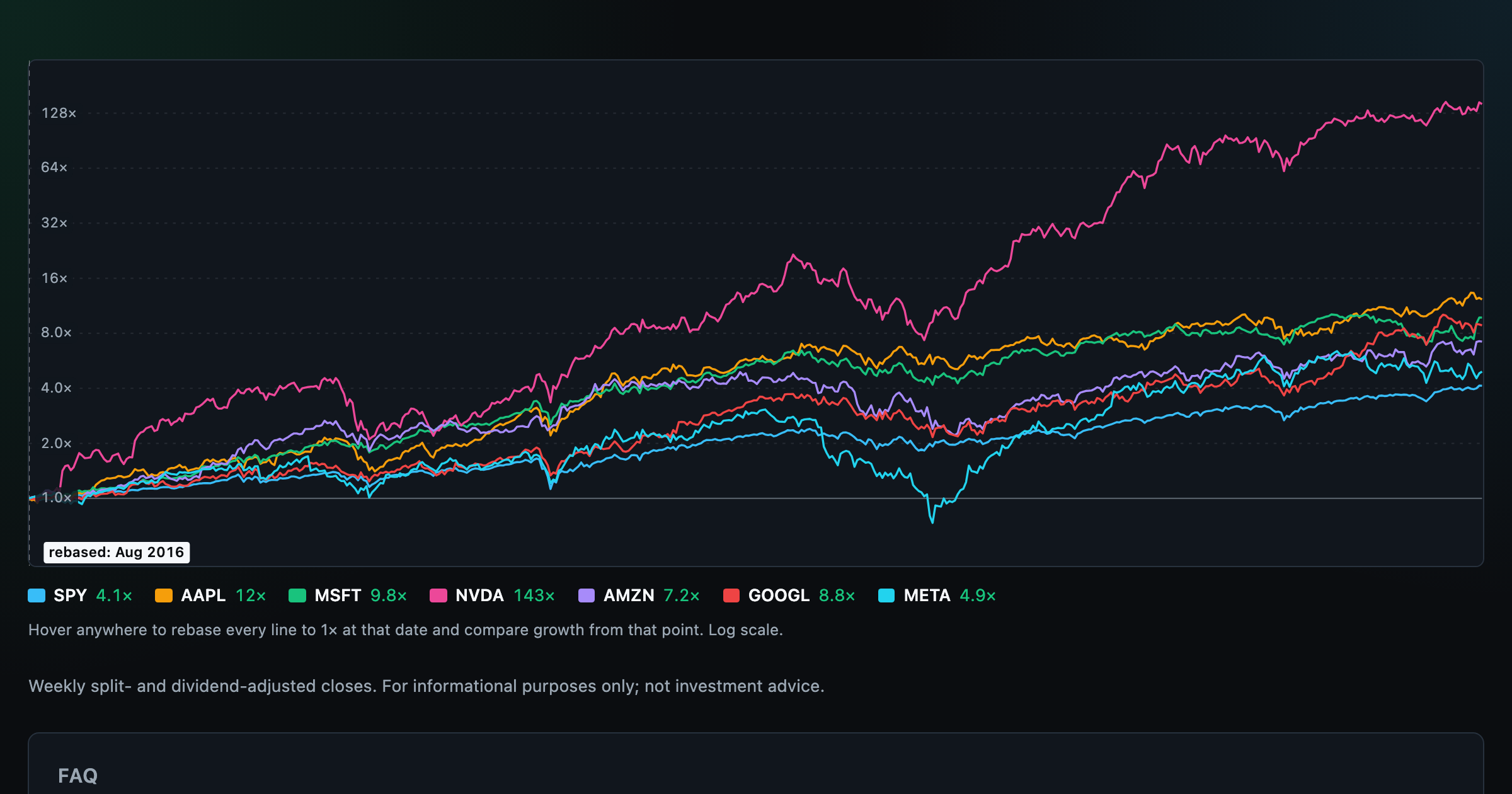
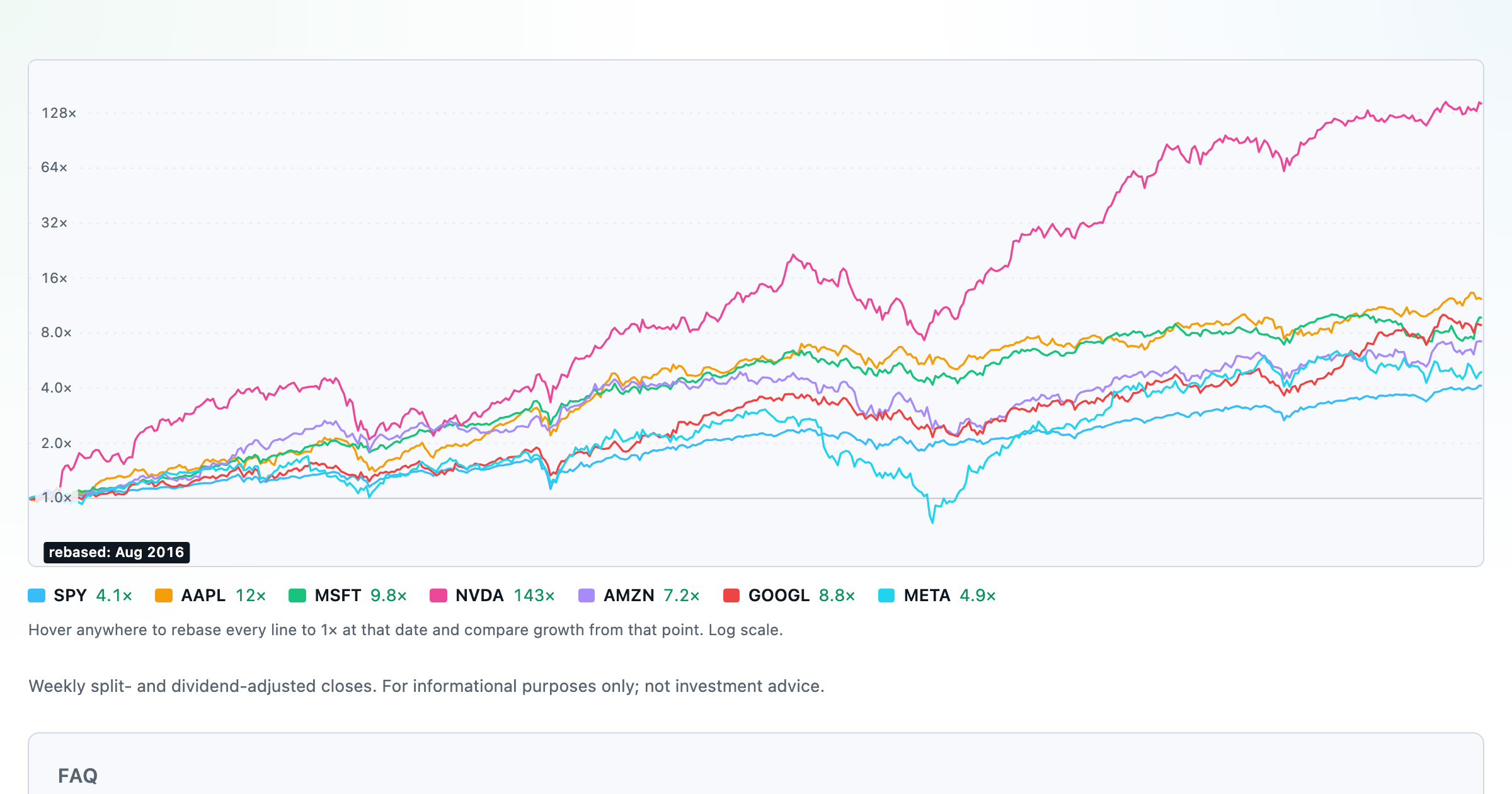
Compare megacaps vs the S&P 500, rebased to 1× at any date you hover.
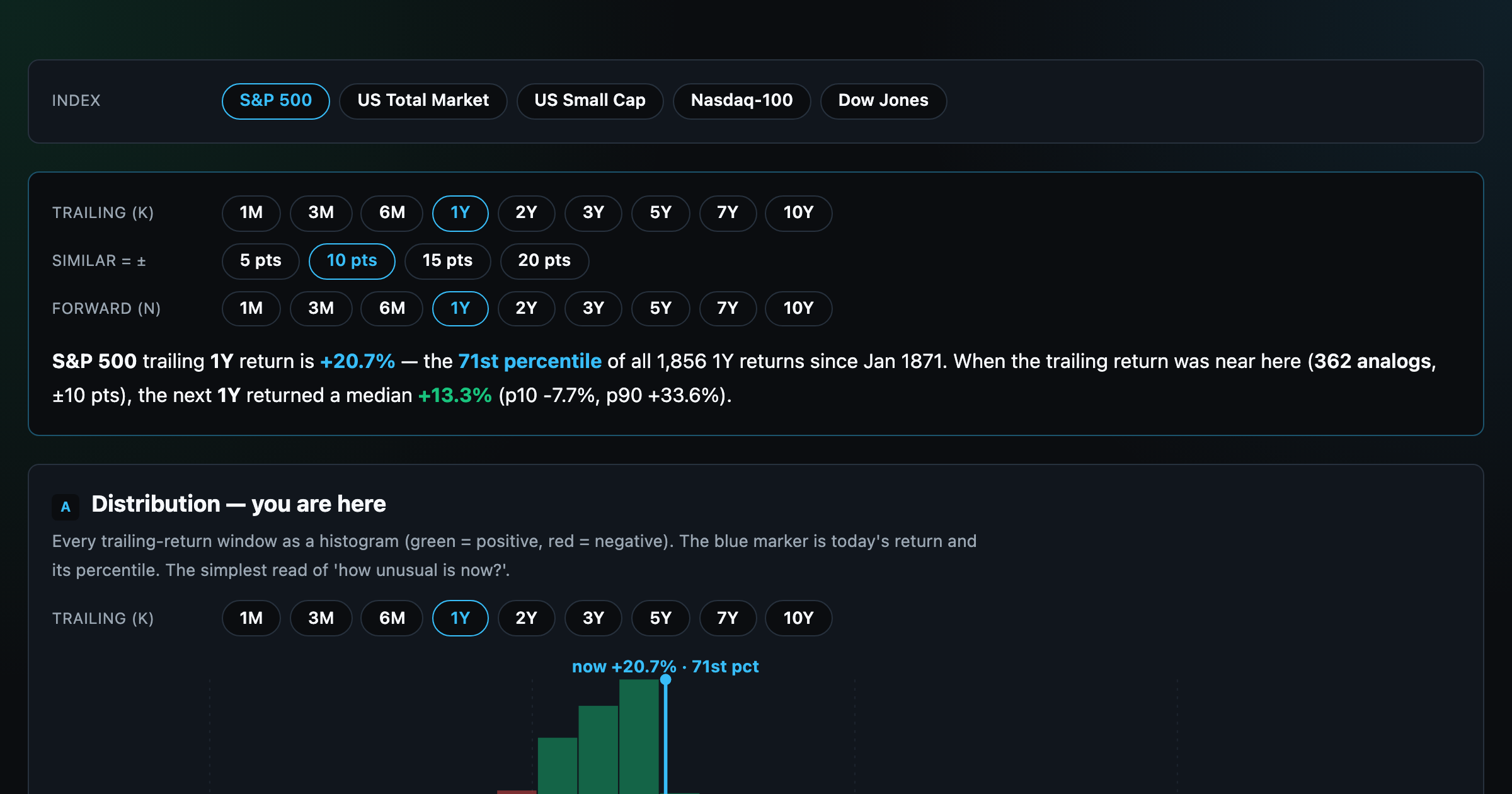
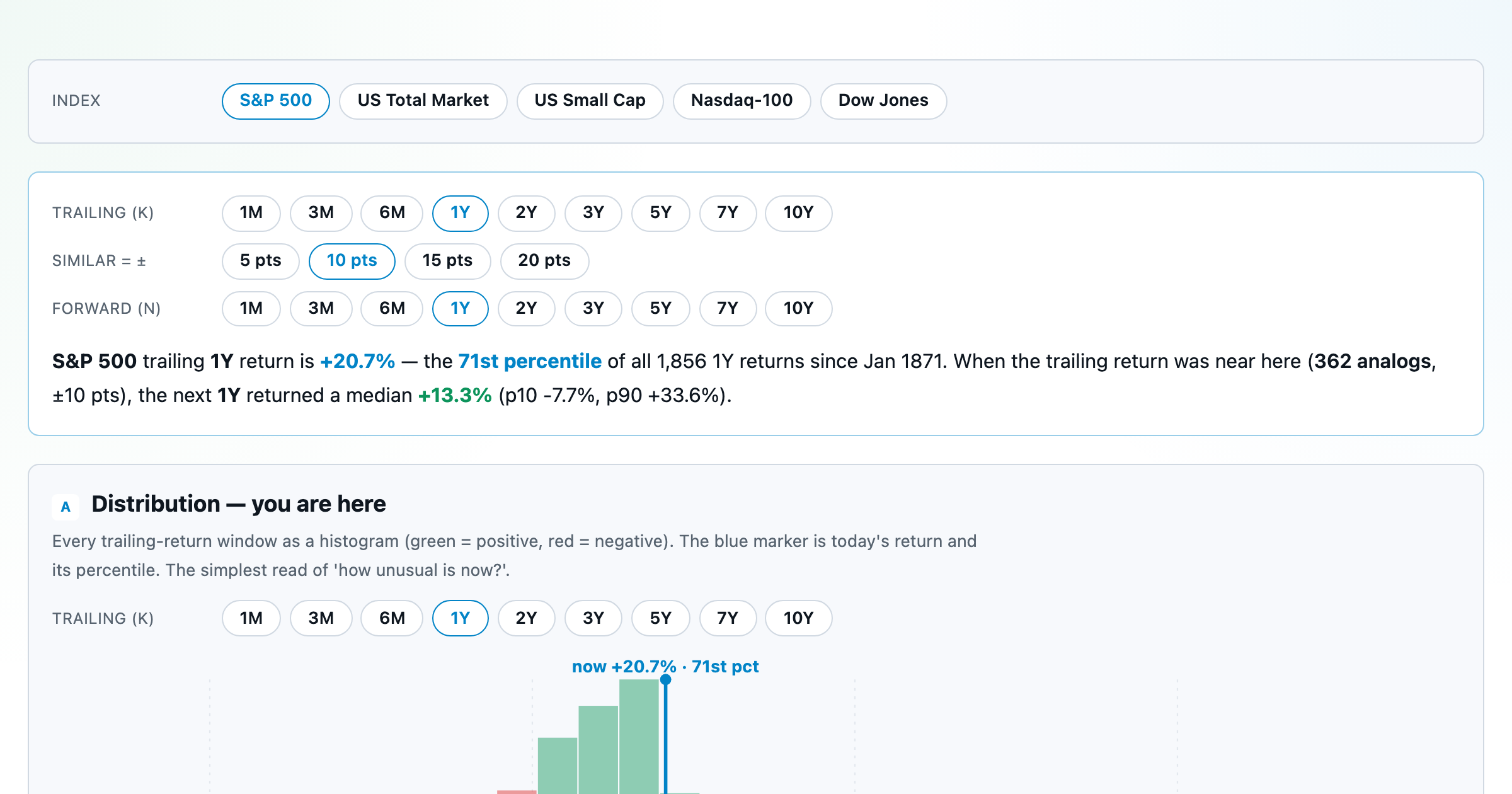
Where today's S&P 500 return ranks against all history — and the forward returns that followed similar moments.
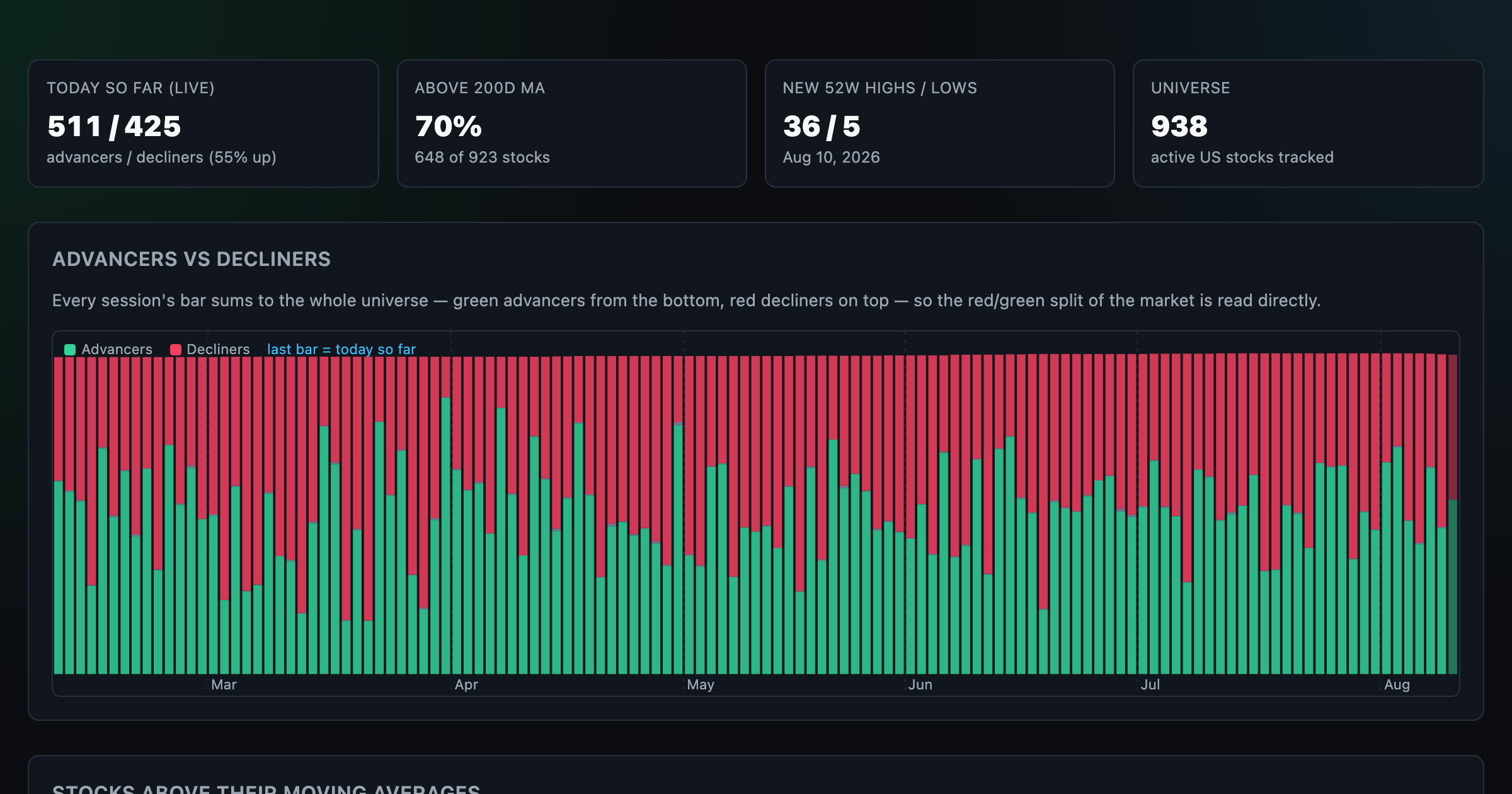
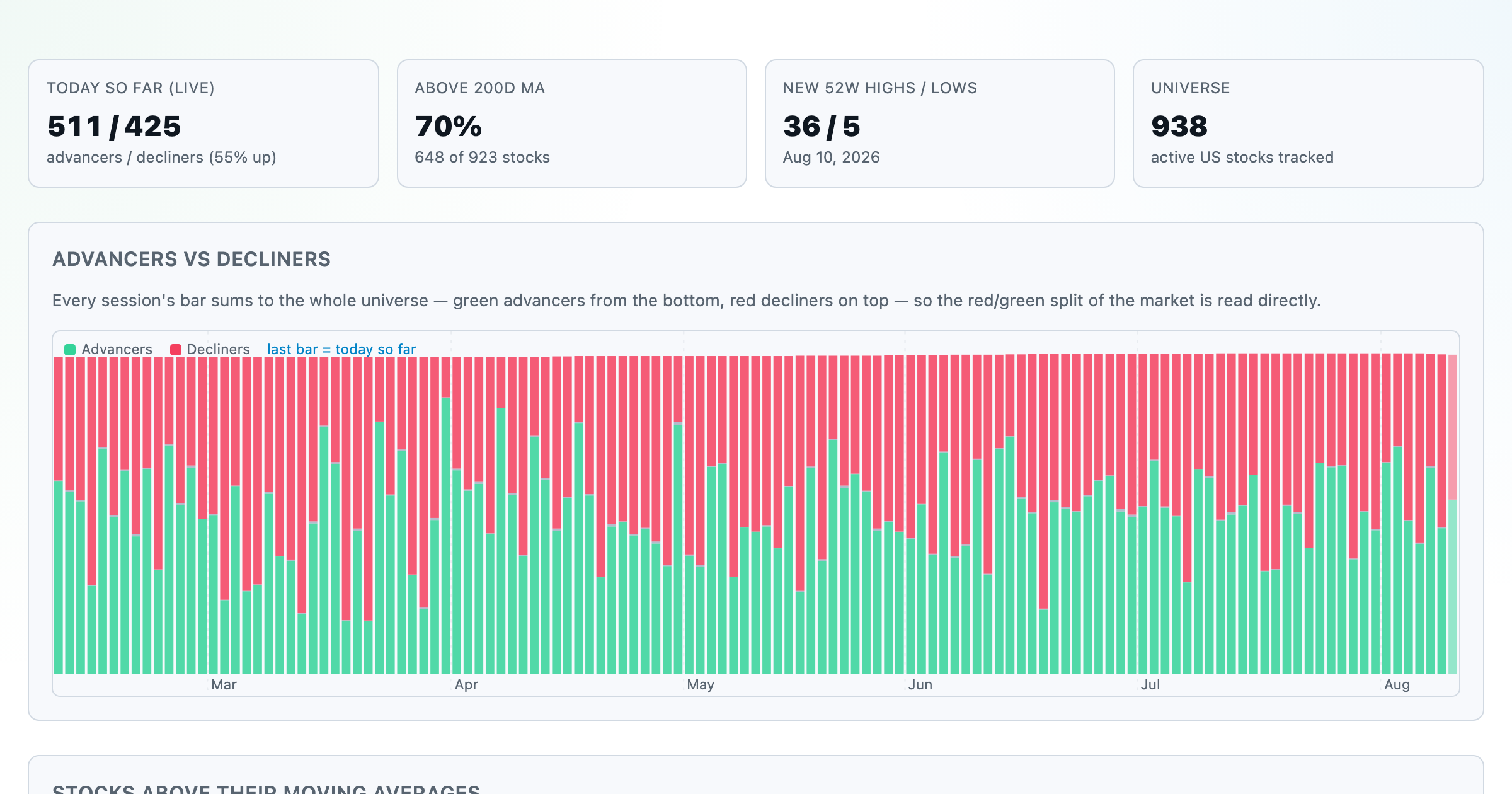
Advancers vs decliners over time, % of stocks above their moving averages, new highs vs lows, and breadth across every trailing window.
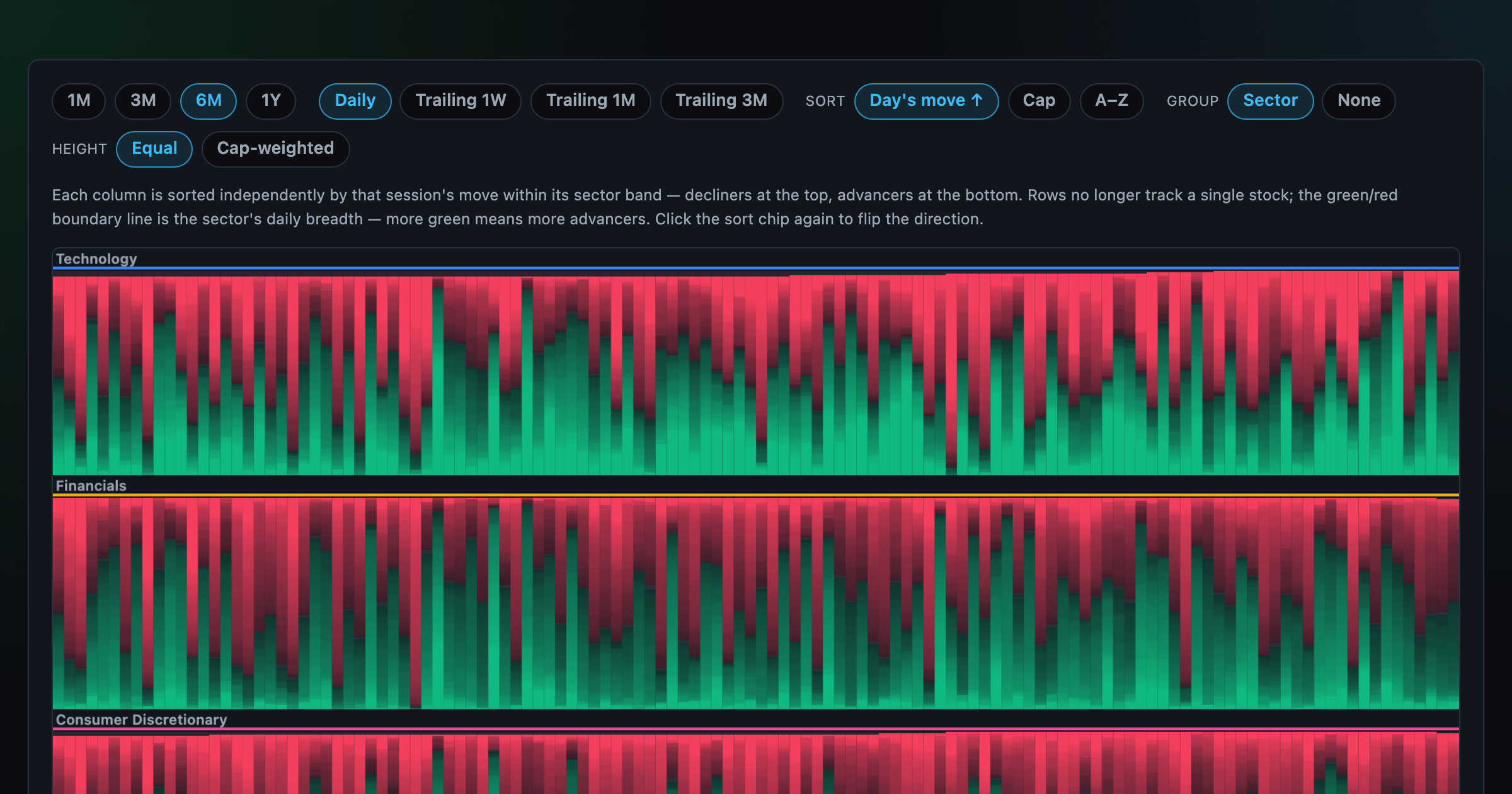
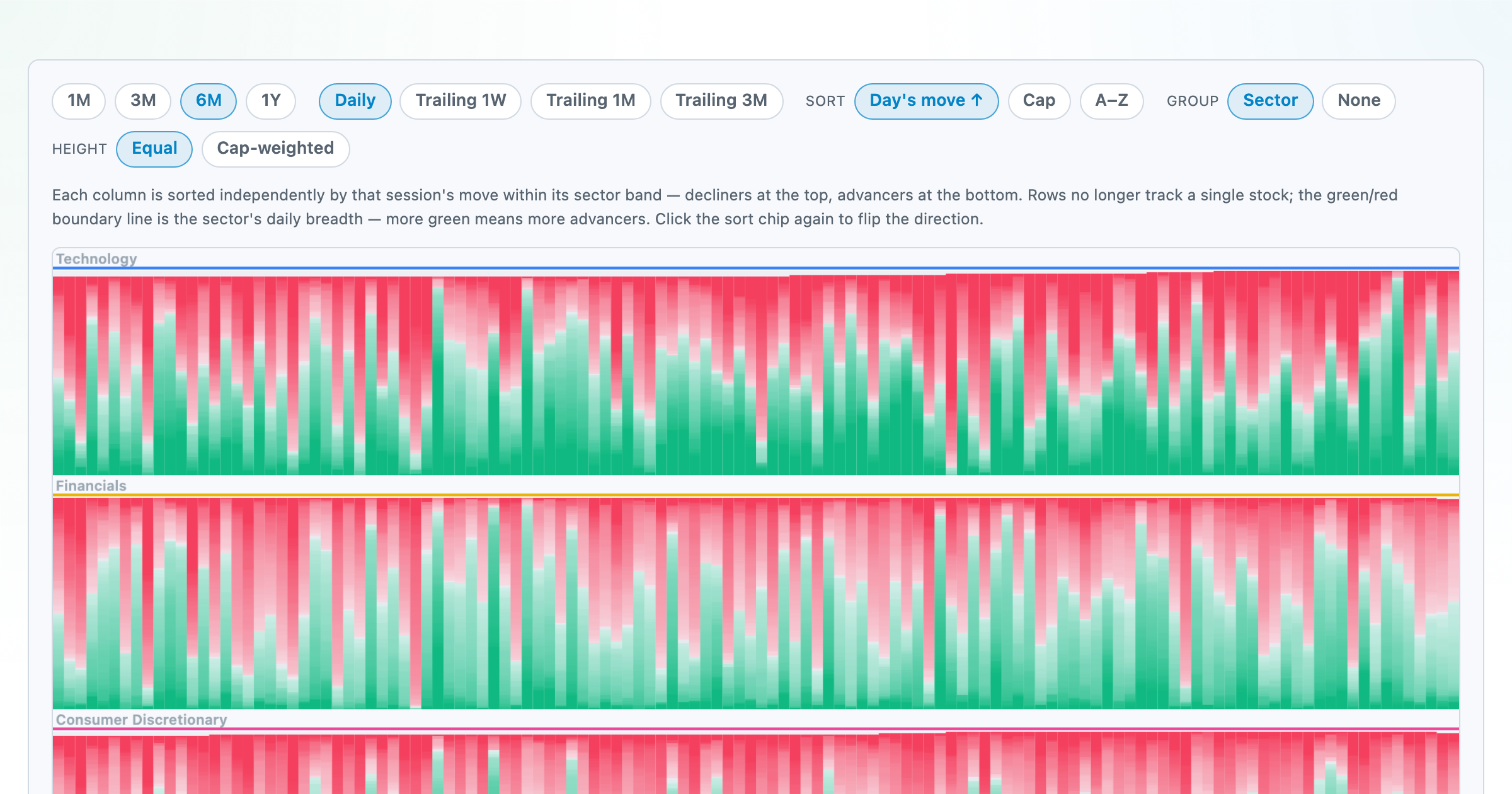
Every stock as a row, every day as a column — market selloffs are vertical stripes, sector routs are blocks.
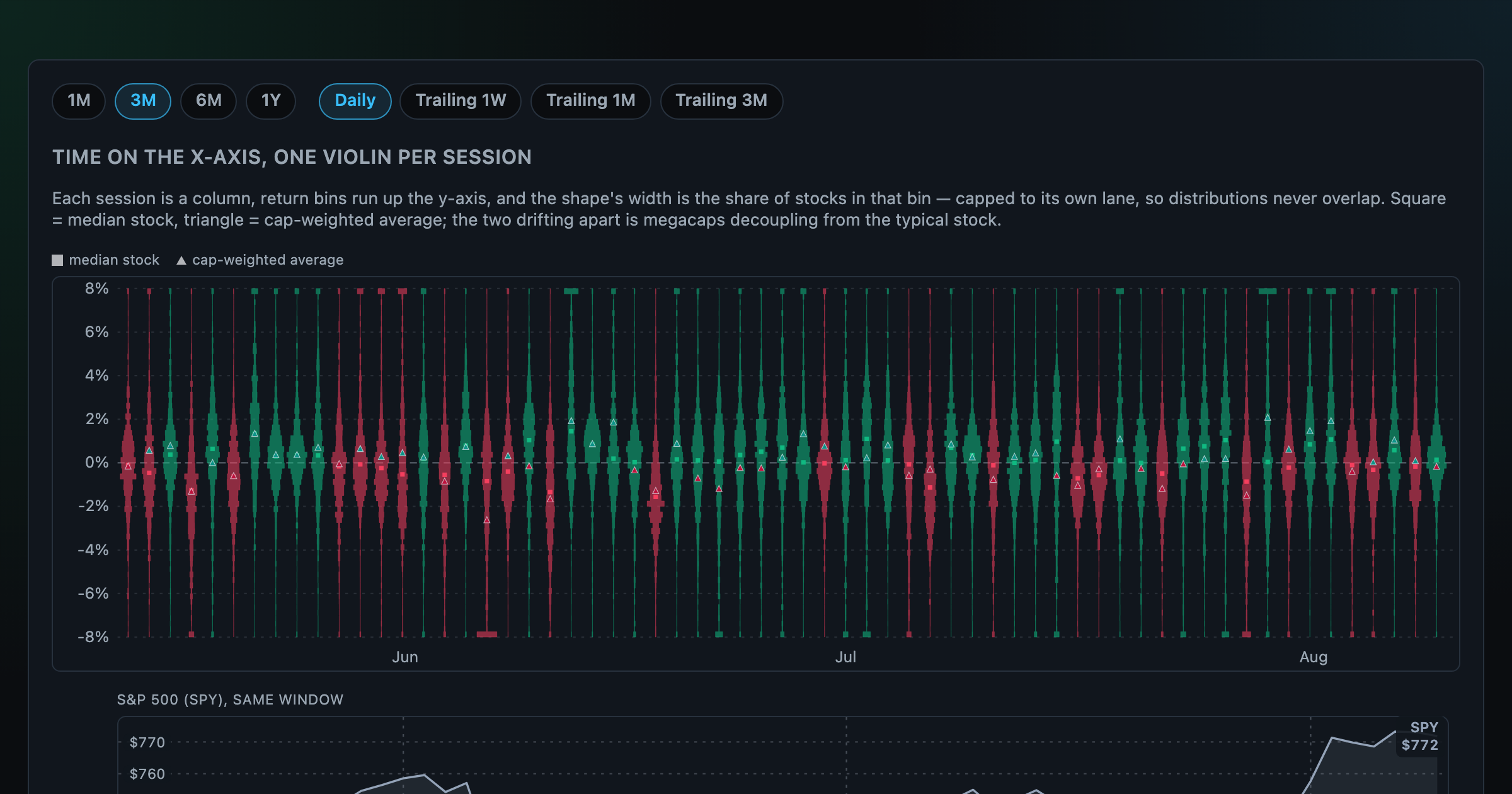
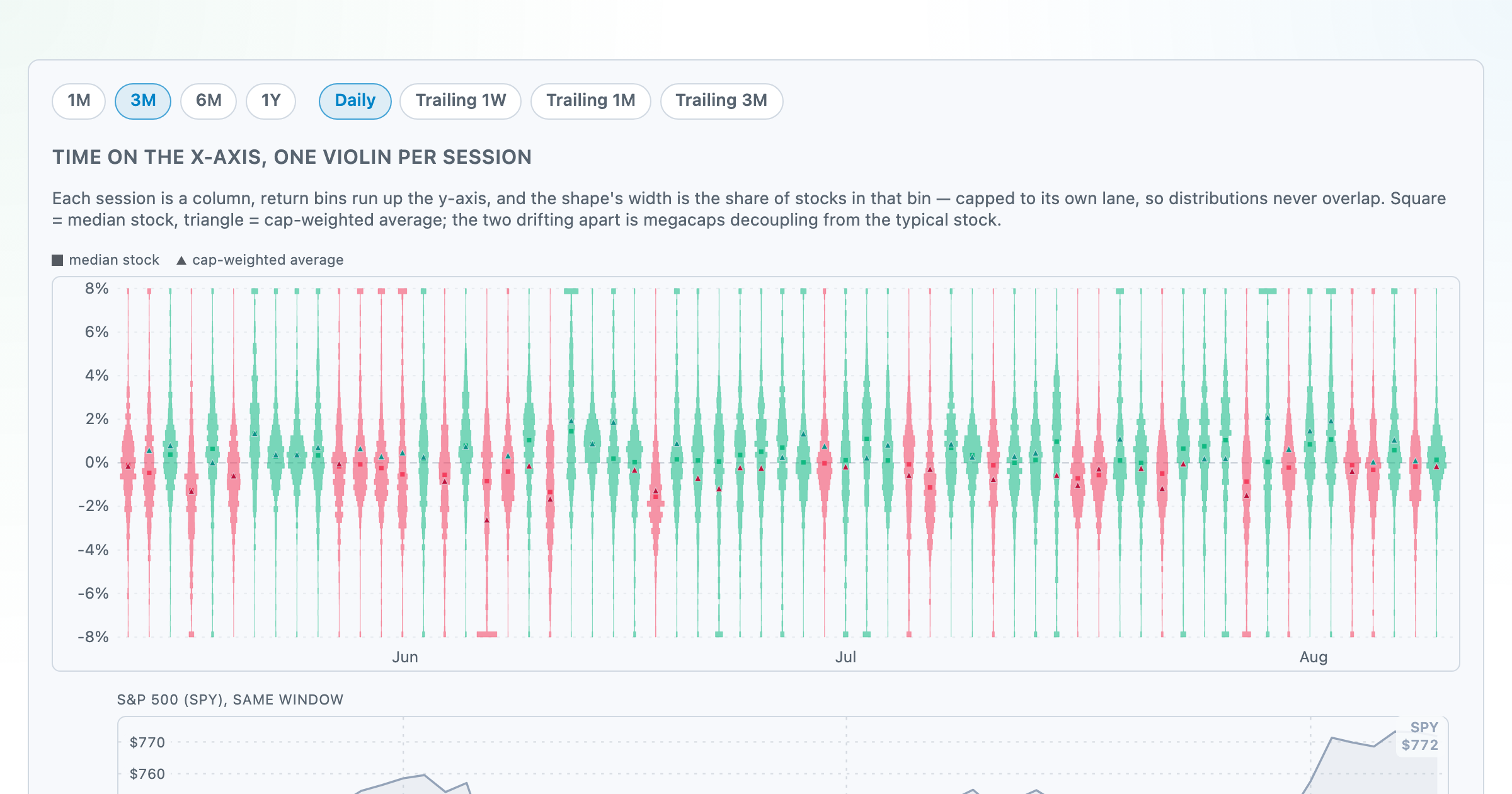
Each session's full distribution of stock returns as an upright violin, with the S&P 500 on the same axis — shifts, dispersion, and fat tails at a glance.
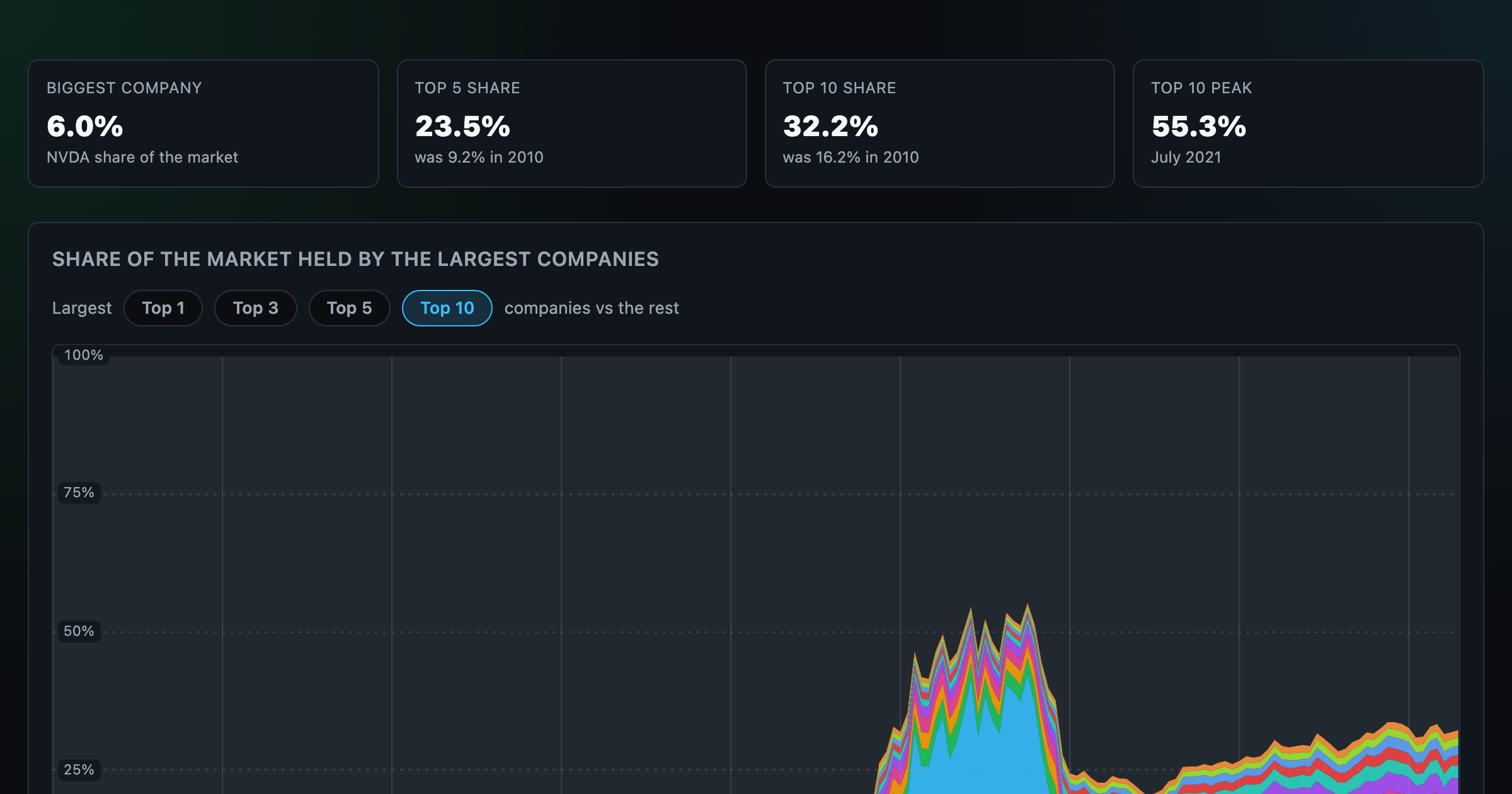
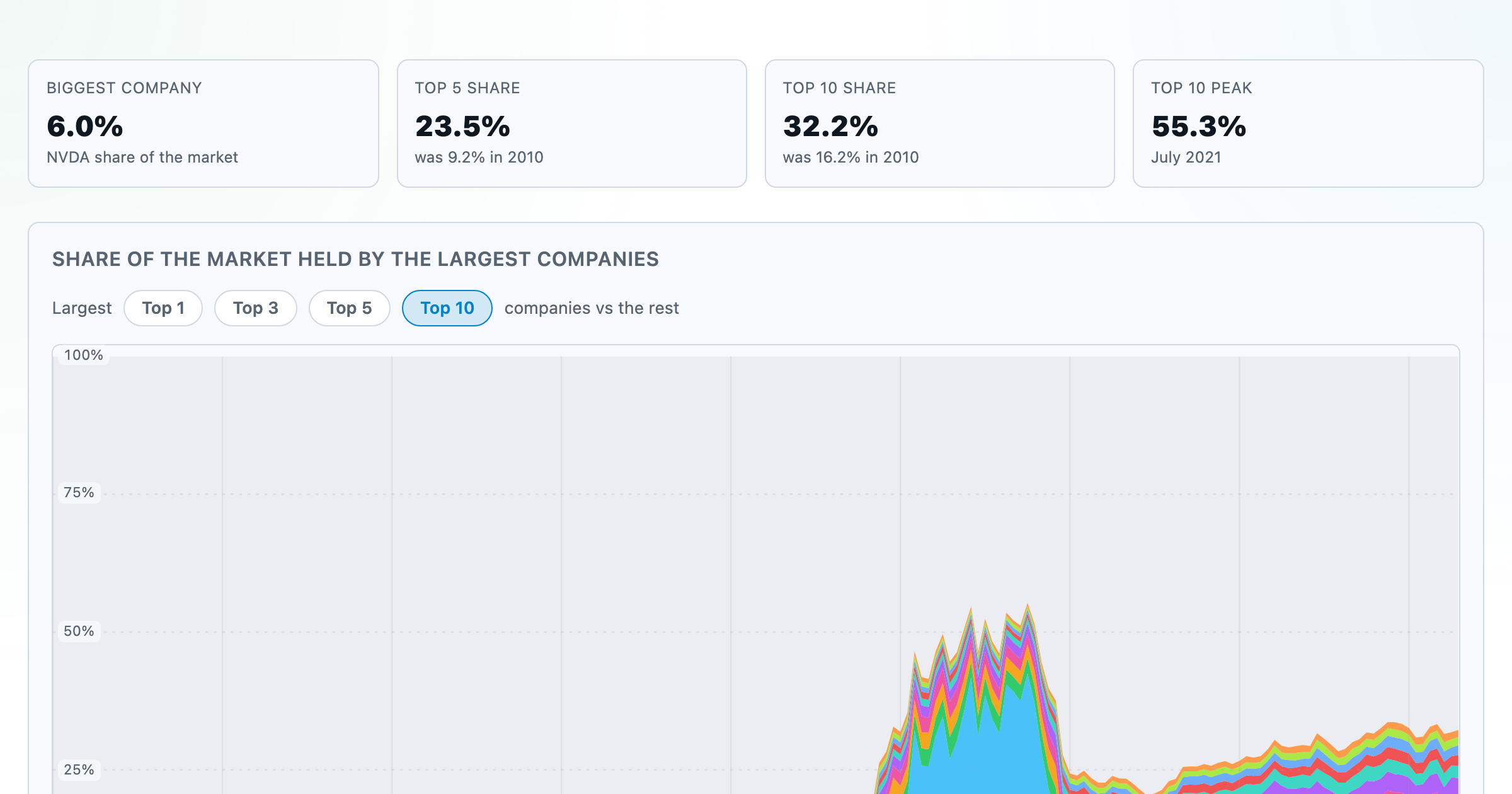
How top-heavy is the market? The top 1–10 companies' share of total market value, month by month since 2010.
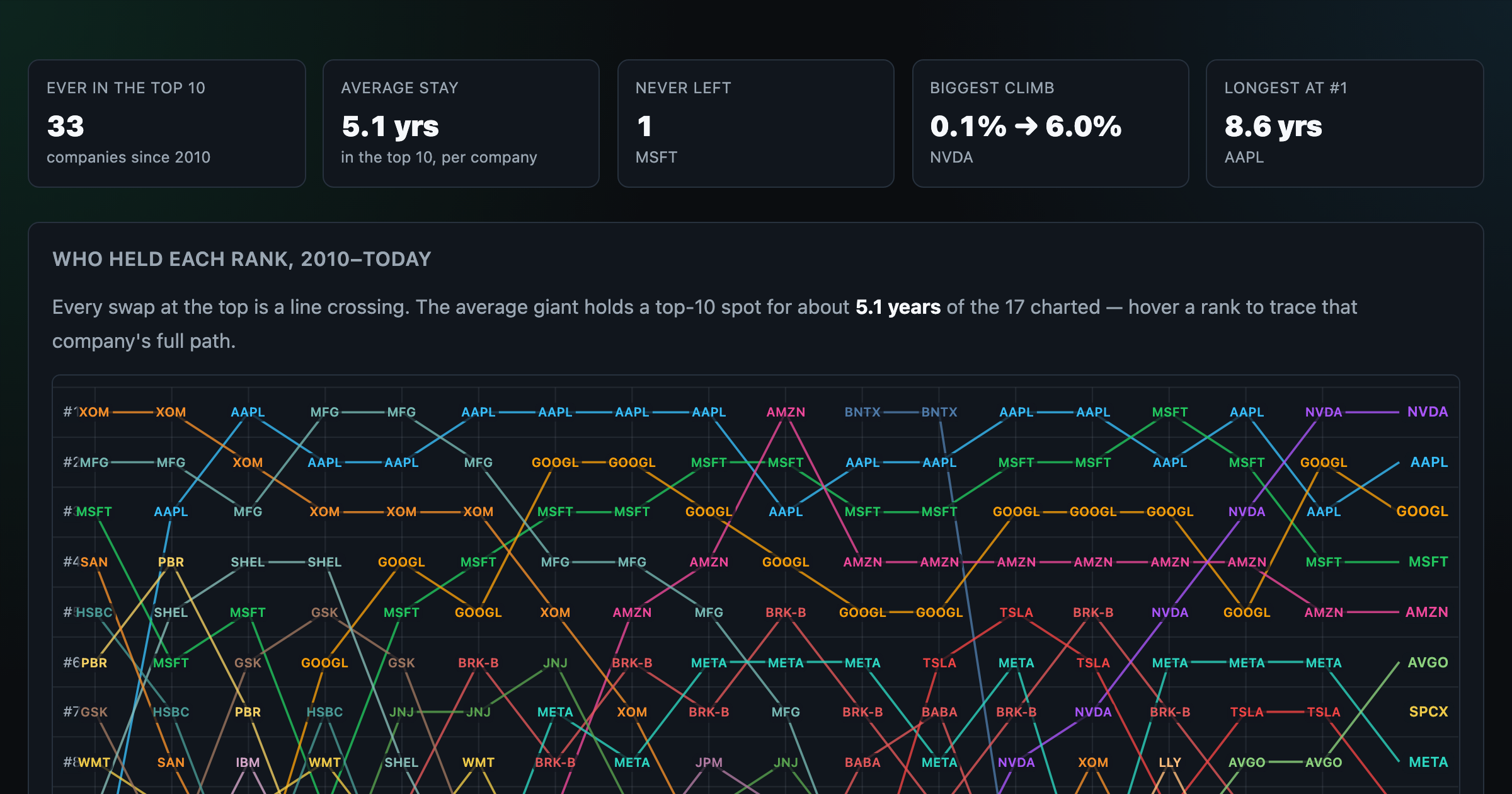
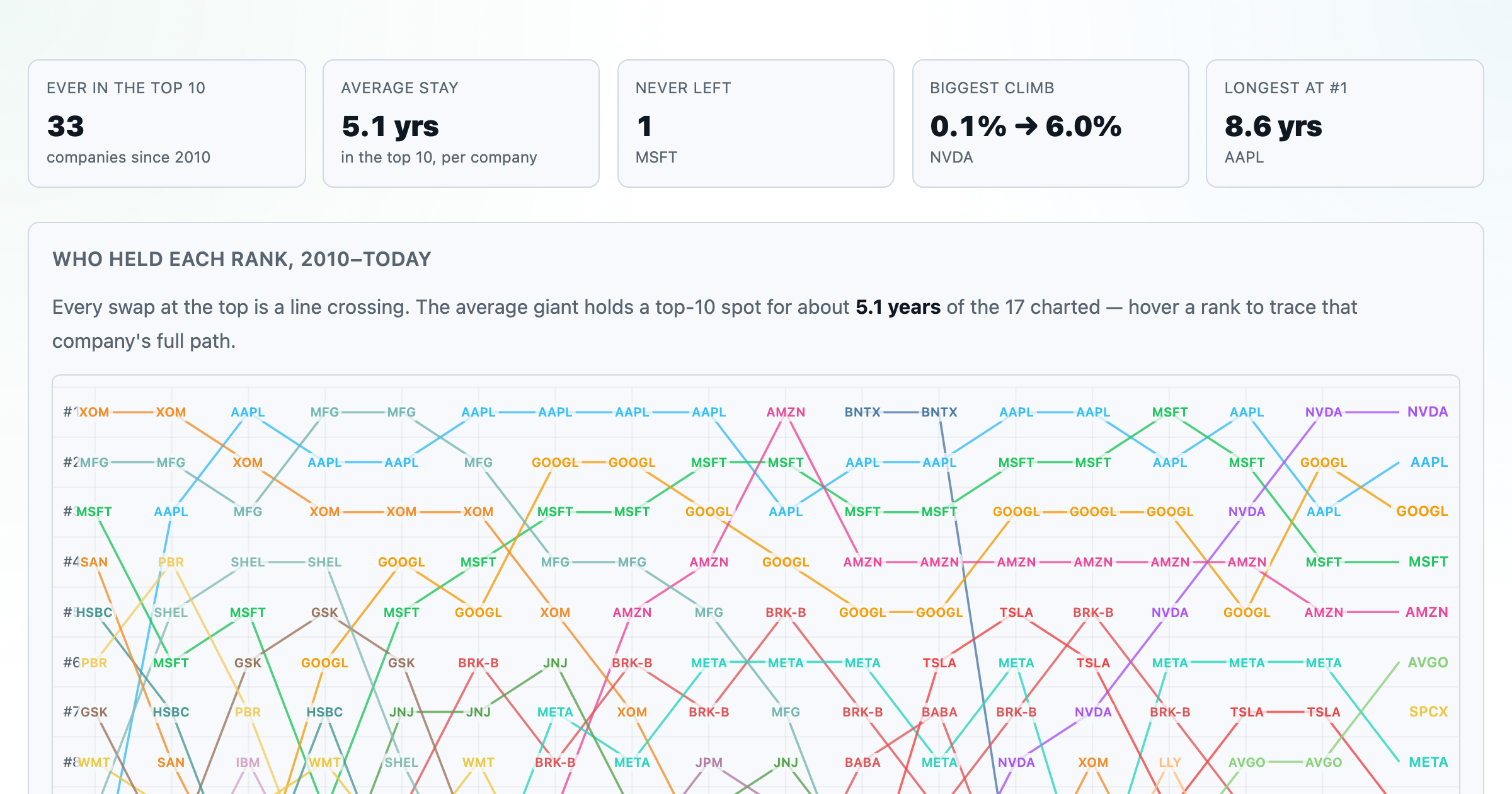
Every company that ever cracked the market's top 10 since 2010 — who climbed, who faded, who never left.
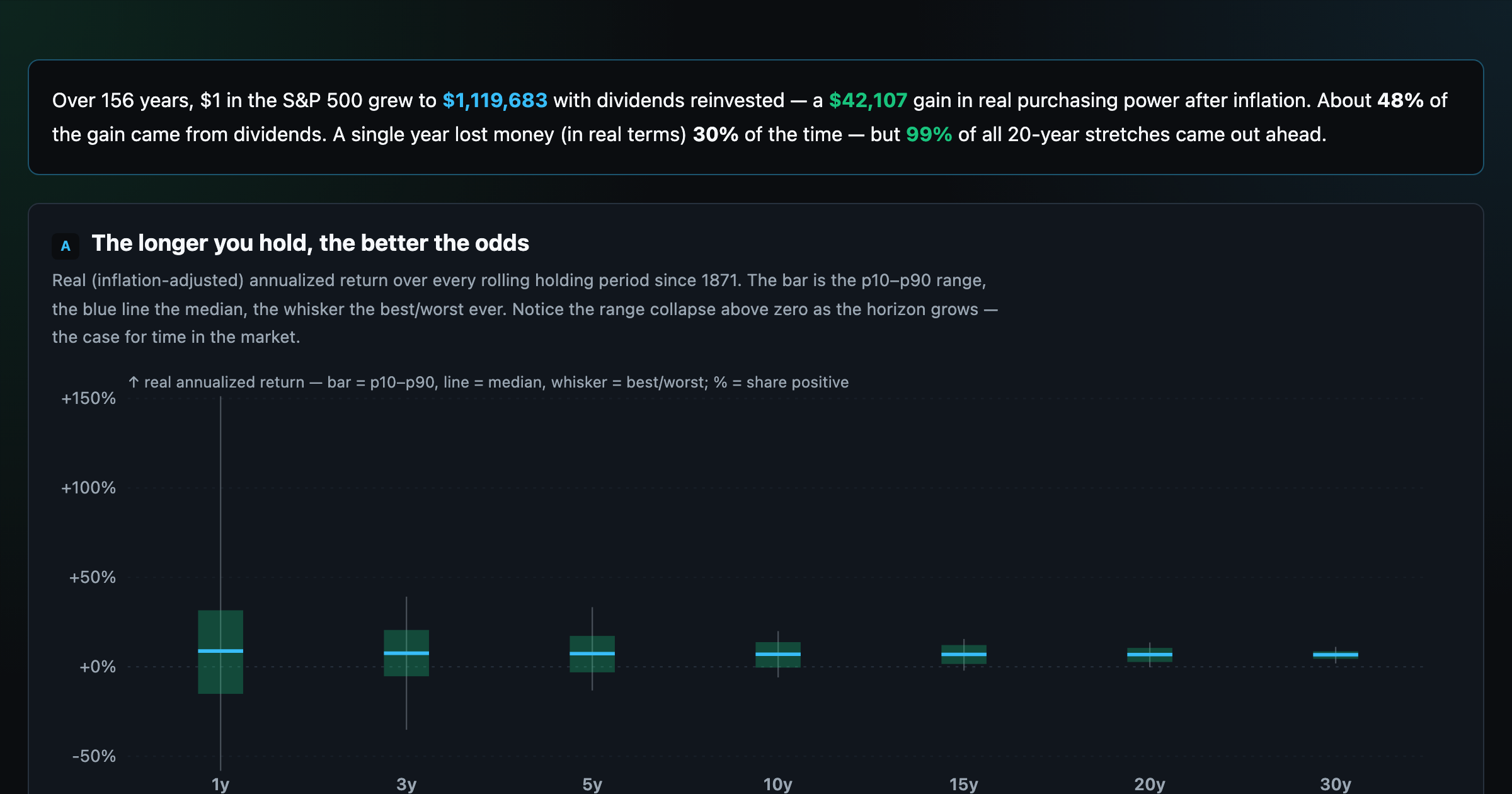
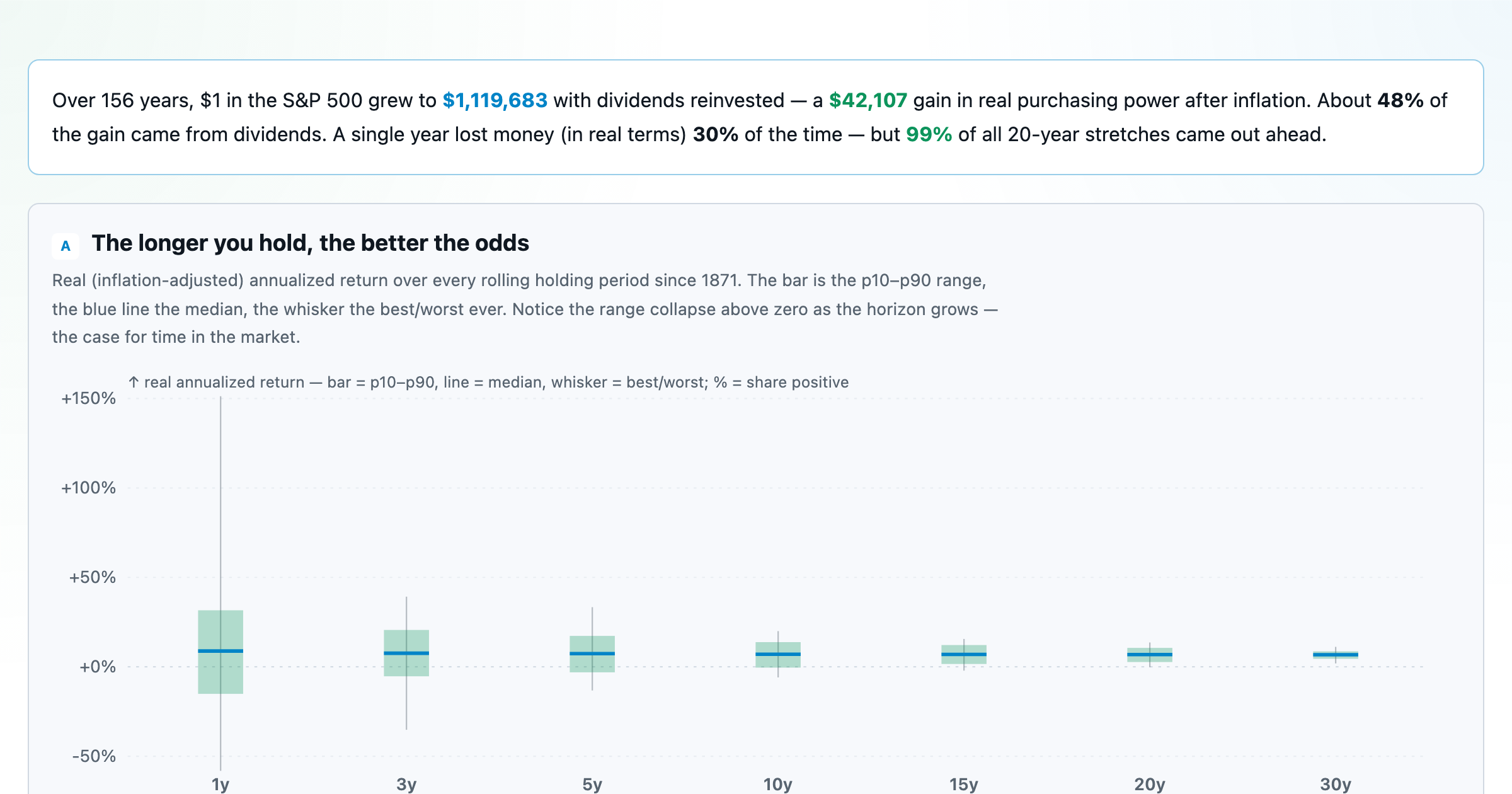
The S&P 500 since 1871 — odds of gain by holding period, real drawdowns, and the growth of $1.
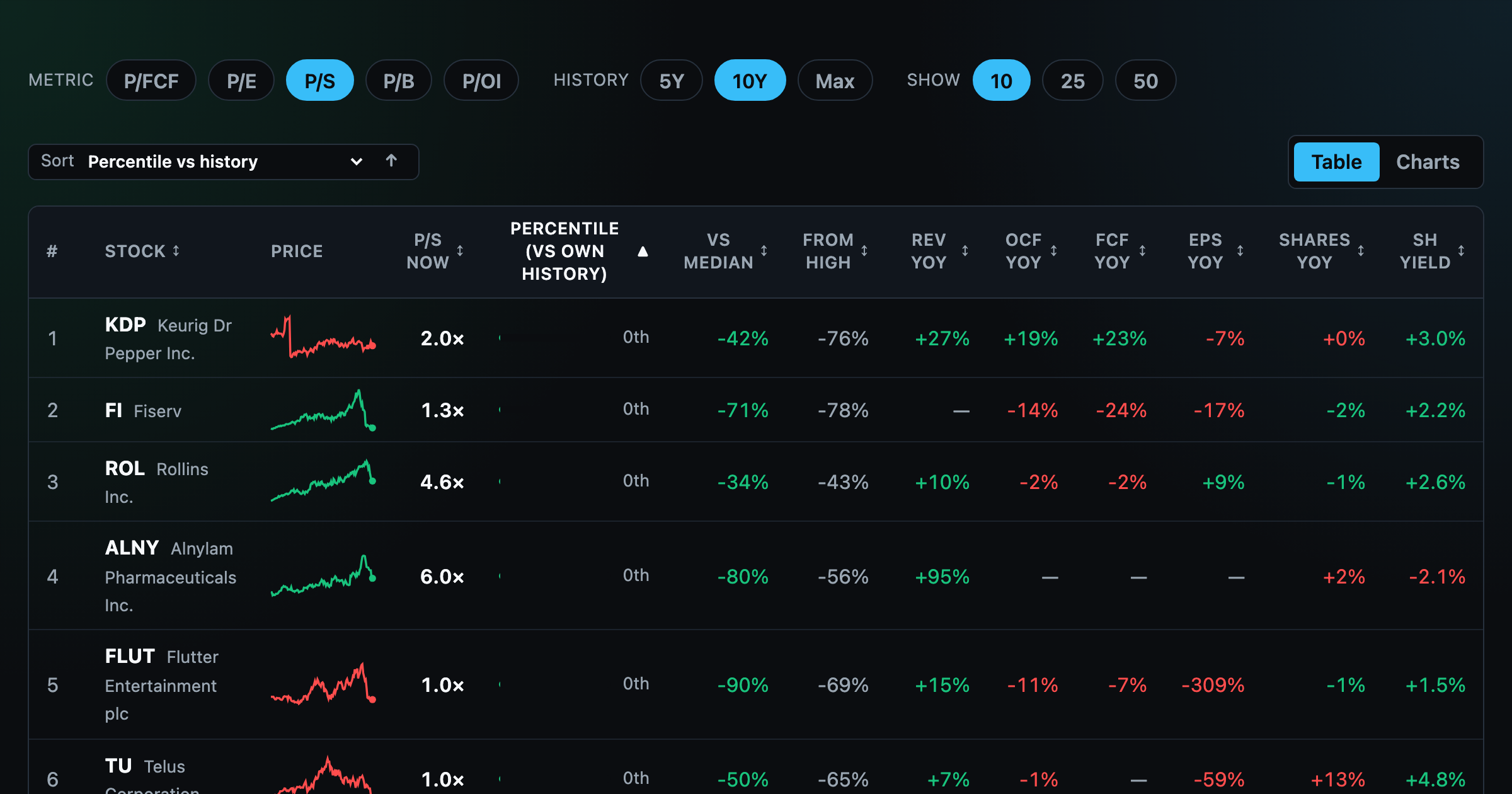
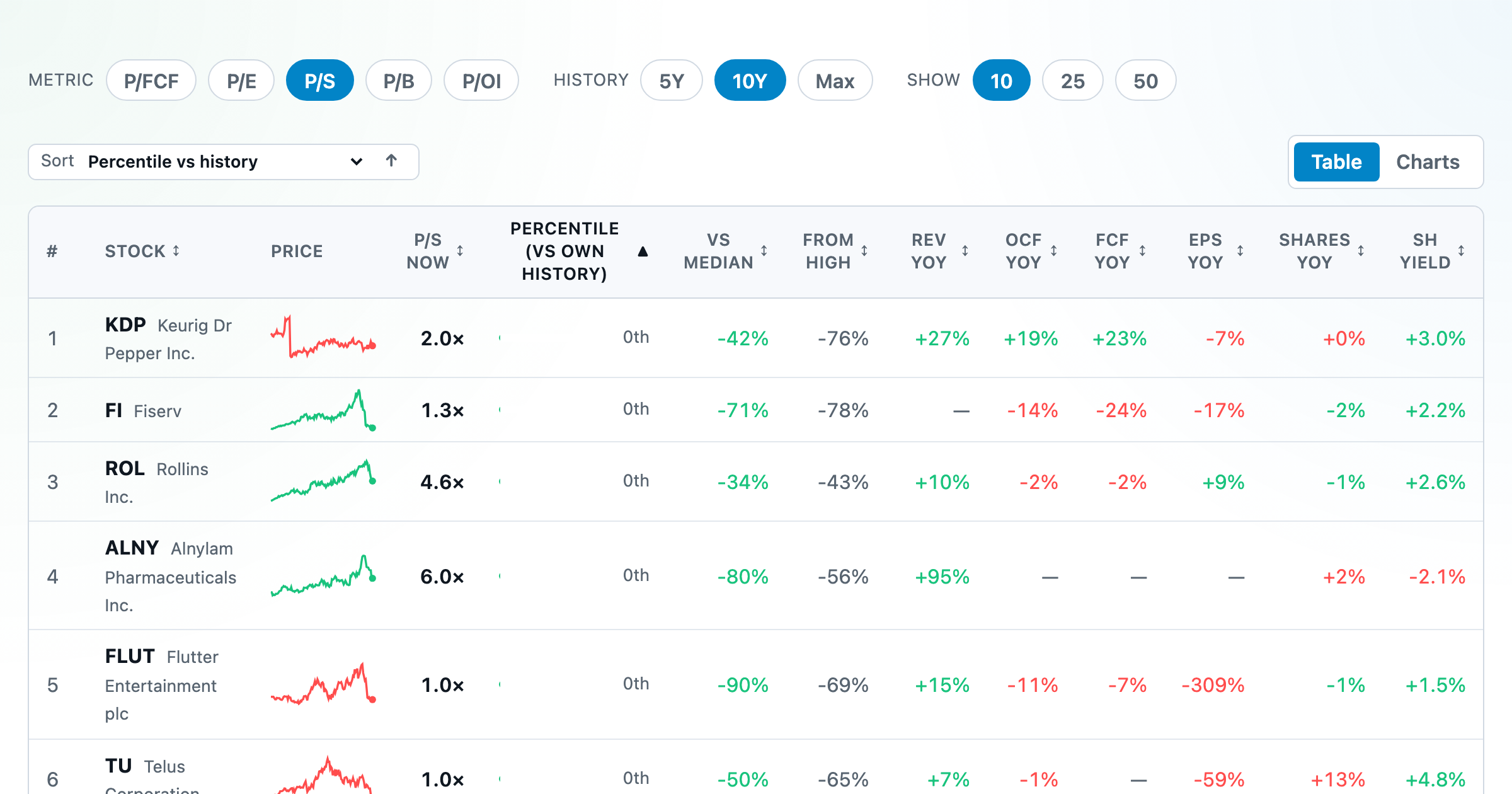
Stocks trading cheapest relative to their own P/E, P/FCF, P/S, or P/B history — with fair-value bands.
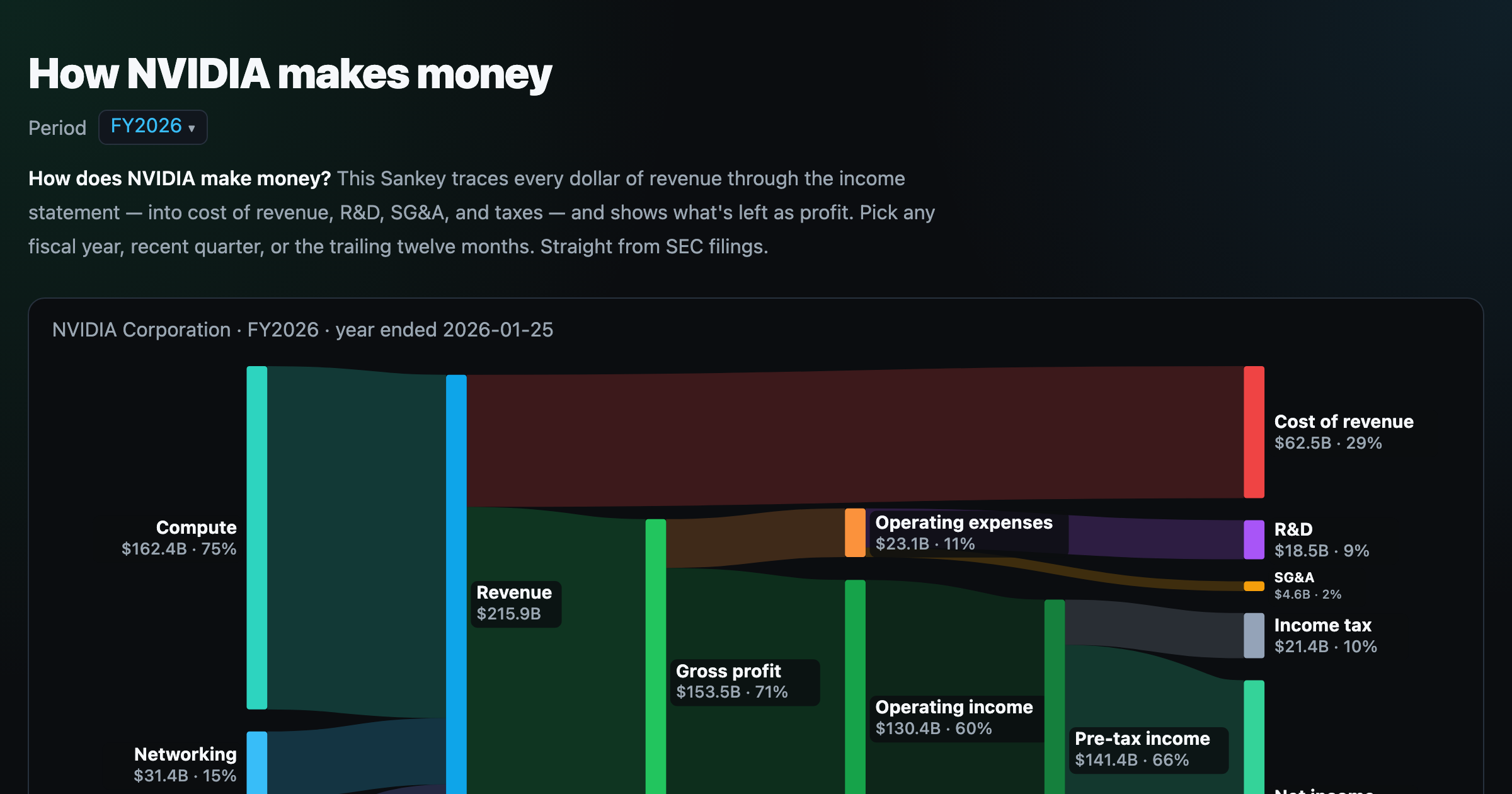
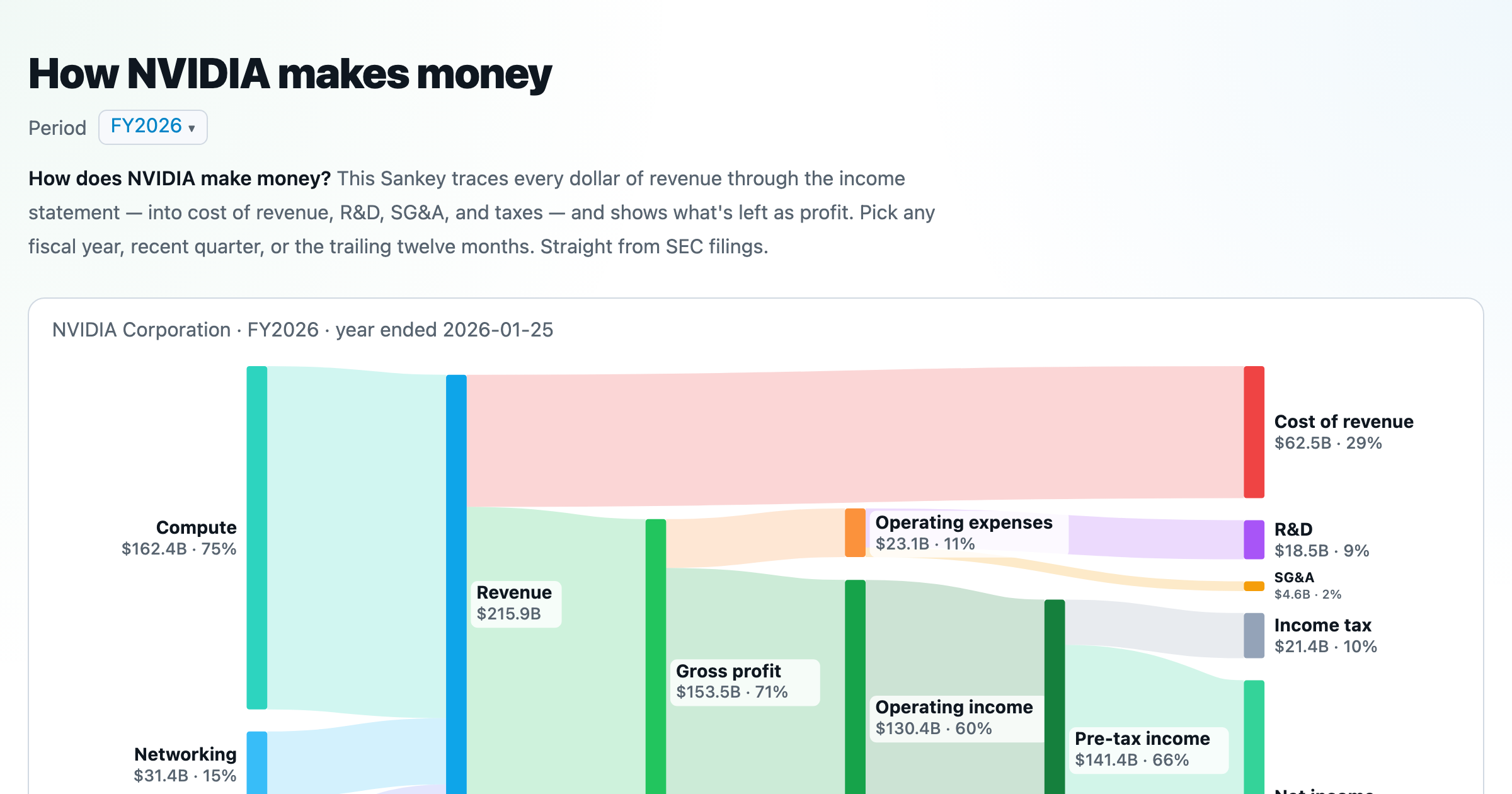
Follow a company's revenue through its income statement as a Sankey — costs, taxes, and profit.
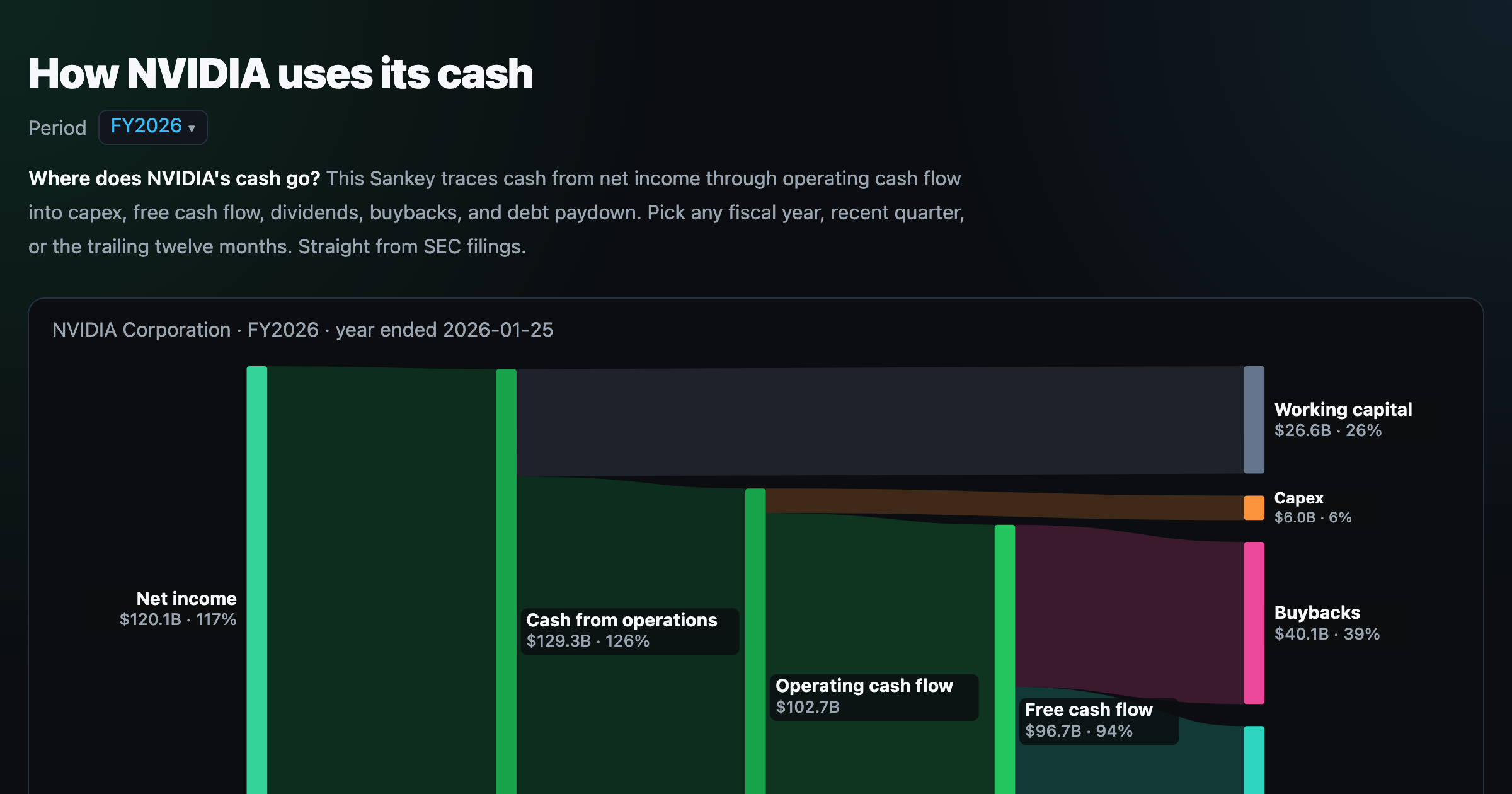
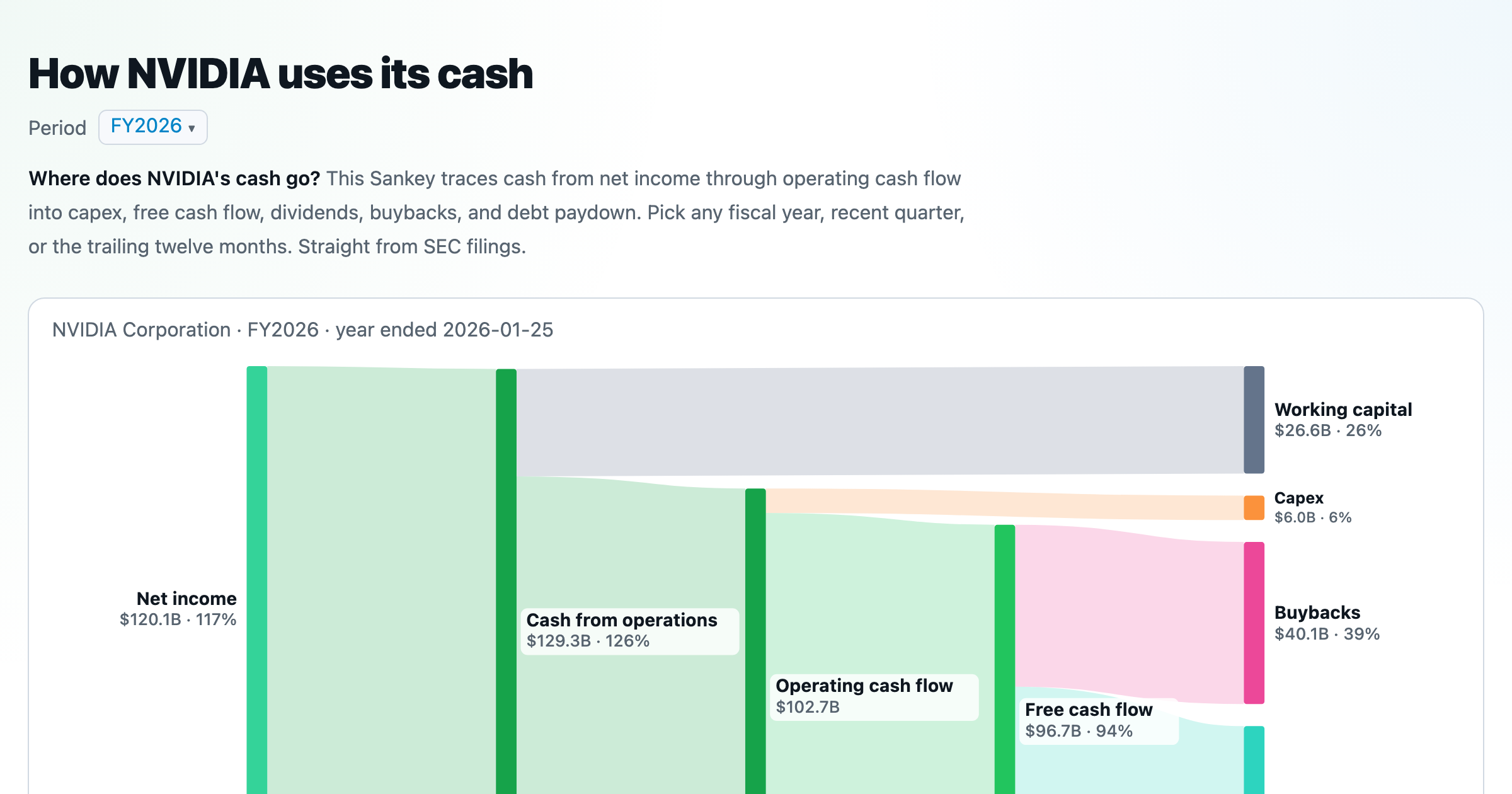
Follow a company's cash from net income through operating cash flow into capex, buybacks, and dividends.
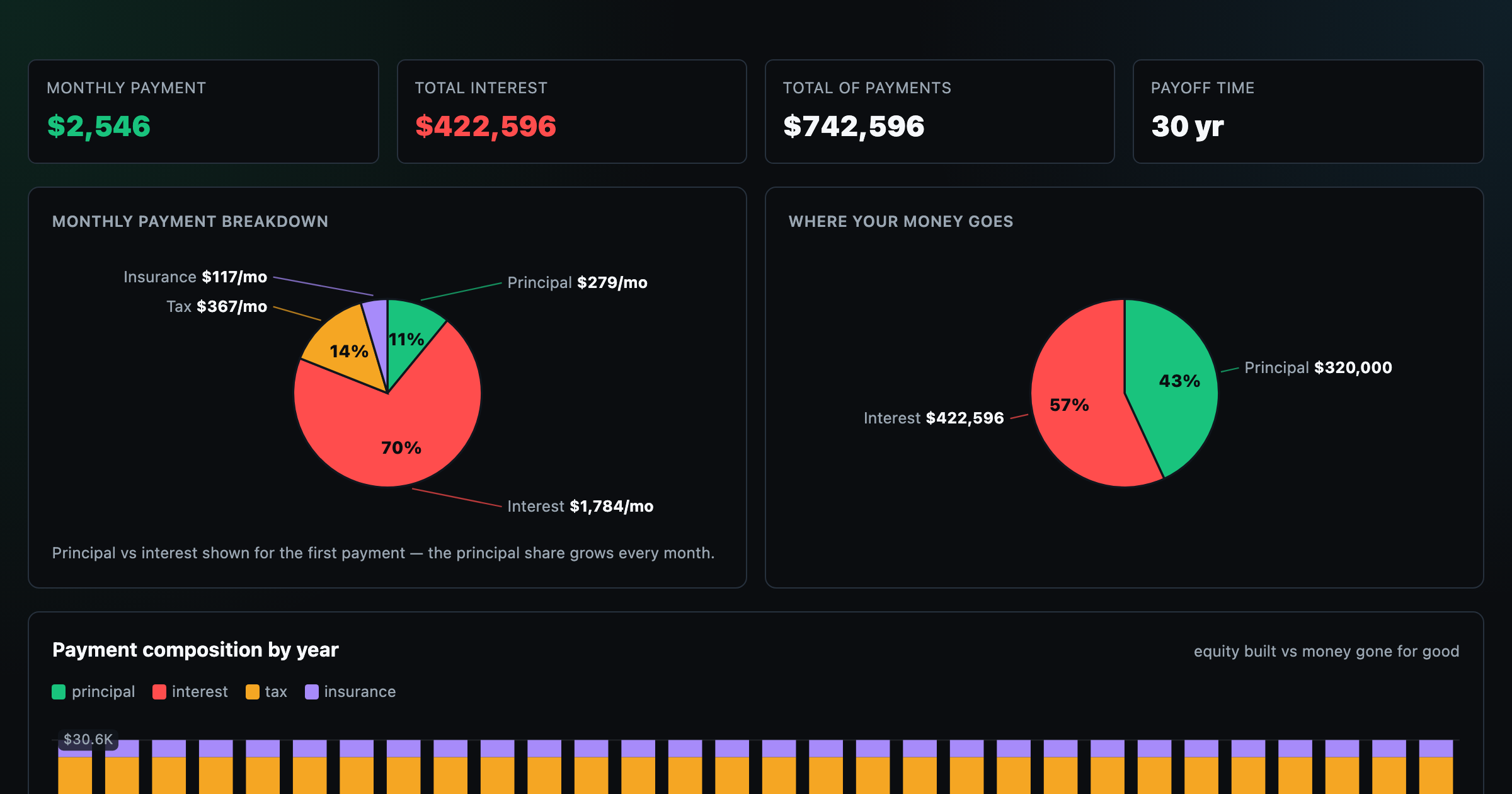
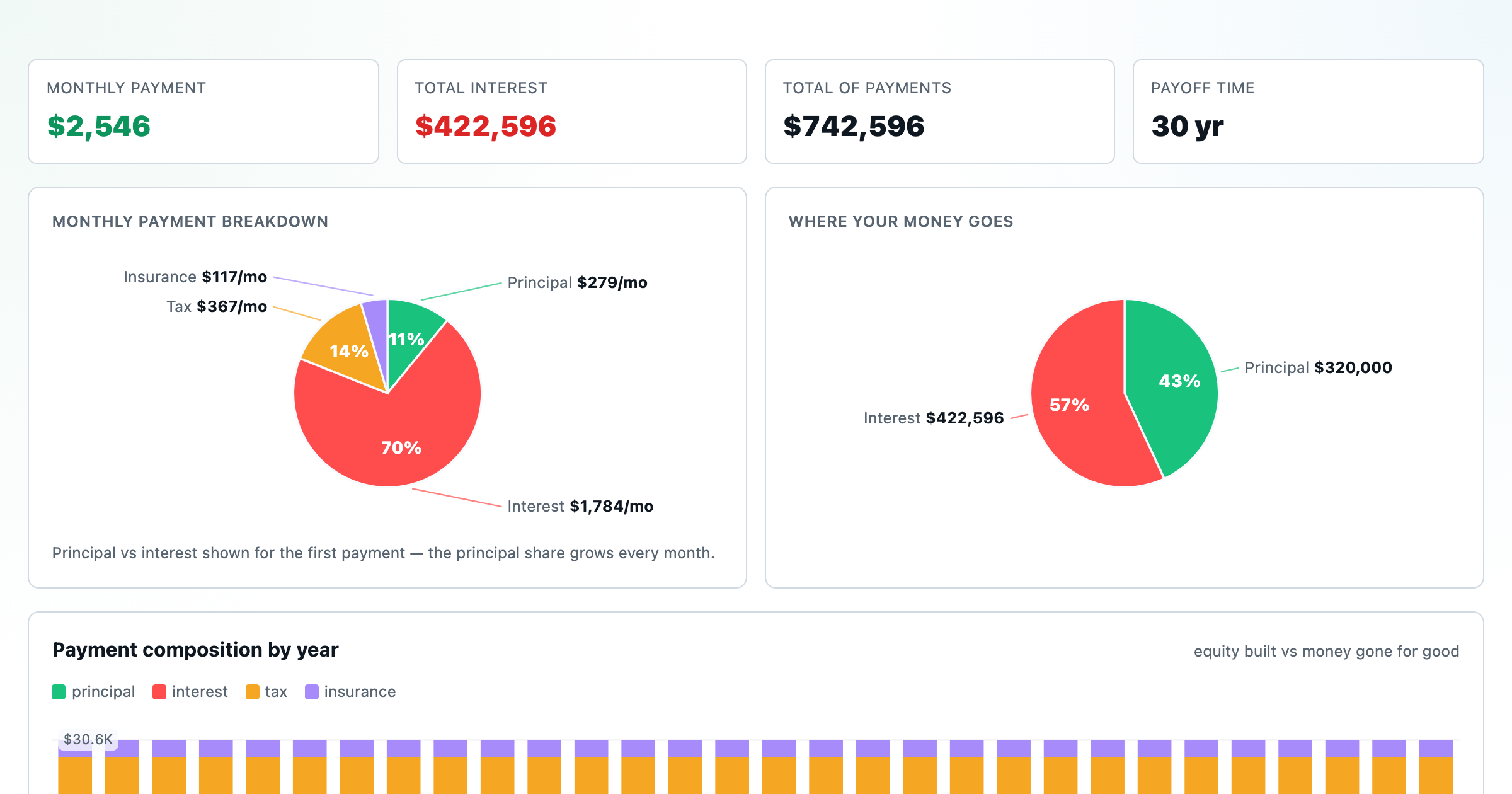
Monthly payment, principal vs interest by year, and the balance paydown — with extra-payment savings.
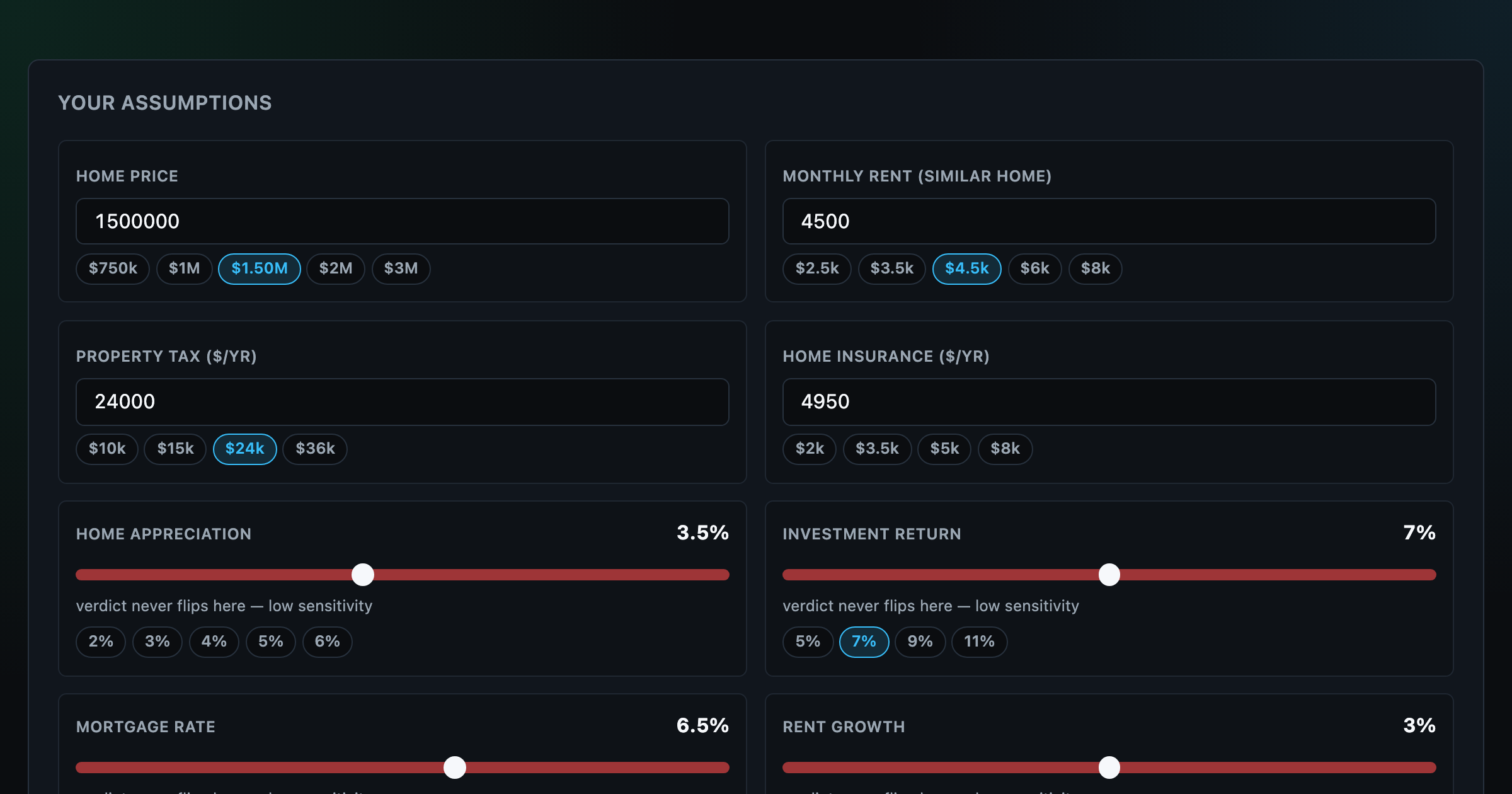
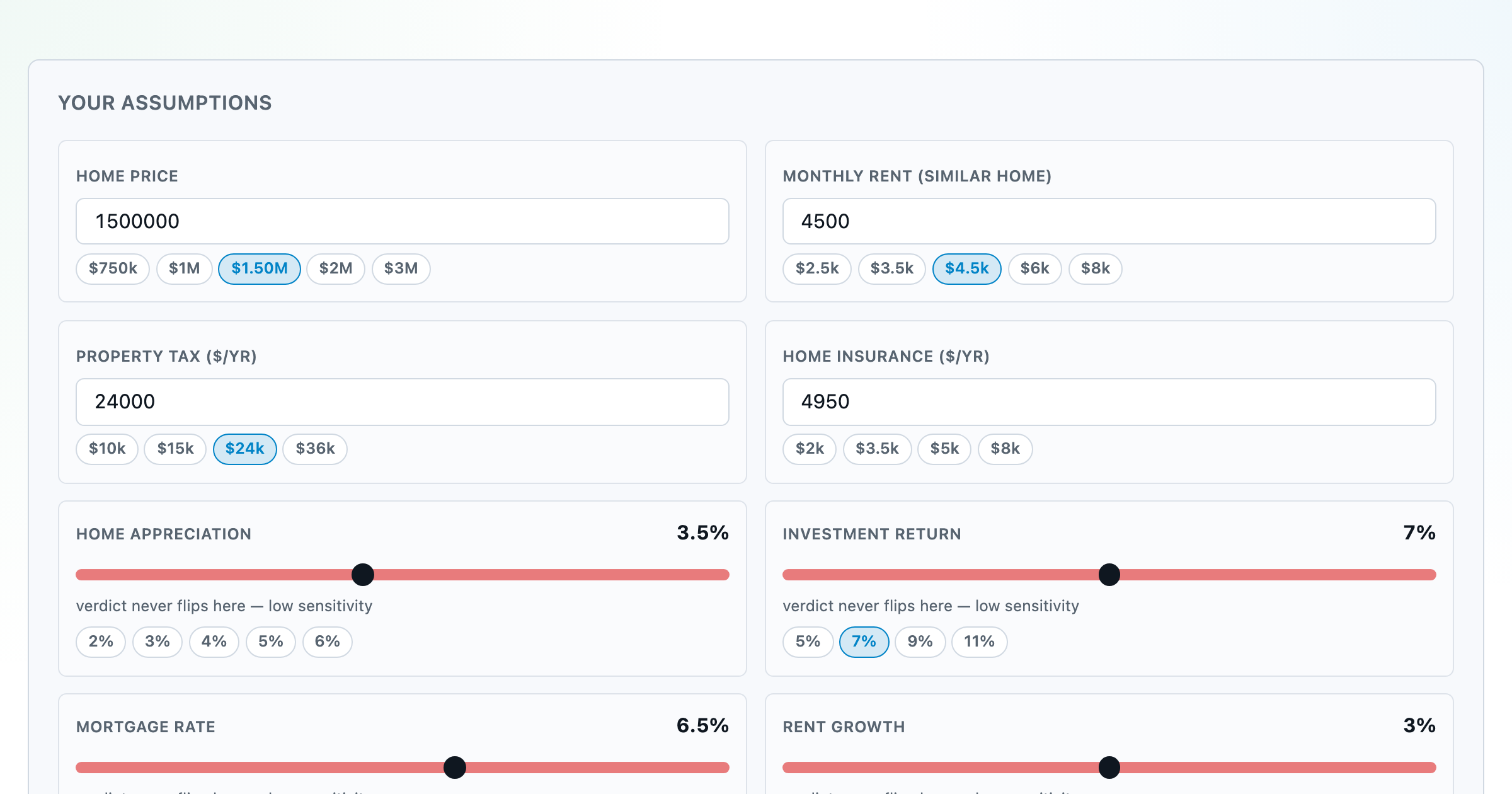
Should you rent or buy? Net-wealth verdict with sensitivity analysis of every assumption.
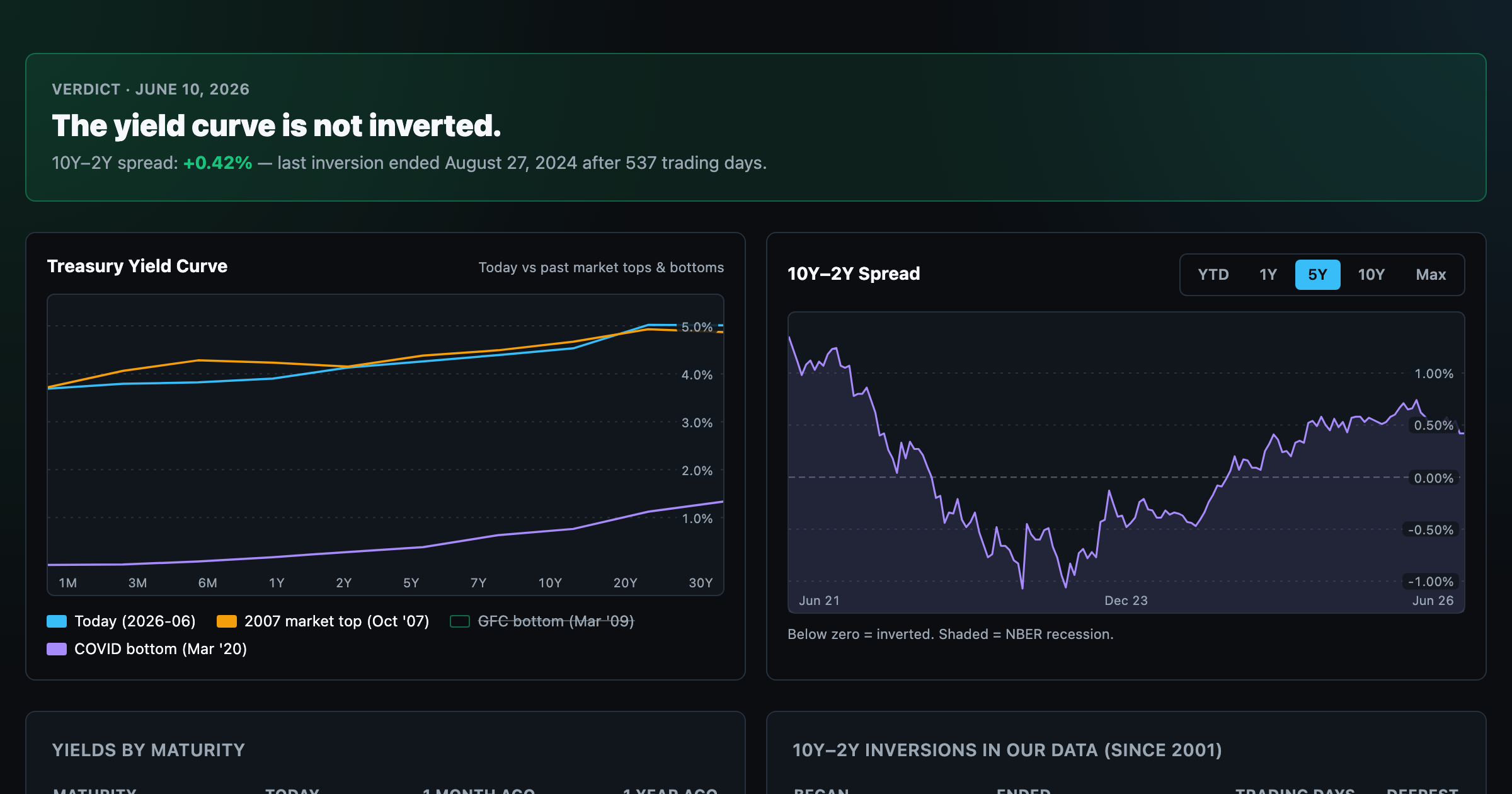
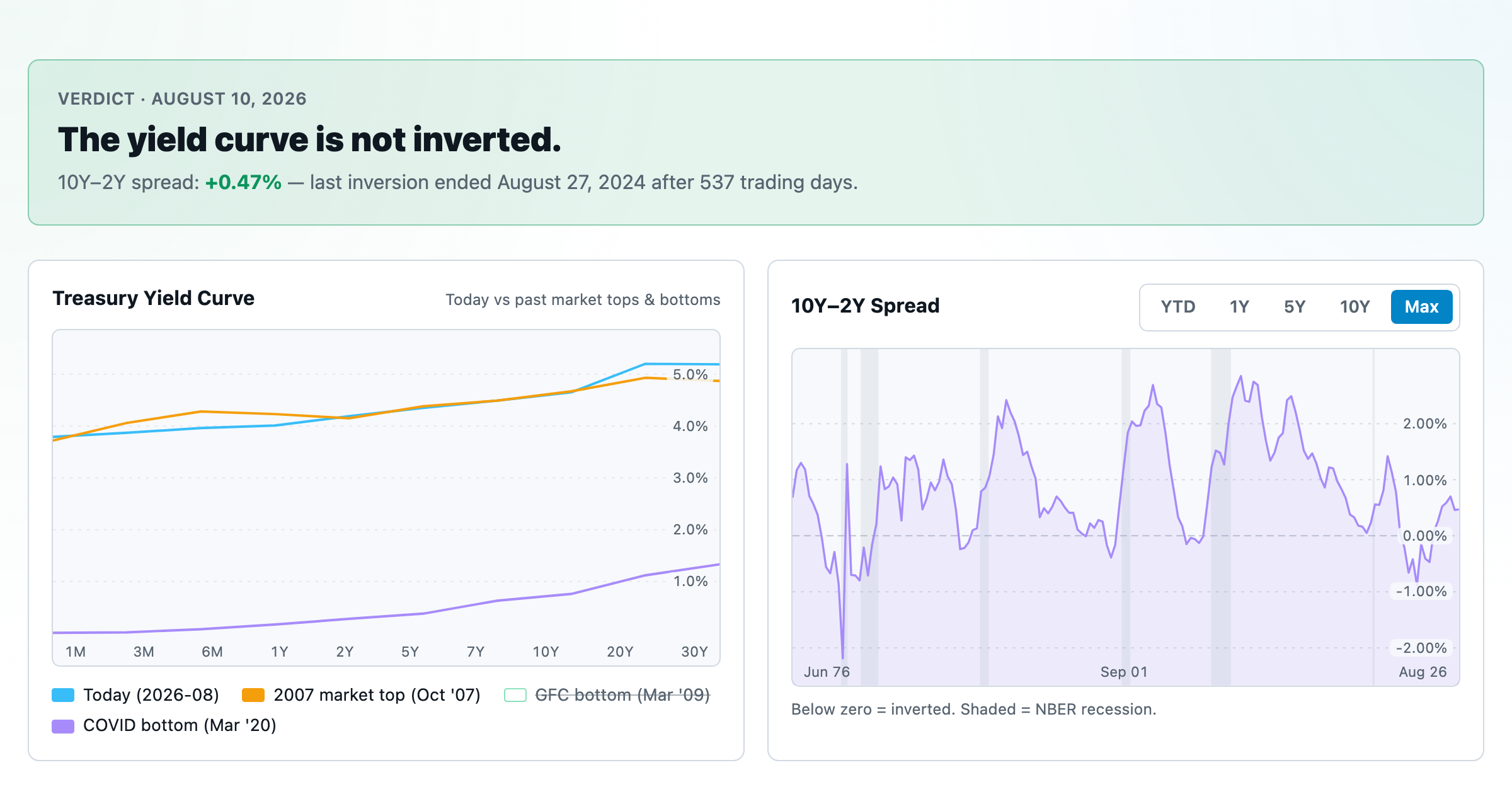
Live term structure, the 10Y–2Y spread, and every inversion episode.