
Most profitable companies (2026)
The 100 companies below have a combined market cap of $50.9T; the best performer of 2026 is SNDK (+653.1% YTD). The top 100 by bottom-line profit. Revenue is vanity; this is the scoreboard. Not investment advice.
End of day 2026-10-01 · 100 entries · digits update live during market hours
Top 100 by TTM net income
Save as watchlist
Technical analysis0
Addendum charts0
Overlay lines0
Columns (13 shown)
| # Company | CategoryCategory | 1Y1Y chart | |||||||||||
|---|---|---|---|---|---|---|---|---|---|---|---|---|---|
| GOOGLAlphabet | Communication Services | $338.26 | -1.69% | +1.0% | -6.4% | +8.1% | +38.1% | +147.7% | $244B | $446B | 16.9 | $4.14T | |
| NVDANVIDIA | Technology | $230.97 | +1.13% | +6.2% | +16.8% | +23.8% | +23.3% | +1013.0% | $193B | $303B | 28.9 | $5.57T | |
| AMZNAmazon.com | Consumer Discretionary | $248.33 | -0.33% | -2.6% | +2.7% | +7.5% | +12.5% | +51.2% | $135B | $776B | 19.8 | $2.68T | |
| MSFTMicrosoft | Technology | $513.11 | +0.04% | +2.4% | +33.4% | +6.0% | -1.3% | +77.4% | $134B | $332B | 28.5 | $3.81T | |
| AAPLApple | Technology | $330.47 | -0.77% | +1.6% | +12.2% | +21.5% | +29.3% | +131.6% | $129B | $467B | 37.4 | $4.82T | |
| BRK-BBerkshire Hathaway | Financials | $500.91 | +0.59% | -0.4% | +0.2% | -0.4% | +0.5% | +81.5% | $86B | $385B | 12.5 | $1.07T | |
| METAMeta Platforms | Communication Services | $725.70 | +0.07% | +25.5% | +18.4% | +10.0% | +1.2% | +111.6% | $68B | $228B | 27.1 | $1.85T | |
| JPMJPMorgan Chase | Financials | $333.33 | +0.76% | -6.1% | -0.3% | +3.4% | +7.2% | +99.4% | $65B | $199B | 13.6 | $886B | |
| TSMTaiwan Semiconductor Manufacturing | Technology | $459.27 | +0.68% | +10.9% | +3.4% | +51.1% | +59.2% | +311.6% | $54B | $121B | 44.1 | $2.38T | |
| MUMicron Technology | Technology | $1,097.68 | +3.06% | +17.6% | +6.3% | +284.5% | +502.5% | +1445.8% | $50B | $90B | 24.6 | $1.24T | |
| AVGOBroadcom | Technology | $343.80 | -2.10% | -7.0% | -7.0% | -0.7% | +3.1% | +605.1% | $38B | $89B | 42.9 | $1.64T | |
| BACBank of America | Financials | $53.72 | -1.30% | -13.3% | -7.9% | -2.3% | +6.0% | +24.7% | $34B | $121B | 11.2 | $376B | |
| LLYEli Lilly | Healthcare | $1,150.05 | -0.61% | -0.9% | -3.5% | +7.0% | +39.3% | +400.8% | $27B | $80B | 38.5 | $1.03T | |
| TMToyota Motor | Industrials | $183.35 | +0.13% | -7.4% | +8.1% | -14.4% | -4.4% | +3.2% | $26B | $335B | 9.1 | $239B | |
| HSBCHSBC Holdings plc. | Financials | $95.83 | -3.50% | -7.3% | +0.0% | +21.8% | +34.3% | +263.2% | $23B | — | 14.2 | $329B | |
| WFCWells Fargo | Financials | $80.28 | +0.28% | -7.8% | -6.6% | -13.9% | -0.8% | +70.7% | $23B | $87B | 10.7 | $243B | |
| VVisa | Financials | $359.97 | +0.18% | -3.4% | +2.5% | +2.6% | +3.5% | +56.1% | $23B | $44B | 29.7 | $672B | |
| WMTWalmart | Consumer Staples | $104.28 | +0.35% | -1.6% | -4.2% | -6.4% | +2.3% | +128.2% | $22B | $728B | 37.5 | $827B | |
| TAT&T | Communication Services | $24.32 | -0.33% | -6.5% | +18.7% | -2.2% | -11.8% | +18.5% | $22B | $127B | 7.7 | $167B | |
| JNJJohnson & Johnson | Healthcare | $258.74 | -2.27% | -4.6% | +1.8% | +25.0% | +39.0% | +61.2% | $21B | $98B | 29.6 | $624B | |
| GSGoldman Sachs Group | Financials | $896.67 | -0.41% | -10.6% | -12.1% | +2.0% | +14.2% | +136.0% | $21B | $66B | 12.4 | $261B | |
| CVXChevron | Energy | $207.19 | +1.46% | -1.9% | +25.0% | +35.9% | +34.0% | +98.5% | $21B | — | 19.9 | $409B | |
| MSMorgan Stanley | Financials | $188.04 | -0.02% | -10.9% | -11.3% | +5.9% | +19.8% | +89.8% | $20B | $78B | 14.7 | $295B | |
| PBRPetroleo Brasileiro S.A. Petrobras ADS | Energy | $21.00 | +0.62% | +3.2% | +31.2% | +77.0% | +66.2% | +95.3% | $20B | $89B | 6.9 | $135B | |
| ORCLOracle | Technology | $138.08 | +0.57% | -2.3% | -3.1% | -29.2% | -52.2% | +53.9% | $19B | $72B | 22.1 | $418B | |
| SHELShell ADR | Energy | $95.60 | +0.58% | +2.2% | +24.9% | +30.1% | +32.0% | +110.6% | $18B | $267B | 15.0 | $272B | |
| CCitigroup | Financials | $127.00 | -1.92% | -4.2% | -9.4% | +8.8% | +28.7% | +78.4% | $18B | $91B | 11.9 | $213B | |
| SANBanco Santander S.A. Sponsored ADR (Spain) | Financials | $13.28 | -4.01% | -7.6% | -3.8% | +13.2% | +27.4% | +263.8% | $18B | — | 11.1 | $195B | |
| MAMastercard | Financials | $550.50 | -0.18% | -5.4% | +5.3% | -3.7% | -4.1% | +52.7% | $16B | $35B | 29.7 | $482B | |
| VZVerizon Communications | Communication Services | $45.97 | +0.22% | -8.6% | +9.5% | +12.9% | +4.9% | -15.3% | $16B | $139B | 11.8 | $191B | |
| PGProcter & Gamble | Consumer Staples | $143.99 | -0.89% | -1.5% | -2.4% | +0.4% | -6.0% | +3.1% | $16B | $87B | 20.9 | $335B | |
| NVONovo Nordisk | Healthcare | $37.41 | -1.33% | -17.1% | -23.3% | -26.5% | -36.8% | -22.0% | $15B | $47B | 10.8 | $166B | |
| BABAAlibaba Group Holding ADR | Consumer Discretionary | $107.45 | -0.08% | -4.8% | +9.7% | -26.7% | -41.2% | -25.5% | $15B | $148B | 16.6 | $250B | |
| TDToronto Dominion Bank | Financials | $117.60 | +0.06% | -1.6% | -3.8% | +24.9% | +46.2% | +74.0% | $15B | $48B | 13.5 | $199B | |
| RYRoyal Bank Of Canada | Financials | $195.33 | -0.64% | -4.0% | -6.2% | +14.6% | +32.7% | +95.7% | $15B | $48B | 18.8 | $274B | |
| KOCoca-Cola | Consumer Staples | $86.12 | +0.05% | -2.2% | +5.9% | +23.2% | +28.9% | +62.4% | $14B | $50B | 25.9 | $371B | |
| HDHome Depot | Consumer Discretionary | $282.50 | -0.70% | -11.7% | -19.5% | -17.9% | -28.9% | -14.4% | $14B | $169B | 19.8 | $282B | |
| UNHUnitedHealth Group | Healthcare | $365.13 | -0.53% | -7.8% | -14.4% | +10.6% | +4.9% | -6.9% | $14B | $450B | 23.2 | $328B | |
| PDDPDD Holdings ADR | Consumer Discretionary | $76.46 | -1.90% | -8.0% | -7.3% | -32.5% | -43.1% | -13.2% | $14B | $62B | 7.8 | $109B | |
| NVSNovartis | Healthcare | $141.04 | -1.07% | -12.5% | -8.5% | +2.3% | +7.1% | +72.0% | $14B | — | 19.3 | $269B | |
| NFLXNetflix | Communication Services | $67.85 | -2.49% | -16.0% | -8.5% | -27.6% | -42.1% | +10.7% | $14B | $48B | 20.7 | $283B | |
| TTETotalEnergies | Energy | $84.52 | -1.15% | -6.5% | +13.0% | +29.2% | +39.8% | +75.9% | $13B | $201B | 14.0 | $187B | |
| ALLAllstate | Financials | $224.47 | +1.18% | -13.0% | -7.7% | +7.8% | +6.5% | +75.7% | $13B | $70B | 4.3 | $57B | |
| CSCOCisco Systems | Technology | $108.74 | +1.03% | -0.9% | -7.1% | +41.2% | +58.2% | +97.2% | $13B | $63B | 32.3 | $429B | |
| BHPBHP Group ADR | Energy | $84.65 | -0.22% | -8.8% | +3.0% | +40.2% | +51.8% | +77.2% | $13B | $59B | 16.5 | $215B | |
| BBVABanco Bilbao Vizcaya Argentaria | Financials | $26.86 | -3.62% | -6.2% | +7.6% | +15.3% | +39.8% | +310.2% | $13B | — | 12.2 | $153B | |
| PGRProgressive | Financials | $211.03 | +1.79% | -4.3% | -6.4% | -7.4% | -14.4% | +132.0% | $12B | $91B | 10.5 | $123B | |
| AXPAmerican Express | Financials | $302.14 | -0.64% | -6.8% | -13.2% | -18.3% | -8.1% | +73.7% | $11B | $76B | 17.8 | $204B | |
| SNDKSandisk | Technology | $1,786.91 | +2.70% | +16.3% | -12.0% | +653.1% | +1376.0% | — | $11B | $20B | 22.9 | $262B | |
| MUFGMitsubishi UFJ Financial Group | Financials | $22.60 | -2.04% | -0.9% | +11.6% | +42.6% | +44.5% | +286.0% | $11B | $46B | 22.5 | $258B | |
| DELLDell Technologies | Technology | $541.70 | +0.70% | +27.5% | +27.4% | +330.4% | +261.9% | +910.4% | $11B | $151B | 30.3 | $344B | |
| ULUnilever ADR | Consumer Discretionary | $59.58 | -1.89% | -7.5% | -2.2% | -8.9% | -10.0% | -2.4% | $11B | $57B | 11.5 | $130B | |
| CMCSAComcast | Communication Services | $21.69 | -0.32% | -17.5% | -8.6% | -22.5% | -25.2% | -59.5% | $11B | $125B | 6.9 | $77B | |
| CBChubb | Financials | $331.27 | +1.85% | -2.2% | -5.8% | +6.1% | +17.7% | +88.9% | $11B | $62B | 11.4 | $128B | |
| PMPhilip Morris International | Consumer Staples | $188.17 | -1.39% | +0.6% | +5.9% | +17.3% | +17.0% | +95.9% | $11B | $43B | 27.0 | $293B | |
| ASMLASML Holding | Technology | $1,808.72 | -0.16% | +8.6% | -1.9% | +69.0% | +80.3% | +143.8% | $11B | $37B | 64.1 | $697B | |
| CATCaterpillar | Industrials | $826.35 | +1.92% | +6.1% | -16.6% | +44.2% | +71.9% | +325.2% | $11B | $75B | 35.0 | $380B | |
| IBMInternational Business Machines | Technology | $225.75 | +2.65% | -2.5% | -21.2% | -23.8% | -21.2% | +64.7% | $11B | $69B | 19.8 | $213B | |
| TMUST-Mobile US | Communication Services | $161.71 | -0.84% | -11.2% | -6.5% | -20.3% | -30.7% | +27.6% | $11B | $92B | 16.4 | $173B | |
| COFCapital One Financial | Financials | $194.48 | +0.73% | -8.0% | -5.0% | -19.8% | -8.9% | +16.8% | $11B | $62B | 11.3 | $119B | |
| PEPPepsiCo | Consumer Staples | $125.62 | -0.87% | -10.2% | -11.0% | -12.5% | -12.3% | -16.8% | $10B | $97B | 16.4 | $171B | |
| BTIBritish American Tobacco | Consumer Staples | $53.19 | -2.23% | -4.9% | -12.2% | -6.1% | +1.7% | +52.6% | $10B | $34B | 11.4 | $117B | |
| RIORio Tinto | Materials | $92.87 | -1.38% | -8.8% | -0.5% | +16.0% | +40.1% | +39.0% | $10B | $58B | 11.4 | $117B | |
| AZNAstraZeneca | Healthcare | $157.68 | -2.35% | -2.9% | -14.2% | -14.2% | -6.5% | +32.1% | $10B | $59B | 24.1 | — | |
| SCHWCharles Schwab | Financials | $98.41 | +0.68% | -9.2% | +2.7% | -1.5% | +6.6% | +32.2% | $10B | $26B | 16.9 | $170B | |
| INGING Group | Financials | $34.22 | -3.61% | -2.8% | +8.8% | +22.3% | +31.3% | +134.1% | $10B | $29B | 10.2 | $99B | |
| CRMSalesforce | Technology | $236.70 | +3.11% | -8.3% | +45.0% | -10.7% | +0.4% | -14.0% | $10B | $44B | 20.2 | $195B | |
| UBERUber Technologies | Industrials | $67.90 | -0.90% | -9.8% | -6.6% | -16.9% | -29.7% | +44.3% | $10B | $55B | 14.5 | $139B | |
| GEVGE Vernova | Industrials | $987.45 | +3.89% | +9.9% | -13.0% | +51.1% | +62.9% | — | $10B | $41B | 27.6 | $263B | |
| BCSBarclays | Financials | $23.64 | -2.60% | -9.6% | -13.3% | -7.1% | +14.8% | +126.7% | $10B | $15B | 8.6 | $82B | |
| WDCWestern Digital | Technology | $462.38 | +1.74% | +2.7% | -22.7% | +168.5% | +254.2% | +971.9% | $9B | $13B | 17.7 | $167B | |
| NEENextEra Energy | Utilities | $76.35 | +0.81% | -7.9% | -11.6% | -4.9% | -2.9% | -3.6% | $9B | $29B | 17.1 | $159B | |
| BMYBristol-Myers Squibb | Healthcare | $61.45 | -1.53% | -8.2% | +8.9% | +13.9% | +29.6% | +3.3% | $9B | $49B | 13.5 | $126B | |
| COPConocoPhillips | Energy | $127.07 | +1.53% | -6.7% | +23.1% | +35.7% | +33.1% | +81.3% | $9B | $63B | 16.4 | $153B | |
| AMATApplied Materials | Technology | $529.27 | +3.50% | +19.8% | -18.7% | +106.0% | +143.1% | +309.9% | $9B | $31B | 45.3 | $420B | |
| QCOMQUALCOMM | Technology | $181.96 | -1.13% | +9.3% | +0.1% | +6.5% | +9.4% | +41.5% | $9B | $44B | 20.6 | $191B | |
| GEGE Aerospace | Industrials | $312.46 | +0.05% | -5.6% | -16.7% | +1.4% | +3.8% | +373.8% | $9B | $51B | 36.1 | $324B | |
| SNYSanofi ADS | Healthcare | $40.65 | -1.41% | -8.3% | -2.3% | -16.1% | -18.3% | -15.1% | $9B | — | 11.2 | $99B | |
| COSTCostco Wholesale | Consumer Staples | $914.99 | +0.51% | -2.7% | -1.1% | +6.1% | -0.3% | +104.1% | $9B | $294B | 45.9 | $406B | |
| MCDMcDonald's | Consumer Discretionary | $231.84 | +0.39% | -11.2% | -14.0% | -24.1% | -22.9% | -4.6% | $9B | $28B | 18.7 | $164B | |
| AMGNAmgen | Healthcare | $407.33 | -3.36% | -7.0% | +12.7% | +24.4% | +36.4% | +90.4% | $9B | $38B | 25.2 | $220B | |
| DISWalt Disney | Communication Services | $101.34 | -3.39% | -4.6% | +5.9% | -10.9% | -10.3% | -42.4% | $9B | $99B | 20.3 | $175B | |
| NEMNewmont | Materials | $114.67 | -0.58% | -6.5% | +22.9% | +14.8% | +33.4% | +114.1% | $9B | $26B | 14.1 | $121B | |
| MPCMarathon Petroleum | Energy | $420.22 | +6.27% | +9.7% | +58.6% | +158.3% | +118.5% | +561.0% | $9B | $154B | 13.8 | $118B | |
| BUDAnheuser-Busch Inbev SA Sponsored ADR (Belgium) | Consumer Staples | $73.01 | -0.63% | -7.7% | -9.0% | +14.0% | +22.6% | +29.2% | $8B | $59B | 15.5 | $131B | |
| TRVTravelers Companies | Financials | $361.67 | +1.45% | -0.6% | +8.1% | +24.7% | +30.4% | +137.3% | $8B | $49B | 9.1 | $75B | |
| GSKGSK ADR | Healthcare | $47.18 | -2.06% | -6.9% | -8.0% | -3.8% | +3.7% | +23.7% | $8B | $43B | 11.7 | $97B | |
| SAPSAP SE ADS | Technology | $210.86 | +1.14% | -0.6% | +32.4% | -13.2% | -21.9% | +55.0% | $8B | $42B | 29.9 | $248B | |
| HONHoneywell International | Industrials | $213.79 | +1.35% | +1.8% | -3.6% | +9.6% | +7.9% | +5.2% | $8B | $38B | 8.3 | $68B | |
| ITUBItau Unibanco Banco Holding ADR | Financials | $8.45 | -0.94% | +10.0% | +3.9% | +18.0% | +21.0% | +110.8% | $8B | $30B | 11.4 | $93B | |
| USBU.S. Bancorp | Financials | $57.39 | -0.65% | -6.3% | -7.4% | +7.5% | +19.8% | -5.6% | $8B | $30B | 10.9 | $89B | |
| MOAltria Group | Consumer Staples | $66.96 | -0.57% | -3.8% | -6.4% | +16.1% | +1.0% | +46.0% | $8B | $23B | 14.0 | $112B | |
| SMFGSumitomo Mitsui Financial Group Inc Unsponsored ADR | Financials | $25.27 | -2.47% | -2.9% | +5.1% | +30.8% | +54.3% | +262.7% | $8B | — | 12.2 | $97B | |
| UBSUBS Group AG Registered | Financials | $47.57 | -1.17% | -12.1% | -4.3% | +2.7% | +17.7% | +198.6% | $8B | — | 20.4 | $159B | |
| ACNAccenture | Technology | $212.54 | +15.91% | +12.9% | +61.9% | -20.9% | -12.9% | -34.6% | $8B | $73B | 16.8 | $131B | |
| CNQCanadian Natural Resources | Energy | $47.82 | +1.59% | -7.8% | +22.8% | +41.2% | +50.5% | +165.2% | $8B | $28B | 12.9 | $100B | |
| RTXRTX | Industrials | $185.03 | -0.33% | -9.8% | -3.5% | +0.9% | +10.7% | +111.5% | $8B | $94B | 32.2 | $249B | |
| NWGNatWest Group ADR | Financials | $17.39 | -4.19% | -5.1% | -3.3% | -0.6% | +22.0% | +164.3% | $8B | $40B | 9.3 | $72B | |
| MFGMizuho Financial Group Inc. Sponosred ADR (Japan) | Financials | $10.76 | -2.67% | +0.2% | +9.8% | +47.0% | +65.3% | +284.3% | $8B | $30B | 17.5 | $134B | |
| HDBHDFC Bank | Financials | $22.95 | +2.71% | +0.0% | -10.2% | -37.2% | -32.1% | -37.7% | $8B | $25B | 15.7 | $118B |
Methodology
Ranked by trailing-twelve-month net income from SEC filings. Bottom-line profit includes one-offs — a single asset sale or writedown can move a company several places — which is why the P/OI column exists as the below-the-line-excluded comparison.
Performance columns are price returns: the change in the split-adjusted share price, the way quote screens report it, through the latest print during the session. Dividends are not reinvested. Fundamentals come from company filings via our EDGAR pipeline. Past performance does not predict future returns; this is not investment advice.
FAQ#
- What is the most profitable company?
- Alphabet Inc. Class A (GOOGL) is the most profitable US-listed company, earning about $244B in net income over the trailing twelve months.
- What are the top 10 companies by profit?
- The 10 most profitable US-listed companies by TTM net income: 1. GOOGL $244B, 2. NVDA $193B, 3. AMZN $135B, 4. MSFT $134B, 5. AAPL $129B, 6. BRK-B $86B, 7. META $68B, 8. JPM $65B, 9. TSM $54B, 10. MU $50B.
More lists
Biggest capex spenders
100 stocksThe largest capital-expenditure budgets in absolute dollars — where the AI build-out actually shows up.
Biggest buyback programs
100 stocksThe most cash spent repurchasing stock over the trailing year, net of shares issued.
Biggest companies by market cap
100 stocksThe top 100 by market cap — and the trillion-dollar club.
Biggest companies by revenue
100 stocksRanked by actual sales from SEC filings. A very different top 10.
Biggest companies by free cash flow
100 stocksCash actually generated after capex — the strictest of the size rankings.
Biggest ETFs
50 ETFsThe 50 largest ETFs by assets, with what they cost to own.
Explore visualizations
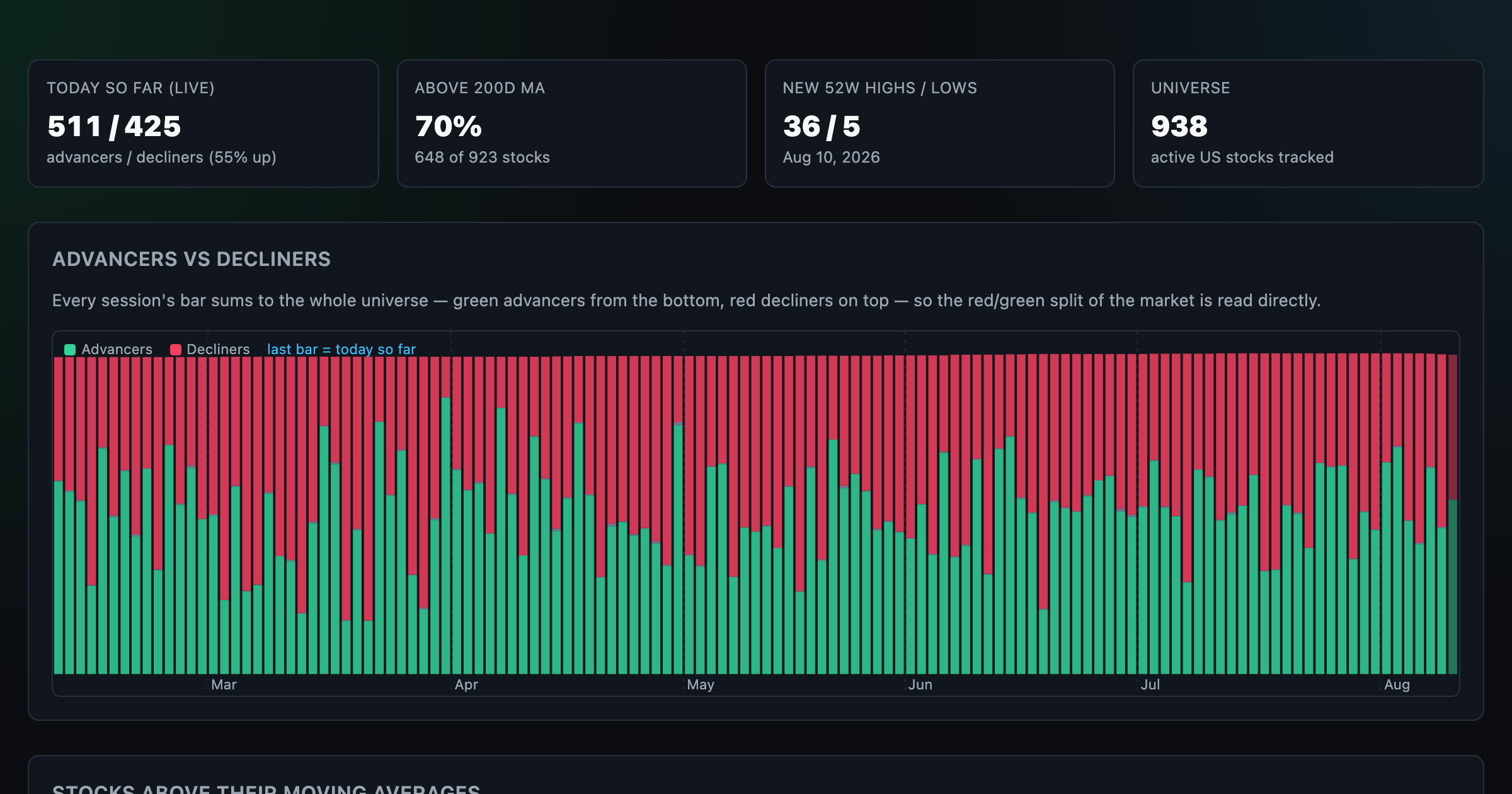
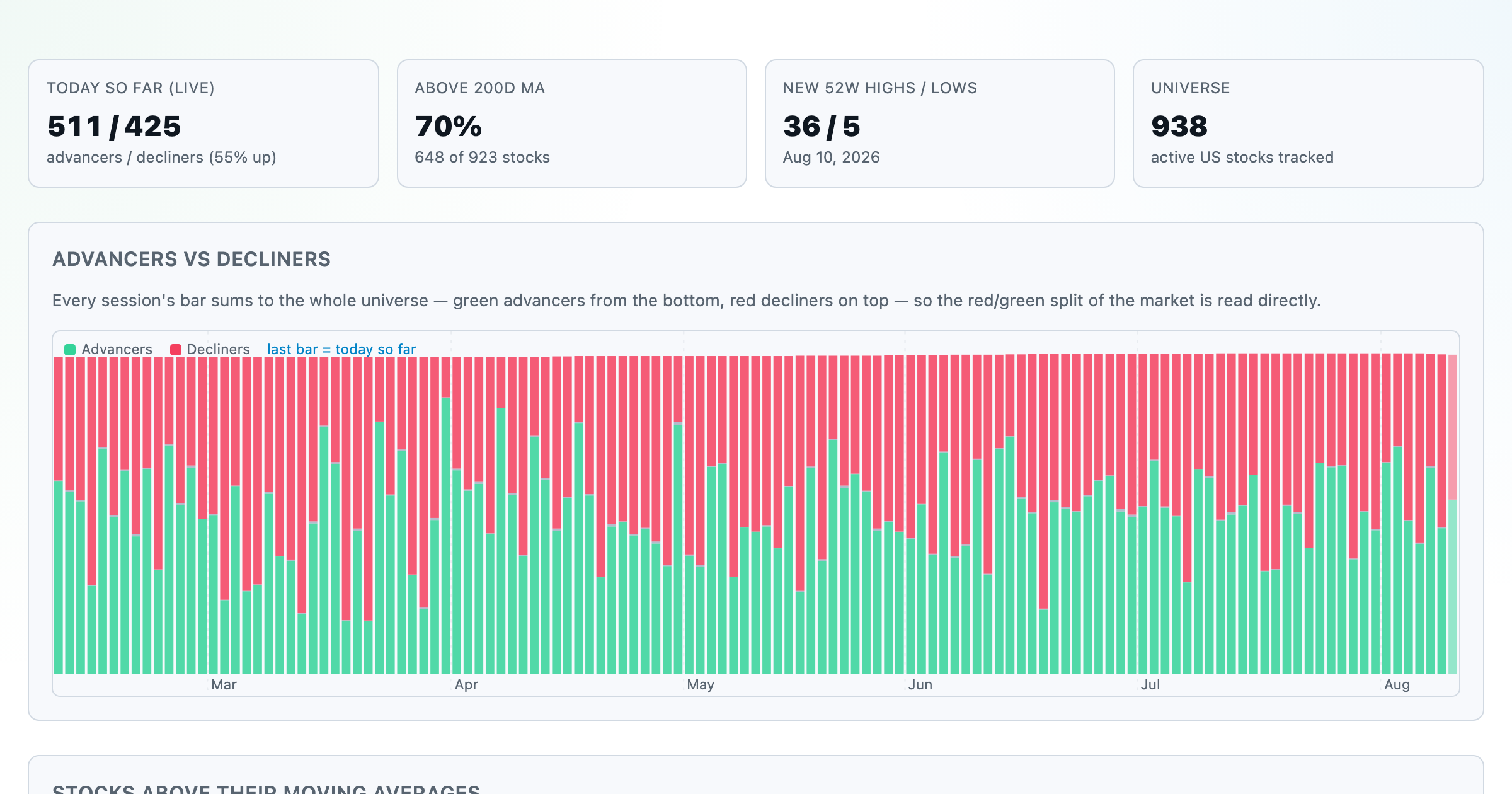
Advancers vs decliners over time, % of stocks above their moving averages, new highs vs lows, and breadth across every trailing window.
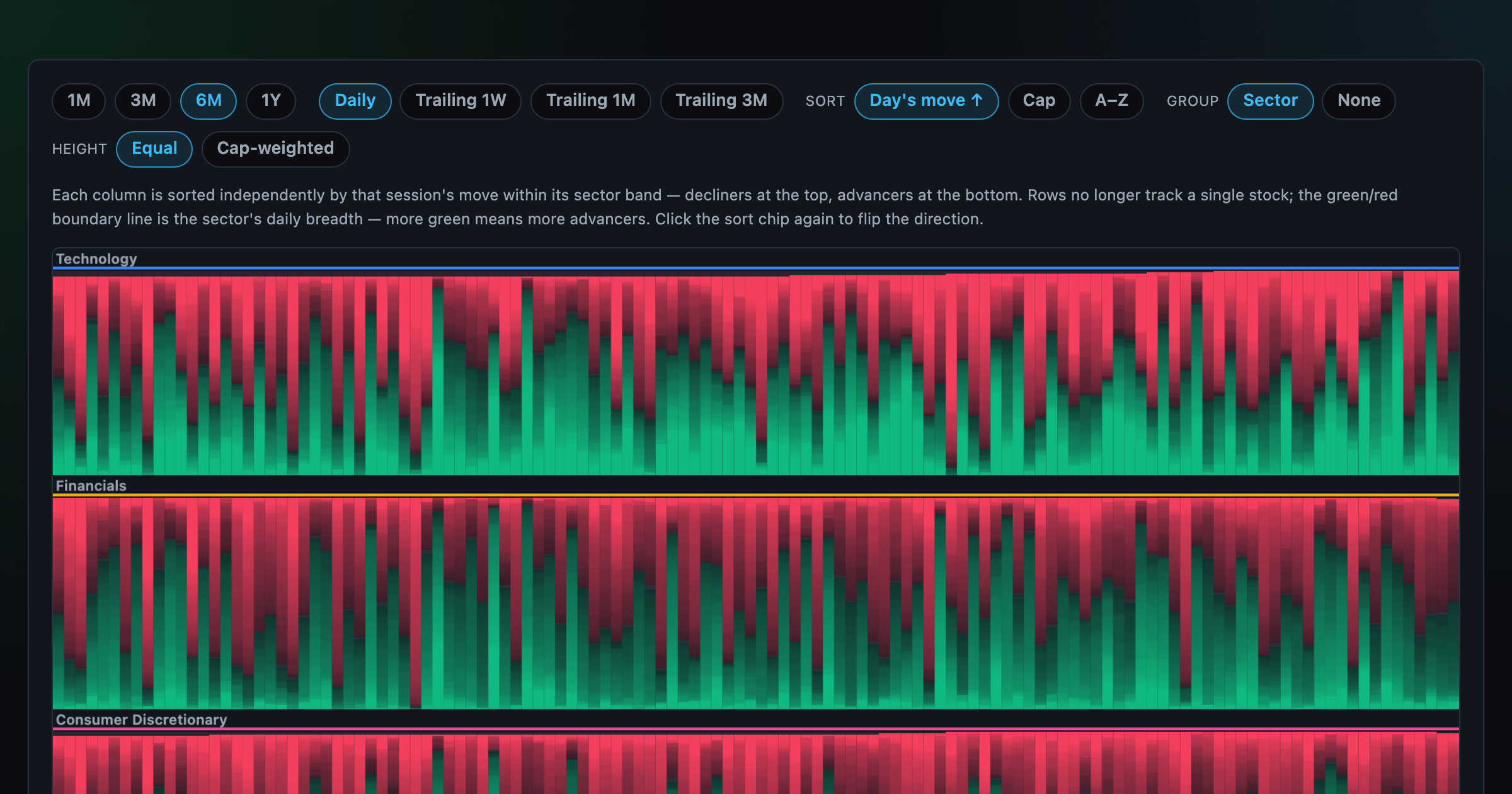
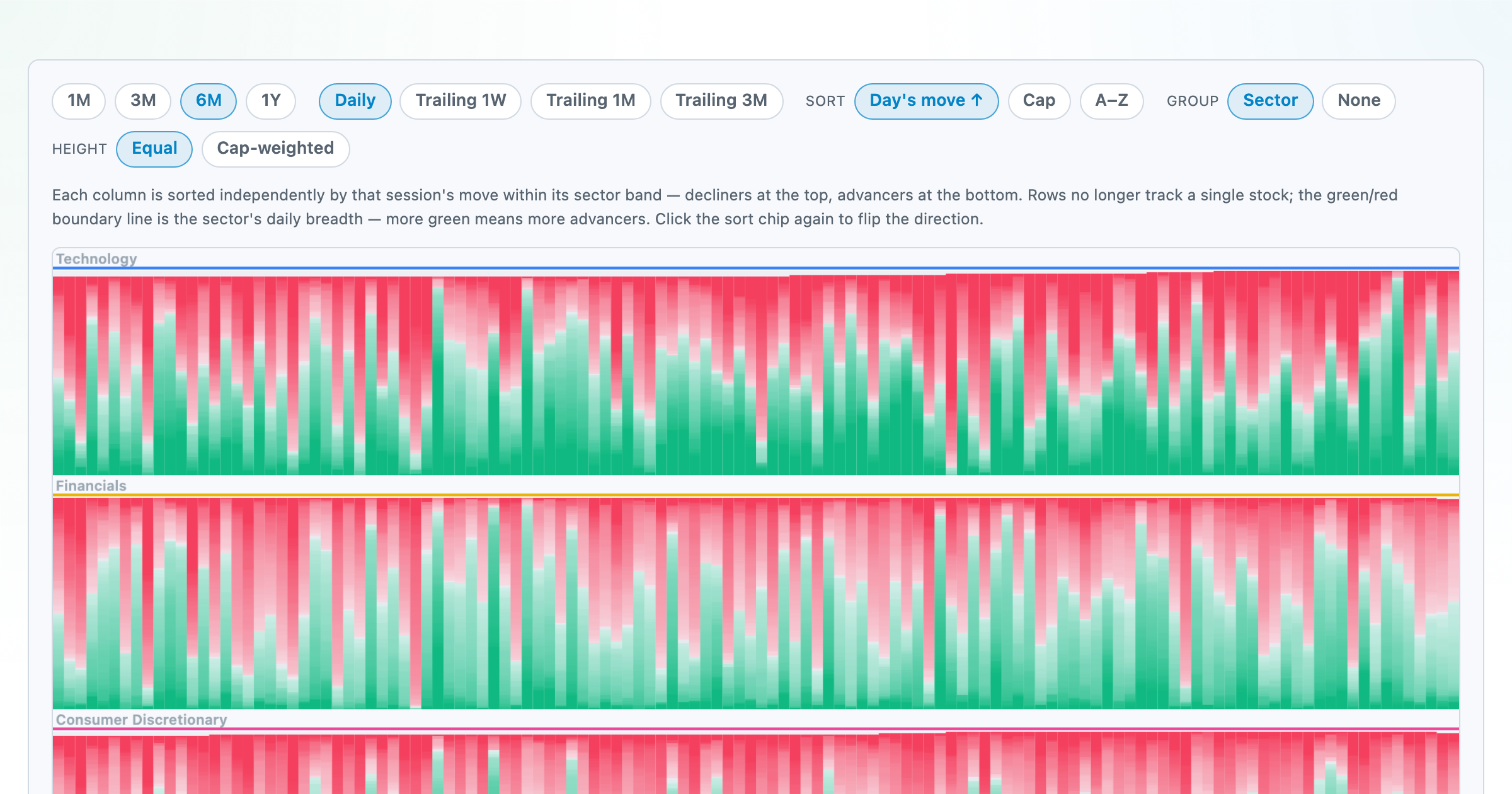
Every stock as a row, every day as a column — market selloffs are vertical stripes, sector routs are blocks.
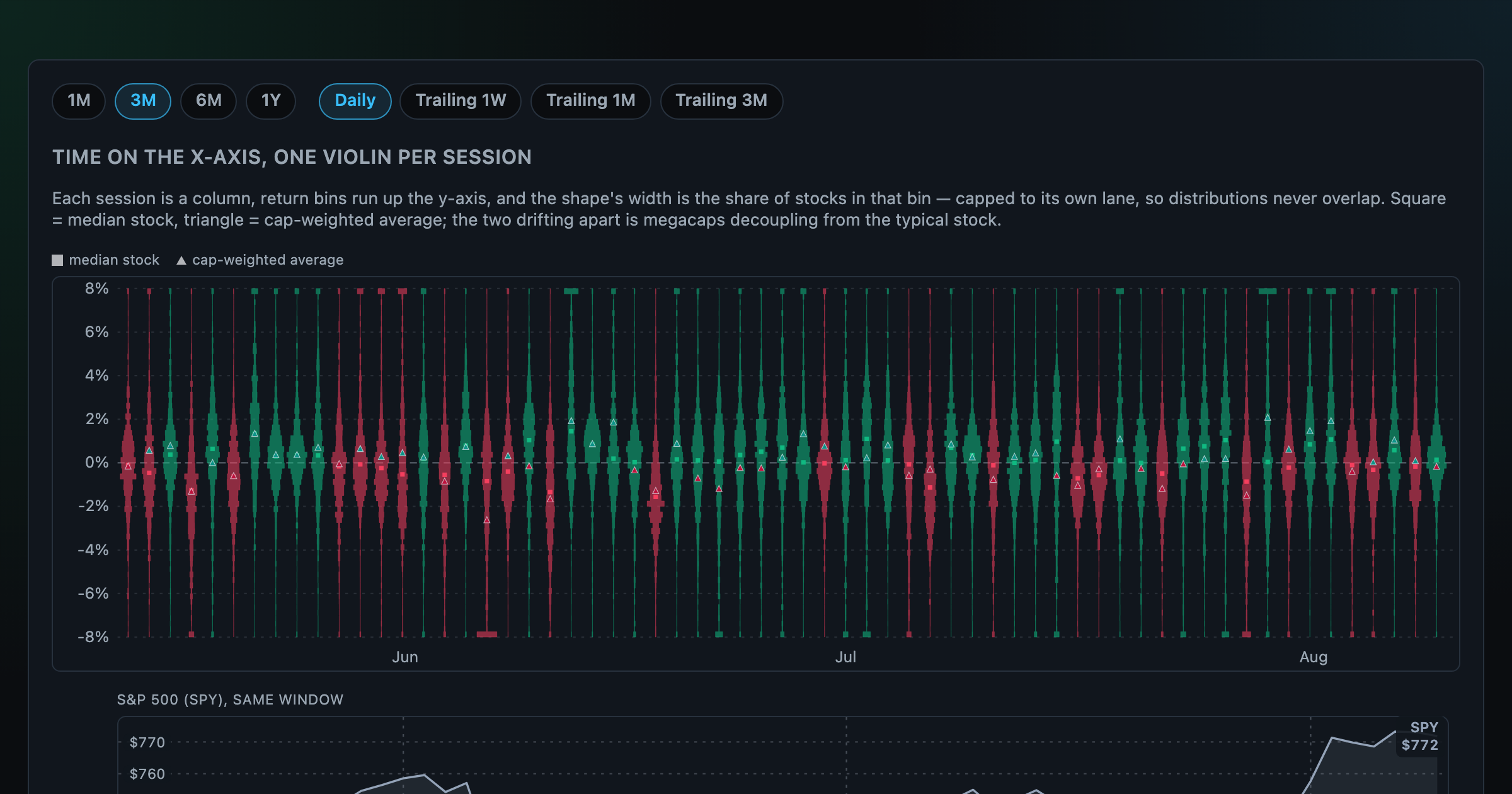
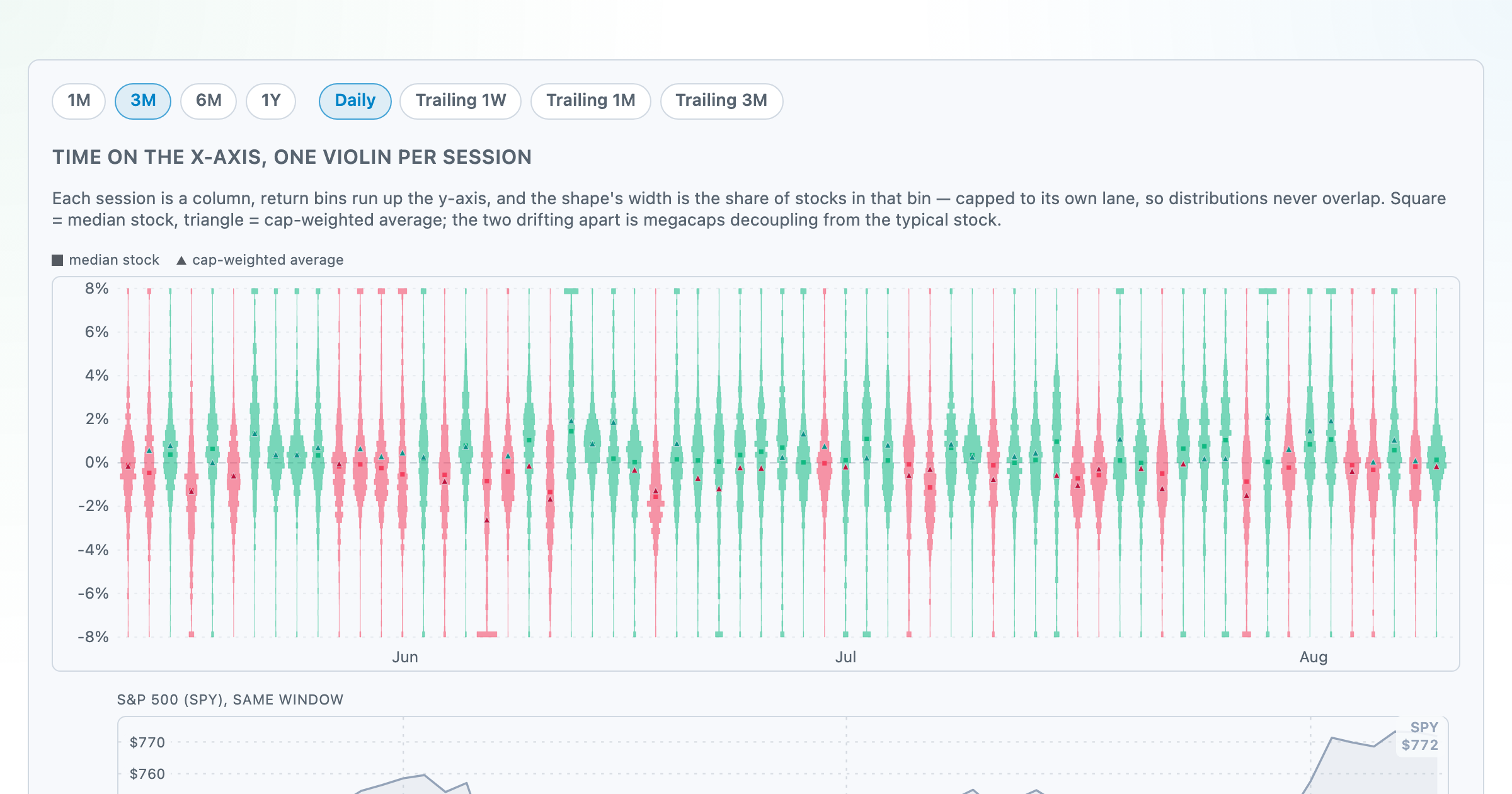
Each session's full distribution of stock returns as an upright violin, with the S&P 500 on the same axis — shifts, dispersion, and fat tails at a glance.