
Value stocks (2026)
The 50 stocks below have a combined market cap of $2.0T; the best performer of 2026 is VG (+87.2% YTD). The cheapest large caps by earnings multiple — double-checked across two data sources. Not investment advice.
End of day 2026-10-01 · 50 entries · digits update live during market hours
Lowest P/E large caps
Save as watchlist
Technical analysis0
Addendum charts0
Overlay lines0
Columns (14 shown)
| # Company | CategoryCategory | 1Y1Y chart | ||||||||||||
|---|---|---|---|---|---|---|---|---|---|---|---|---|---|---|
| RCIRogers Communication | Communication Services | $30.74 | -0.19% | -15.6% | -4.4% | -18.6% | -11.8% | -34.0% | 3.4 | 1.1 | 1.3 | 0 | $17B | |
| BCEBCE | Communication Services | $19.93 | -2.02% | -14.9% | -5.2% | -16.4% | -15.1% | -60.2% | 4.0 | 1.1 | 1.1 | 0 | $19B | |
| ALLAllstate | Financials | $224.47 | +1.18% | -13.0% | -7.7% | +7.8% | +6.5% | +75.7% | 4.3 | 0.8 | 1.7 | 0 | $57B | |
| AGNCAGNC Investment | Real Estate | $8.95 | -1.32% | -15.6% | -17.1% | -16.5% | -9.9% | -43.7% | 4.7 | 13.8 | 0.8 | 4 | $11B | |
| NLYAnnaly Capital Management | Real Estate | $18.71 | -0.98% | -17.3% | -15.8% | -16.4% | -9.4% | -44.7% | 4.8 | — | 0.8 | 43 | $14B | |
| FISFidelity National Information Services | Financials | $33.12 | +0.65% | -18.9% | -18.9% | -50.2% | -50.2% | -73.1% | 5.1 | 1.4 | 1.1 | 0 | $17B | |
| RNRRenaissanceRe Holdings | Financials | $322.98 | +1.49% | -2.1% | +1.9% | +14.9% | +25.9% | +131.4% | 5.1 | 1.2 | 1.1 | 21 | $13B | |
| TCOMTrip.com Group ADR | Consumer Discretionary | $38.76 | -0.88% | -11.6% | -5.6% | -46.1% | -48.3% | +25.0% | 5.3 | 2.8 | 1.0 | 15 | $25B | |
| GFLGFL Environmental Inc. Subordinate | Utilities | $40.43 | -3.35% | -2.6% | +8.0% | -5.9% | -13.3% | +8.0% | 5.5 | 3.2 | 2.8 | — | $15B | |
| EIXEdison International | Utilities | $53.81 | +0.14% | -8.5% | -26.8% | -10.4% | -4.4% | -2.3% | 5.5 | 1.1 | 1.2 | 2 | $21B | |
| AESAES | Utilities | $14.93 | +0.20% | +1.0% | +1.9% | +4.0% | -2.9% | -34.8% | 5.7 | 0.8 | 2.2 | 15 | $11B | |
| PAAPlains All American Pipeline | Energy | $23.72 | +0.00% | -8.4% | +6.6% | +32.0% | +39.1% | +132.1% | 6.1 | 0.3 | — | 10 | $17B | |
| AERAerCap Holdings | Consumer Discretionary | $143.99 | +0.33% | -0.2% | +1.4% | +0.1% | +17.3% | +138.1% | 6.4 | 2.8 | 1.3 | 29 | $24B | |
| SYFSynchrony Financial | Financials | $71.53 | +0.78% | -6.7% | -6.9% | -14.3% | +2.4% | +43.3% | 6.6 | 1.2 | 1.4 | 40 | $23B | |
| UHSUniversal Health Services | Healthcare | $175.07 | +0.46% | +2.5% | +16.3% | -19.7% | -14.0% | +26.1% | 6.8 | 0.6 | 1.4 | 4 | $10B | |
| ACGLArch Capital Group | Financials | $94.26 | +2.06% | -4.4% | -4.4% | -1.7% | +4.4% | +146.9% | 6.9 | 1.7 | 1.3 | 7 | $32B | |
| PBRPetroleo Brasileiro S.A. Petrobras ADS | Energy | $21.00 | +0.62% | +3.2% | +31.2% | +77.0% | +66.2% | +95.3% | 6.9 | 1.5 | 1.8 | 67 | $135B | |
| CMCSAComcast | Communication Services | $21.69 | -0.32% | -17.5% | -8.6% | -22.5% | -25.2% | -59.5% | 6.9 | 0.6 | 0.9 | 18 | $77B | |
| LULULululemon Athletica | Consumer Discretionary | $95.88 | -0.32% | -18.8% | -17.6% | -53.9% | -46.0% | -76.1% | 7.1 | 0.9 | 2.1 | 0 | $10B | |
| EXEExpand Energy | Energy | $85.97 | +2.24% | -14.0% | -4.0% | -22.1% | -21.3% | +38.5% | 7.2 | 1.5 | 1.0 | 44 | $20B | |
| EGEverest Group | Financials | $368.72 | +0.97% | -2.6% | +2.4% | +8.7% | +4.3% | +46.3% | 7.4 | 0.8 | 0.9 | 14 | $14B | |
| CINFCincinnati Financial | Financials | $162.12 | +1.73% | -4.8% | -13.4% | -0.7% | +1.5% | +41.3% | 7.5 | 1.8 | 1.5 | 11 | $25B | |
| PUKPrudential Public | Financials | $24.69 | -0.20% | -8.8% | -10.8% | -20.6% | -12.1% | -37.7% | 7.6 | 2.7 | 1.6 | 0 | $31B | |
| TAT&T | Communication Services | $24.32 | -0.33% | -6.5% | +18.7% | -2.2% | -11.8% | +18.5% | 7.7 | 1.3 | 1.3 | 28 | $167B | |
| PDDPDD Holdings ADR | Consumer Discretionary | $76.46 | -1.90% | -8.0% | -7.3% | -32.5% | -43.1% | -13.2% | 7.8 | 1.8 | 1.8 | 0 | $109B | |
| HIGHartford Insurance Group | Financials | $125.80 | +2.81% | -8.3% | -6.1% | -8.8% | -5.4% | +77.1% | 7.8 | 1.2 | 1.7 | 4 | $34B | |
| ALLYAlly Financial | Financials | $37.65 | +0.08% | -10.0% | -18.3% | -16.9% | -2.8% | -27.5% | 7.9 | 1.3 | 0.7 | 34 | $11B | |
| OXYOccidental Petroleum | Energy | $57.84 | +4.55% | -5.1% | +20.7% | +40.7% | +21.2% | +85.7% | 7.9 | 2.8 | 1.4 | 19 | $58B | |
| MKCMcCormick | Consumer Staples | $44.15 | -4.85% | -18.7% | -16.6% | -35.2% | -34.9% | -45.3% | 8.0 | 1.5 | 1.7 | 1 | $12B | |
| HONHoneywell International | Industrials | $213.79 | +1.35% | +1.8% | -3.6% | +9.6% | +7.9% | +5.2% | 8.3 | 1.8 | 3.7 | 11 | $68B | |
| CFCF Industries Holdings | Materials | $114.53 | -0.58% | -15.5% | +5.9% | +48.1% | +32.5% | +87.3% | 8.3 | 2.2 | 3.0 | 18 | $17B | |
| ZMZoom Communications | Technology | $93.82 | +3.36% | -1.2% | +4.1% | +8.7% | +15.4% | -64.9% | 8.4 | 5.5 | 2.4 | 1 | $27B | |
| VGVenture Global | Utilities | $12.77 | +1.03% | -15.5% | +15.8% | +87.2% | -13.2% | — | 8.4 | 1.9 | 3.7 | — | $32B | |
| PCGPacific Gas & Electric | Utilities | $12.18 | -0.61% | -13.4% | -26.6% | -24.3% | -22.3% | +26.6% | 8.5 | 1.0 | 0.8 | 2 | $27B | |
| BCSBarclays | Financials | $23.64 | -2.60% | -9.6% | -13.3% | -7.1% | +14.8% | +126.7% | 8.6 | 5.6 | 0.8 | 52 | $82B | |
| FISVFiserv | Consumer Discretionary | $45.43 | +0.55% | -12.2% | -10.5% | -32.4% | -64.0% | -58.7% | 8.6 | 1.1 | 0.9 | 1 | $24B | |
| BBDBanco Bradesco ADR | Financials | $3.51 | -0.28% | +5.7% | +0.9% | +5.4% | +8.3% | -12.0% | 8.7 | 1.0 | 1.1 | 49 | $37B | |
| AAAlcoa | Industrials | $42.06 | +0.14% | -17.4% | -11.4% | -20.9% | +24.3% | -15.5% | 8.7 | 0.8 | 1.5 | 14 | $11B | |
| GFIGold Fields ADR | Materials | $35.77 | -0.97% | -19.9% | +6.1% | -18.0% | -14.3% | +337.5% | 8.8 | 3.7 | 3.8 | 4 | $32B | |
| VICIVICI Properties | Real Estate | $22.74 | -1.00% | -11.0% | -13.5% | -19.2% | -30.9% | -22.0% | 9.1 | 6.1 | 0.9 | 0 | $25B | |
| APAAPA | Energy | $43.34 | +4.33% | -2.2% | +36.0% | +77.2% | +72.9% | +98.8% | 9.1 | 3.5 | 2.2 | 64 | $15B | |
| TMToyota Motor | Industrials | $183.35 | +0.13% | -7.4% | +8.1% | -14.4% | -4.4% | +3.2% | 9.1 | 0.7 | 1.0 | 83 | $239B | |
| TRVTravelers Companies | Financials | $361.67 | +1.45% | -0.6% | +8.1% | +24.7% | +30.4% | +137.3% | 9.1 | 1.5 | 2.3 | 3 | $75B | |
| PYPLPayPal Holdings | Financials | $53.07 | +1.03% | +1.3% | +20.4% | -9.1% | -20.4% | -80.0% | 9.3 | 1.3 | 2.3 | 5 | $45B | |
| NWGNatWest Group ADR | Financials | $17.39 | -4.19% | -5.1% | -3.3% | -0.6% | +22.0% | +164.3% | 9.3 | 1.8 | 1.2 | 63 | $72B | |
| MKLMarkel Group | Financials | $1,725.25 | +0.75% | -4.0% | -9.9% | -19.7% | -8.5% | +43.6% | 9.4 | 1.4 | 1.1 | 22 | $21B | |
| SUISun Communities | Real Estate | $110.00 | -0.70% | -9.4% | -8.9% | -11.2% | -14.4% | -41.1% | 9.4 | 5.8 | 2.0 | 0 | $14B | |
| LTMLATAM Airlines Group ADR | Consumer Discretionary | $47.75 | -4.29% | -3.1% | -16.1% | -11.6% | +8.5% | — | 9.4 | 1.0 | 10.2 | — | $14B | |
| BBarrick Mining | Materials | $40.05 | -1.54% | -7.0% | +10.0% | -7.9% | +19.0% | +122.9% | 9.4 | 4.0 | 2.5 | 40 | $67B | |
| ECEcopetrol ADR | Energy | $16.27 | -1.27% | -6.8% | +12.6% | +62.4% | +76.7% | +11.2% | 9.4 | 1.1 | 1.6 | 64 | $33B |
Methodology
The cheapest large caps by trailing earnings multiple, cross-checked across two sources so a single bad data point cannot put a company on the list. The P/E percentile column is the more useful one: it says where today's multiple sits in that company's OWN ten-year range, which distinguishes a cheap stock from a structurally low-multiple industry.
Performance columns are price returns: the change in the split-adjusted share price, the way quote screens report it, through the latest print during the session. Dividends are not reinvested. Fundamentals come from company filings via our EDGAR pipeline. Past performance does not predict future returns; this is not investment advice.
FAQ#
- What is the cheapest large-cap stock by P/E?
- Rogers Communication Inc. (RCI) is currently the cheapest US large cap by trailing P/E, at about 3.4× earnings.
- Is a low P/E stock always a good buy?
- A low P/E is a starting point, not a verdict: it can mean an undervalued business or one whose earnings are about to shrink (a "value trap"). Check earnings direction, debt and the sector context — cyclicals at peak earnings often look cheapest right before profits fall.
More lists
Highest realized shareholder yield
50 stocksShares actually retired plus dividends — the cash-over-market-cap version flatters fallen stocks.
Highest fundamental return
50 stocksEarnings growth plus cash returned — the annual return the business made, before any re-rating.
Highest realized buyback yield
50 stocksShares actually retired over the past year — the buyback measure a collapsed stock price can't flatter.
Highest dividend stocks
50 stocksThe 50 highest dividend yields among US-listed large caps, each one checked against dividends actually paid in the past year.
Dividend growth stocks
50 stocksLarge caps that have raised the dividend every year for 10 or more years, ranked by how fast the payment has grown over five years.
25+ years of dividend increases
Every US-listed large cap that has raised its dividend for 25 or more consecutive years in our record, longest streak first.
Explore visualizations
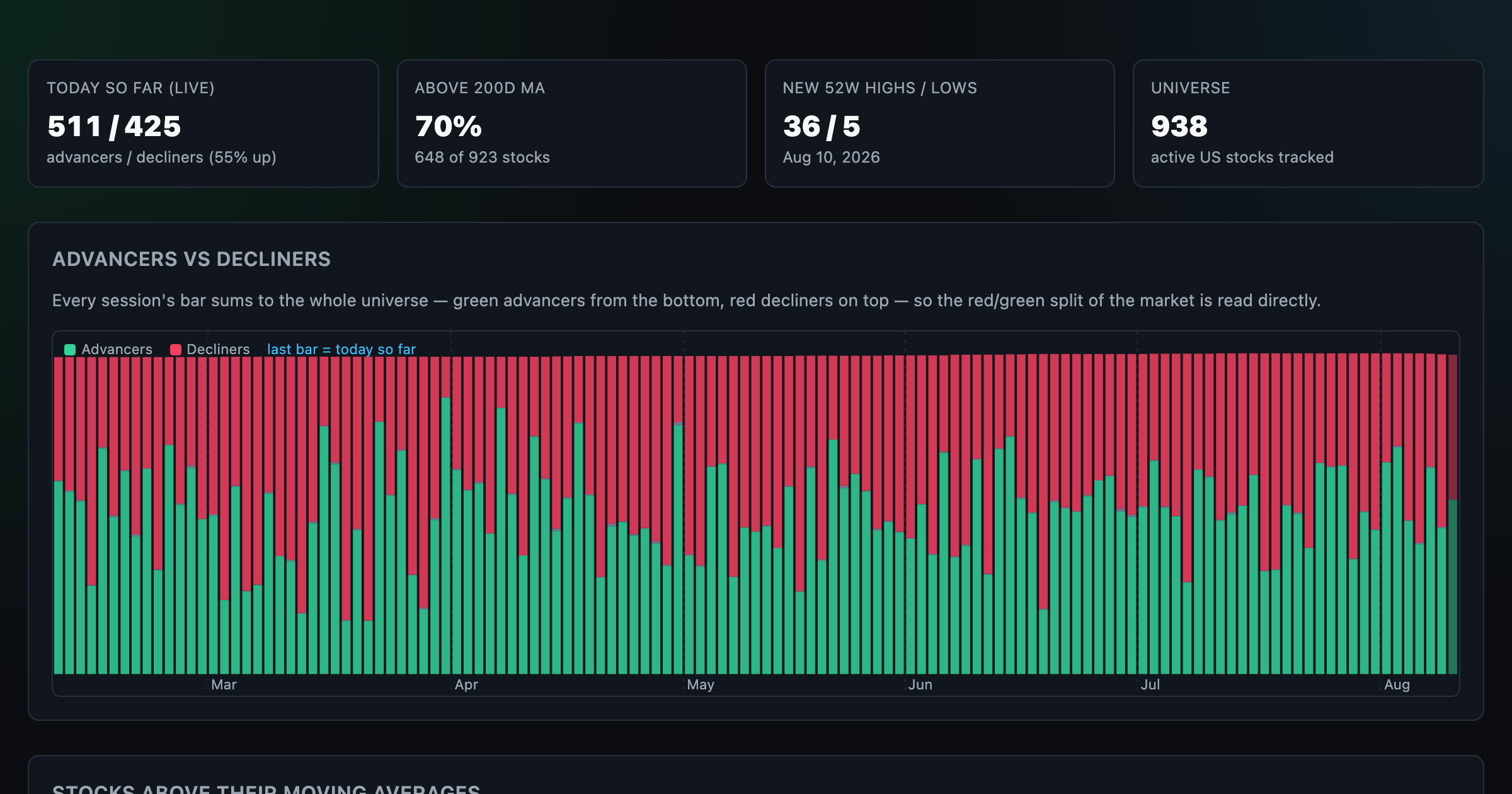
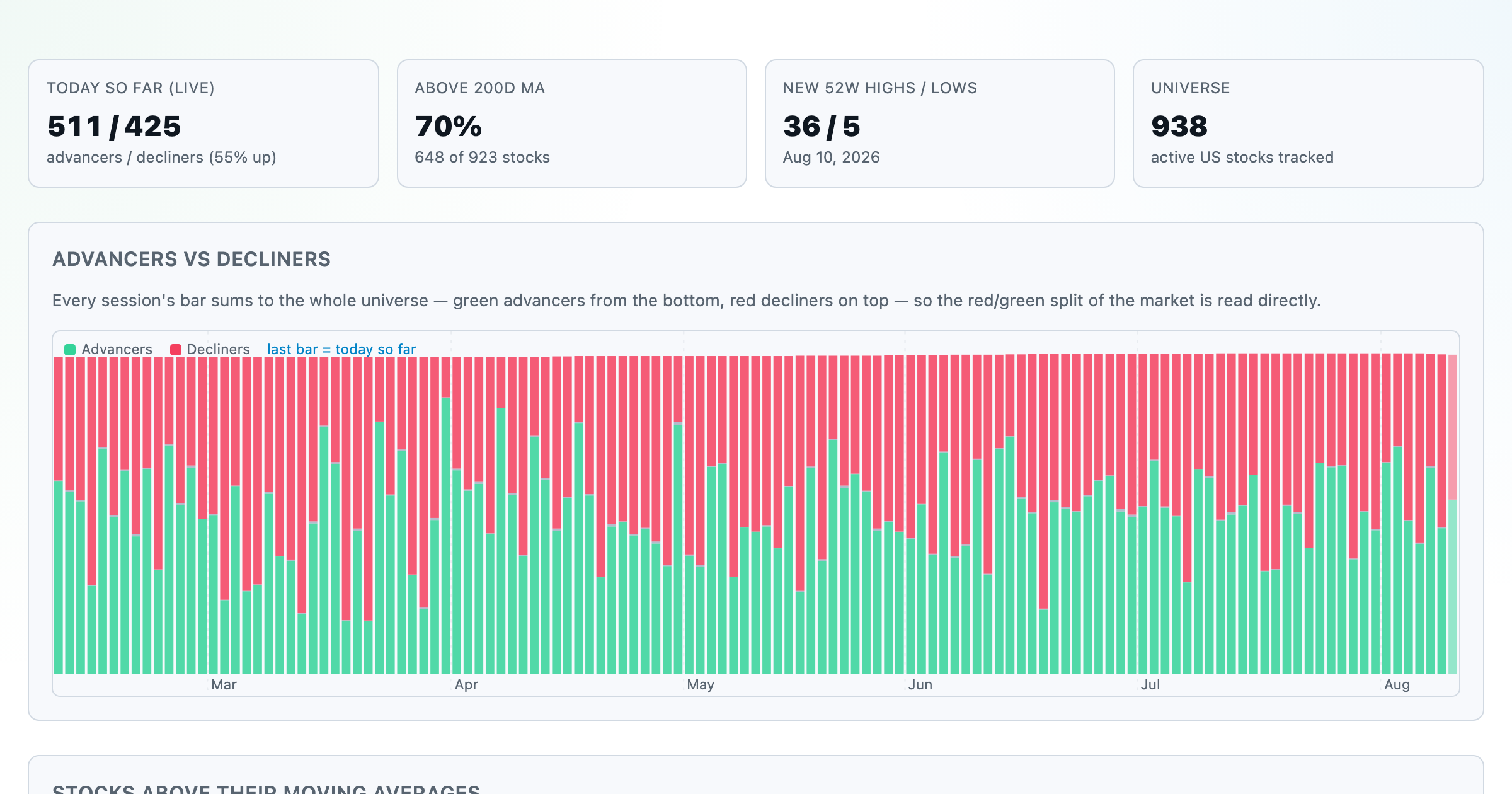
Advancers vs decliners over time, % of stocks above their moving averages, new highs vs lows, and breadth across every trailing window.
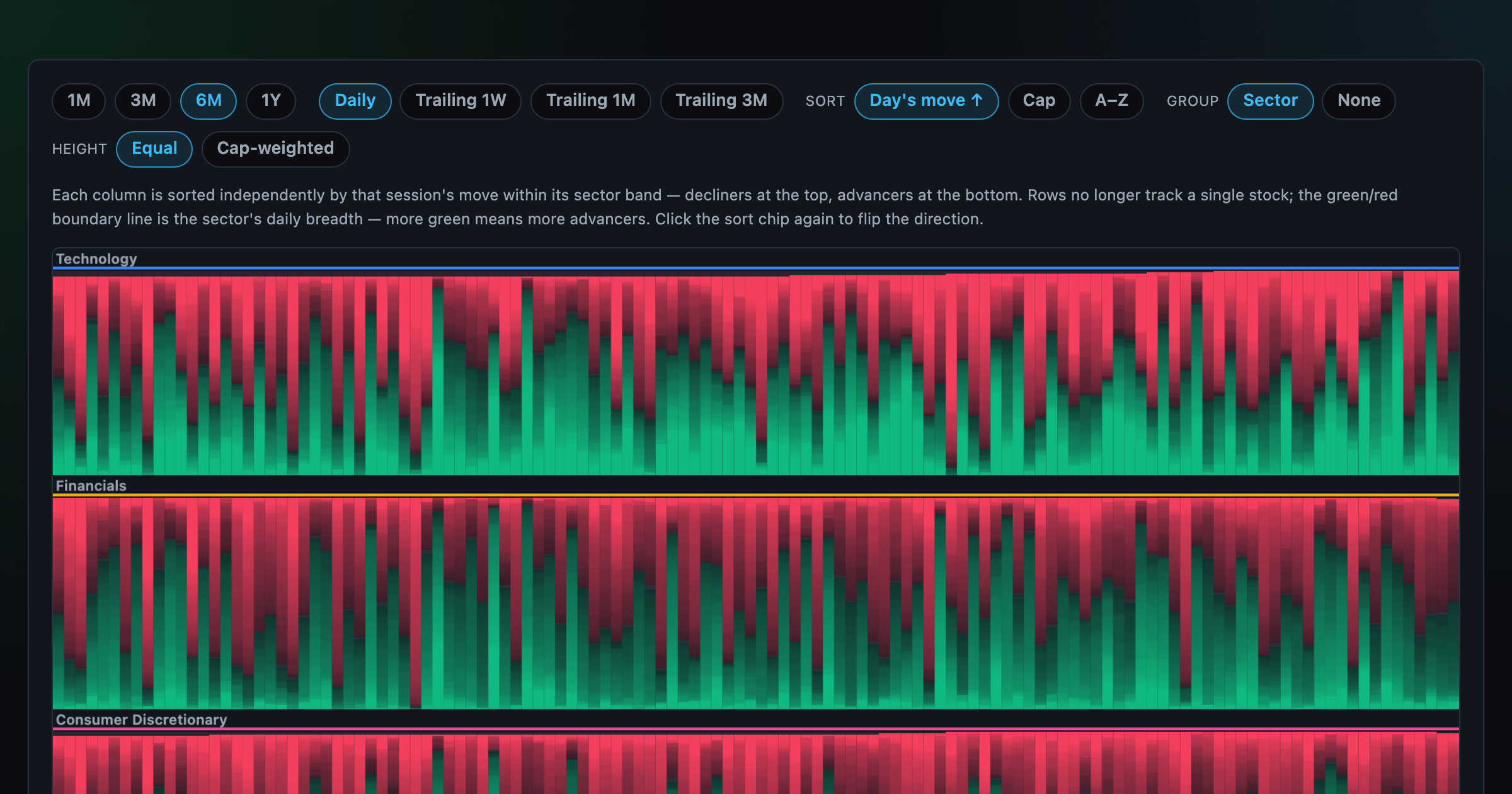
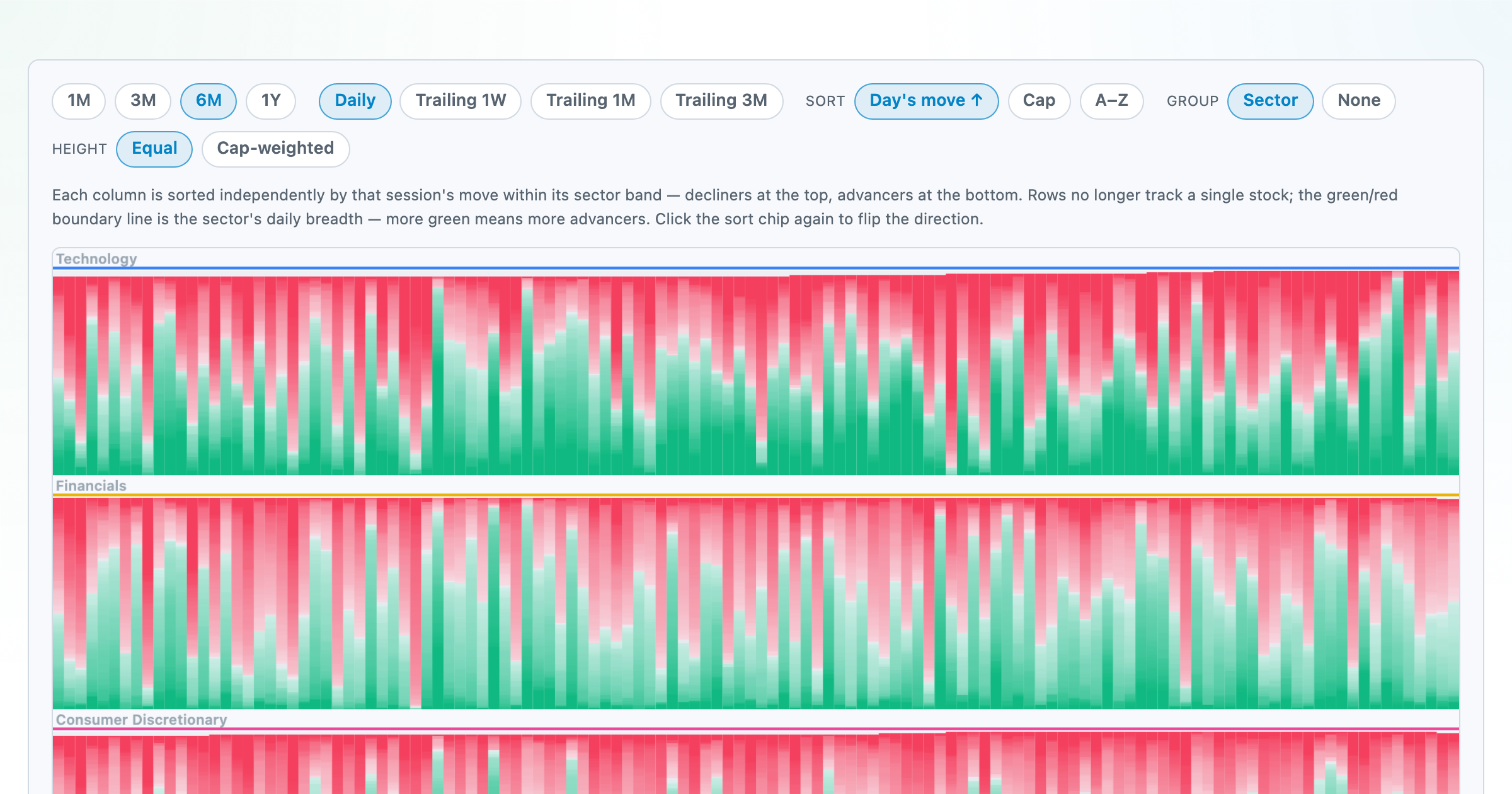
Every stock as a row, every day as a column — market selloffs are vertical stripes, sector routs are blocks.
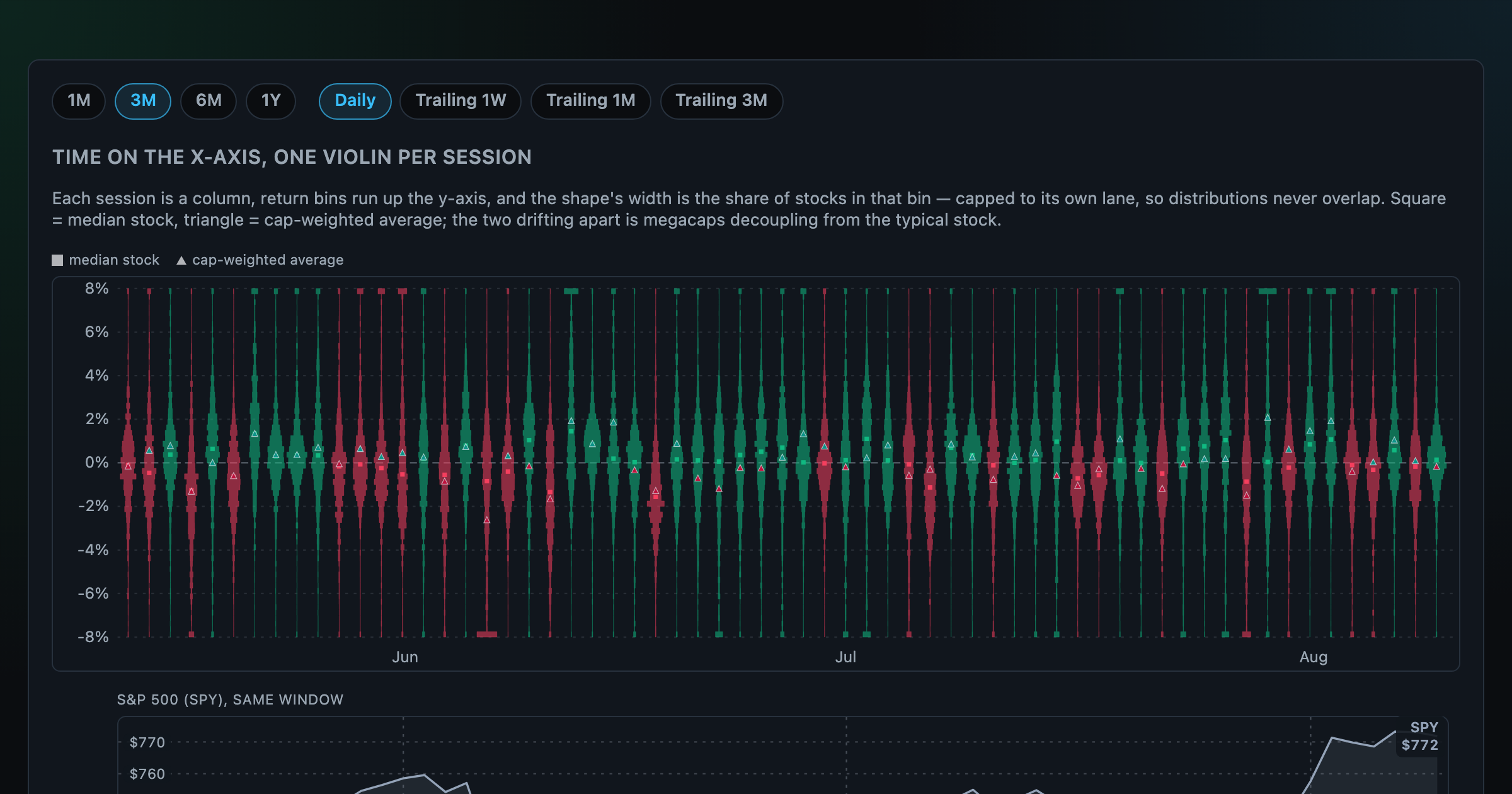
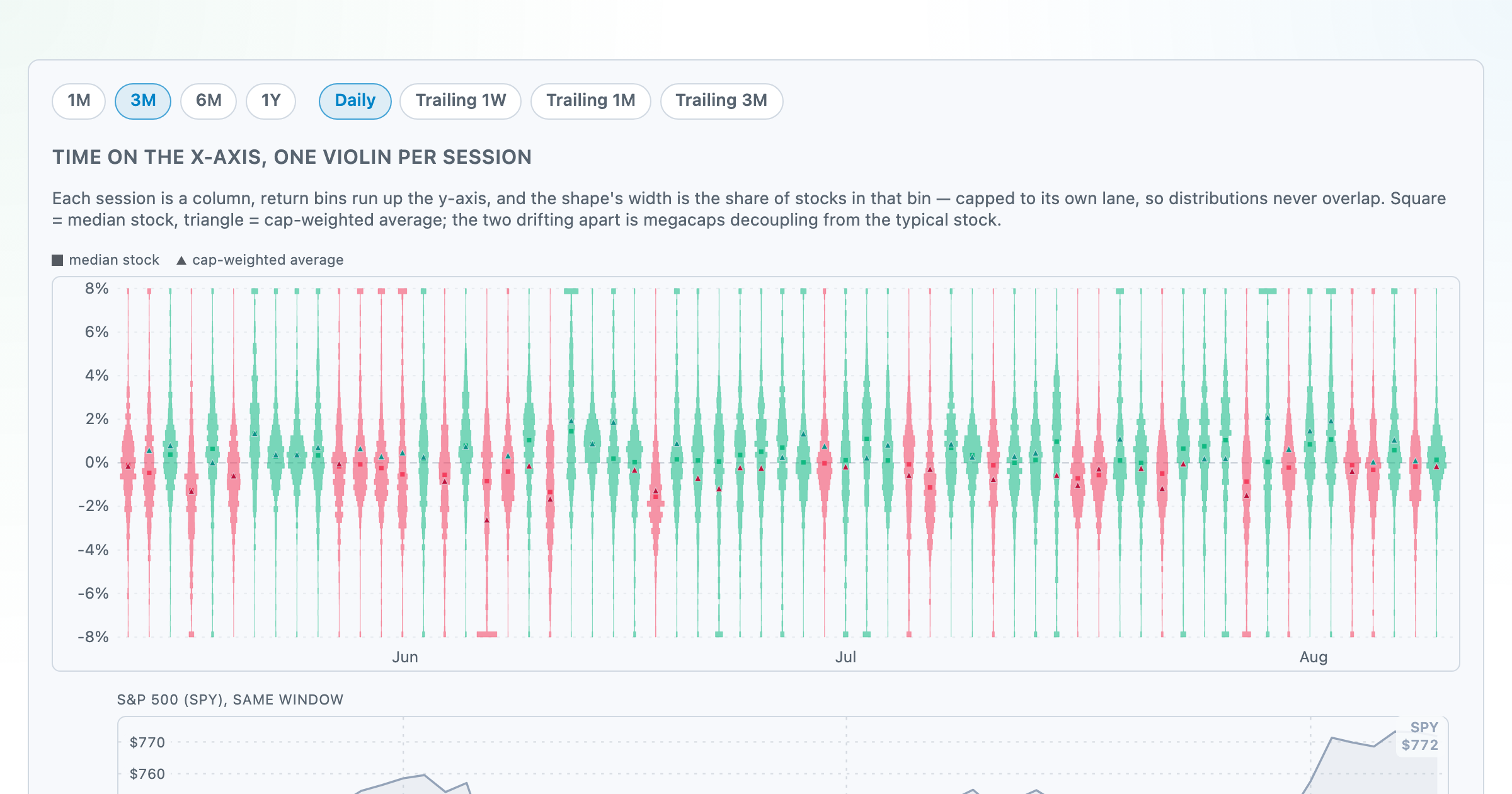
Each session's full distribution of stock returns as an upright violin, with the S&P 500 on the same axis — shifts, dispersion, and fat tails at a glance.