
AI stocks (2026)
The 36 stocks below have a combined market cap of $31.0T; the best performer of 2026 is SNDK (+653.1% YTD). The AI build-out, measured — chips to power plants, one table. Not investment advice.
End of day 2026-10-01 · 36 entries · digits update live during market hours
AI stock performance
Save as watchlist
Technical analysis0
Addendum charts0
Overlay lines0
Columns (12 shown)
| # Company | CategoryCategory | 1Y1Y chart | ||||||||||
|---|---|---|---|---|---|---|---|---|---|---|---|---|
| SNDKSandisk | Memory & storage | $1,786.91 | +2.70% | +16.3% | -12.0% | +653.1% | +1376.0% | — | 22.9 | +171.0% | $262B | |
| DELLDell Technologies | Hardware infra | $541.70 | +0.70% | +27.5% | +27.4% | +330.4% | +261.9% | +910.4% | 30.3 | +49.2% | $344B | |
| MUMicron Technology | Memory & storage | $1,097.68 | +3.06% | +17.6% | +6.3% | +284.5% | +502.5% | +1445.8% | 24.6 | +167.9% | $1.24T | |
| STXSeagate Technology Holdings | Memory & storage | $945.47 | +2.51% | +15.8% | +3.3% | +243.4% | +268.2% | +1020.2% | 67.3 | +33.4% | $214B | |
| INTCIntel | Chips | $120.01 | -0.18% | +34.9% | -5.5% | +225.2% | +233.9% | +122.8% | — | +7.5% | $605B | |
| MRVLMarvell Technology | Chips | $268.07 | +1.46% | +27.4% | -1.5% | +215.5% | +219.6% | +348.1% | 89.0 | +30.7% | $235B | |
| AMDAdvanced Micro Devices | Chips | $615.64 | +0.63% | +34.0% | +13.8% | +187.5% | +275.4% | +501.0% | 156 | +39.7% | $1.01T | |
| HPEHewlett Packard Enterprise | Hardware infra | $64.62 | +1.13% | +27.0% | +46.9% | +168.9% | +159.0% | +341.7% | 30.7 | +26.6% | $86B | |
| WDCWestern Digital | Memory & storage | $462.38 | +1.74% | +2.7% | -22.7% | +168.5% | +254.2% | +971.9% | 17.7 | +35.1% | $167B | |
| ARMArm Holdings | Chips | $292.34 | +0.93% | +24.5% | -13.4% | +167.4% | +94.4% | — | 344 | +22.8% | $311B | |
| AMATApplied Materials | Semi supply chain | $529.27 | +3.50% | +19.8% | -18.7% | +106.0% | +143.1% | +309.9% | 45.3 | +7.8% | $420B | |
| LRCXLam Research | Semi supply chain | $339.80 | +3.44% | +17.2% | -13.1% | +98.7% | +138.2% | +496.9% | 58.5 | +26.1% | $425B | |
| SOXXiShares Semiconductor ETF | AI & semi ETFs | $576.38 | +1.36% | +15.2% | -3.9% | +91.4% | +108.6% | +287.5% | — | — | $48B | |
| SMHVanEck Semiconductor ETF | AI & semi ETFs | $617.97 | +1.47% | +13.3% | -0.4% | +71.6% | +85.1% | +381.7% | — | — | $77B | |
| ASMLASML Holding | Semi supply chain | $1,808.72 | -0.16% | +8.6% | -1.9% | +69.0% | +80.3% | +143.8% | 64.1 | +20.9% | $697B | |
| KLACKLA | Semi supply chain | $200.28 | +2.74% | +17.2% | -24.7% | +64.9% | +77.5% | +498.0% | 54.2 | +11.7% | $262B | |
| ANETArista Networks | Networking | $204.47 | +0.43% | +8.0% | +22.7% | +56.1% | +37.0% | +833.5% | 63.8 | +32.6% | $258B | |
| VRTVertiv Holdings | Hardware infra | $246.14 | +2.00% | -3.8% | -21.0% | +51.9% | +52.3% | +902.9% | 54.7 | +26.3% | $95B | |
| TSMTaiwan Semiconductor Manufacturing | Semi supply chain | $459.27 | +0.68% | +10.9% | +3.4% | +51.1% | +59.2% | +311.6% | 44.1 | +37.6% | $2.38T | |
| GEVGE Vernova | Energy | $987.45 | +3.89% | +9.9% | -13.0% | +51.1% | +62.9% | — | 27.6 | +13.0% | $263B | |
| SMCISuper Micro Computer | Hardware infra | $41.92 | +2.07% | +14.2% | +51.6% | +43.2% | -20.0% | +1022.4% | 12.3 | +77.9% | $28B | |
| CSCOCisco Systems | Networking | $108.74 | +1.03% | -0.9% | -7.1% | +41.2% | +58.2% | +97.2% | 32.3 | +11.8% | $429B | |
| ETNEaton | Hardware infra | $437.46 | +1.80% | +11.9% | +6.1% | +37.3% | +17.0% | +190.3% | 44.4 | +15.5% | $170B | |
| NVDANVIDIA | Chips | $230.97 | +1.13% | +6.2% | +16.8% | +23.8% | +23.3% | +1013.0% | 28.9 | +83.8% | $5.57T | |
| CRWVCoreWeave | Neoclouds | $88.57 | +1.66% | +8.2% | +3.4% | +23.7% | -35.4% | — | — | +115.4% | $49B | |
| METAMeta Platforms | Hyperscalers | $725.70 | +0.07% | +25.5% | +18.4% | +10.0% | +1.2% | +111.6% | 27.1 | +27.7% | $1.85T | |
| GOOGLAlphabet | Hyperscalers | $338.26 | -1.69% | +1.0% | -6.4% | +8.1% | +38.1% | +147.7% | 16.9 | +20.1% | $4.14T | |
| AMZNAmazon.com | Hyperscalers | $248.33 | -0.33% | -2.6% | +2.7% | +7.5% | +12.5% | +51.2% | 19.8 | +15.8% | $2.68T | |
| PLTRPalantir Technologies | AI software | $190.01 | +1.58% | +5.6% | +51.1% | +6.9% | +2.8% | +681.1% | 151 | +79.0% | $457B | |
| QCOMQUALCOMM | Chips | $181.96 | -1.13% | +9.3% | +0.1% | +6.5% | +9.4% | +41.5% | 20.6 | +1.9% | $191B | |
| MSFTMicrosoft | Hyperscalers | $513.11 | +0.04% | +2.4% | +33.4% | +6.0% | -1.3% | +77.4% | 28.5 | +17.8% | $3.81T | |
| AVGOBroadcom | Chips | $343.80 | -2.10% | -7.0% | -7.0% | -0.7% | +3.1% | +605.1% | 42.9 | +48.9% | $1.64T | |
| BOTZGlobal X Robotics & Artificial Intelligence ETF | AI & semi ETFs | $35.39 | +0.45% | +0.8% | -6.9% | -2.2% | -0.8% | -1.9% | — | — | $4B | |
| VSTVistra | Energy | $139.81 | +1.06% | +1.2% | -8.8% | -13.4% | -30.6% | +729.4% | 21.1 | +18.6% | $47B | |
| CEGConstellation Energy | Energy | $258.92 | +1.93% | -7.6% | +9.5% | -26.7% | -26.2% | — | 26.5 | +26.0% | $92B | |
| ORCLOracle | Hyperscalers | $138.08 | +0.57% | -2.3% | -3.1% | -29.2% | -52.2% | +53.9% | 22.1 | +21.6% | $418B |
Methodology
The AI build-out end to end: chip designers and the foundry/equipment chain, the hyperscalers buying the chips, the networking and power companies the data centres depend on, and the software layered on top. Curated rather than screened, because no GICS sector describes it — which is why utilities appear here and Alphabet appears here but not on the tech list. Returns are total returns.
Performance columns are price returns: the change in the split-adjusted share price, the way quote screens report it, through the latest print during the session. Dividends are not reinvested. Fundamentals come from company filings via our EDGAR pipeline. Past performance does not predict future returns; this is not investment advice.
FAQ#
- What is the largest AI stock?
- NVIDIA Corporation (NVDA) is the largest AI stock, with a market cap of about $5.6 trillion.
- What is the best-performing AI stock of 2026?
- Among the 36 AI stocks tracked here, the best performer of 2026 so far is Sandisk Corporation (SNDK), up +653.1% year-to-date.
- Which companies count as AI stocks?
- This list tracks 36 companies across the AI build-out: chip designers (NVDA, AMD, AVGO), memory and storage (MU, SNDK), the semiconductor supply chain (TSM, ASML), networking, hyperscaler clouds, GPU "neoclouds", datacenter energy, and hardware infrastructure — deliberately excluding application-software companies whose AI exposure is marketing more than revenue.
More lists
Magnificent 7
7 stocksThe seven megacaps that drive the market — Apple, Microsoft, Alphabet, Amazon, Nvidia, Meta, Tesla.
Dow Jones stocks
30 stocksAll 30 members of the Dow Jones Industrial Average, with returns and valuations.
Semiconductor stocks
23 stocksThe chip industry end to end — designers, the foundry and equipment chain, memory, analog.
Energy stocks
The complete S&P 500 energy sector, yields included.
Tech stocks
All 71 S&P 500 tech stocks, from semis to software.
Top performing stocks
50 stocksThis year's 50 biggest large-cap winners. No penny-stock noise.
Explore visualizations
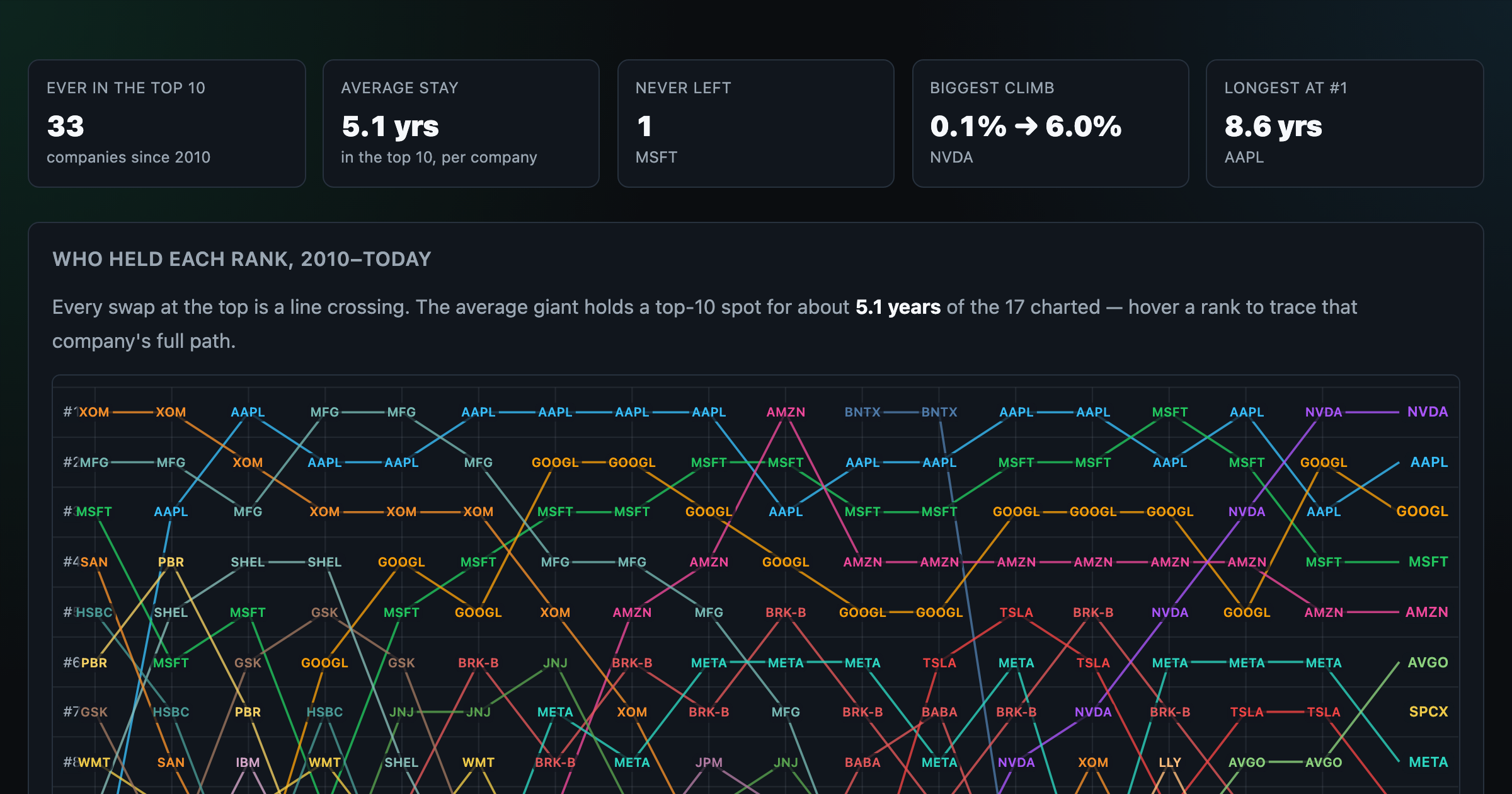
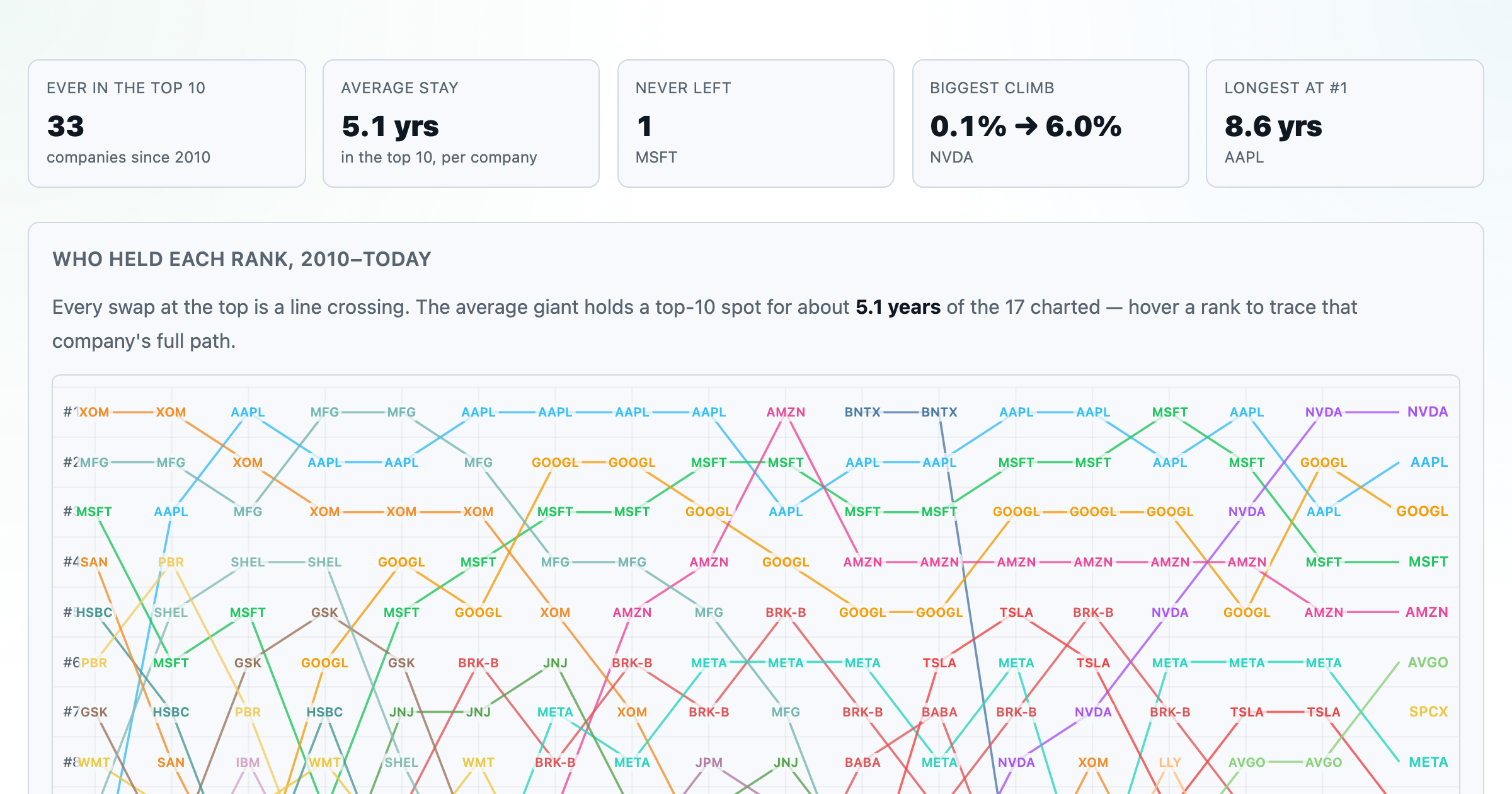
Every company that ever cracked the market's top 10 since 2010 — who climbed, who faded, who never left.
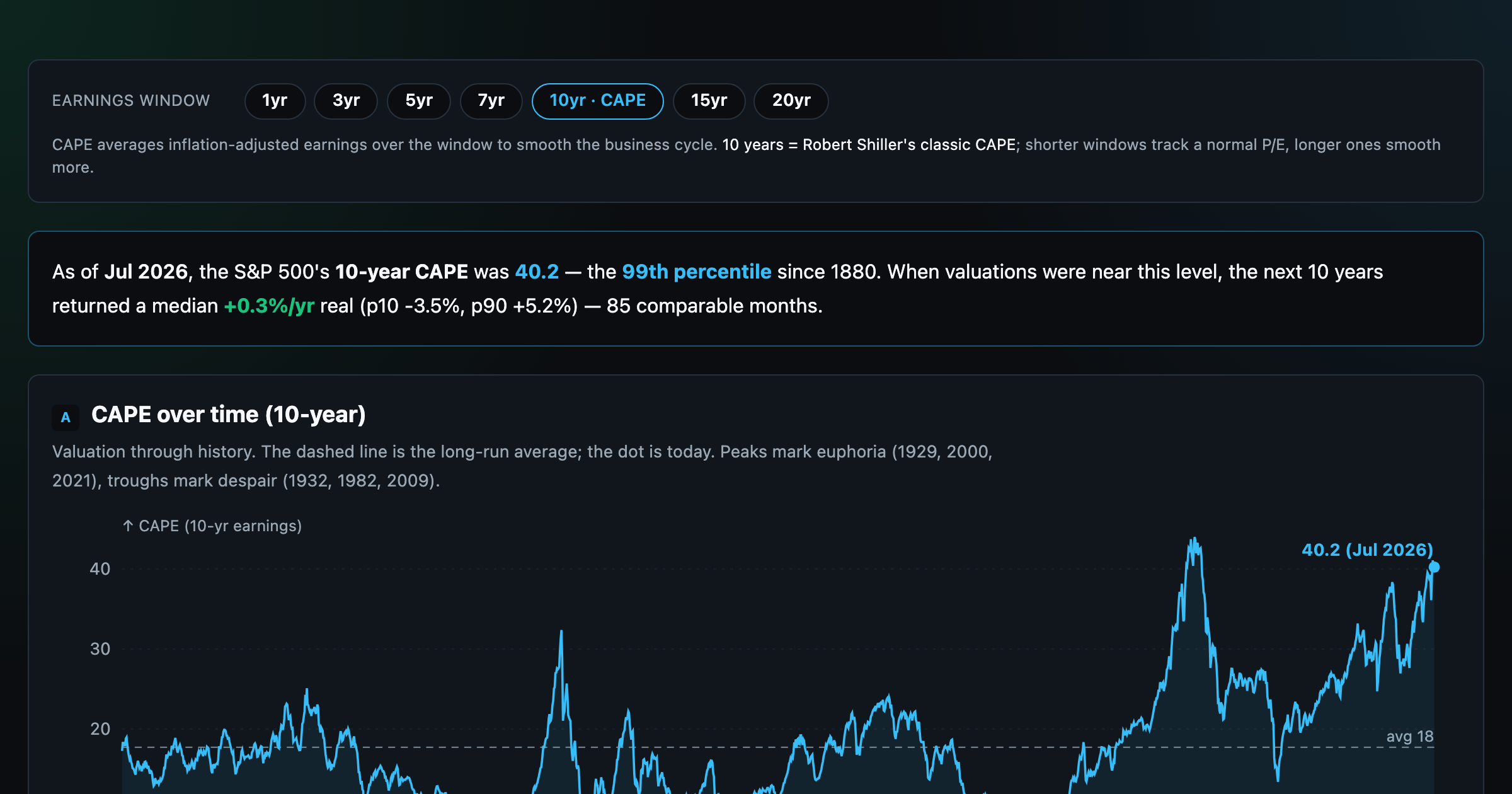
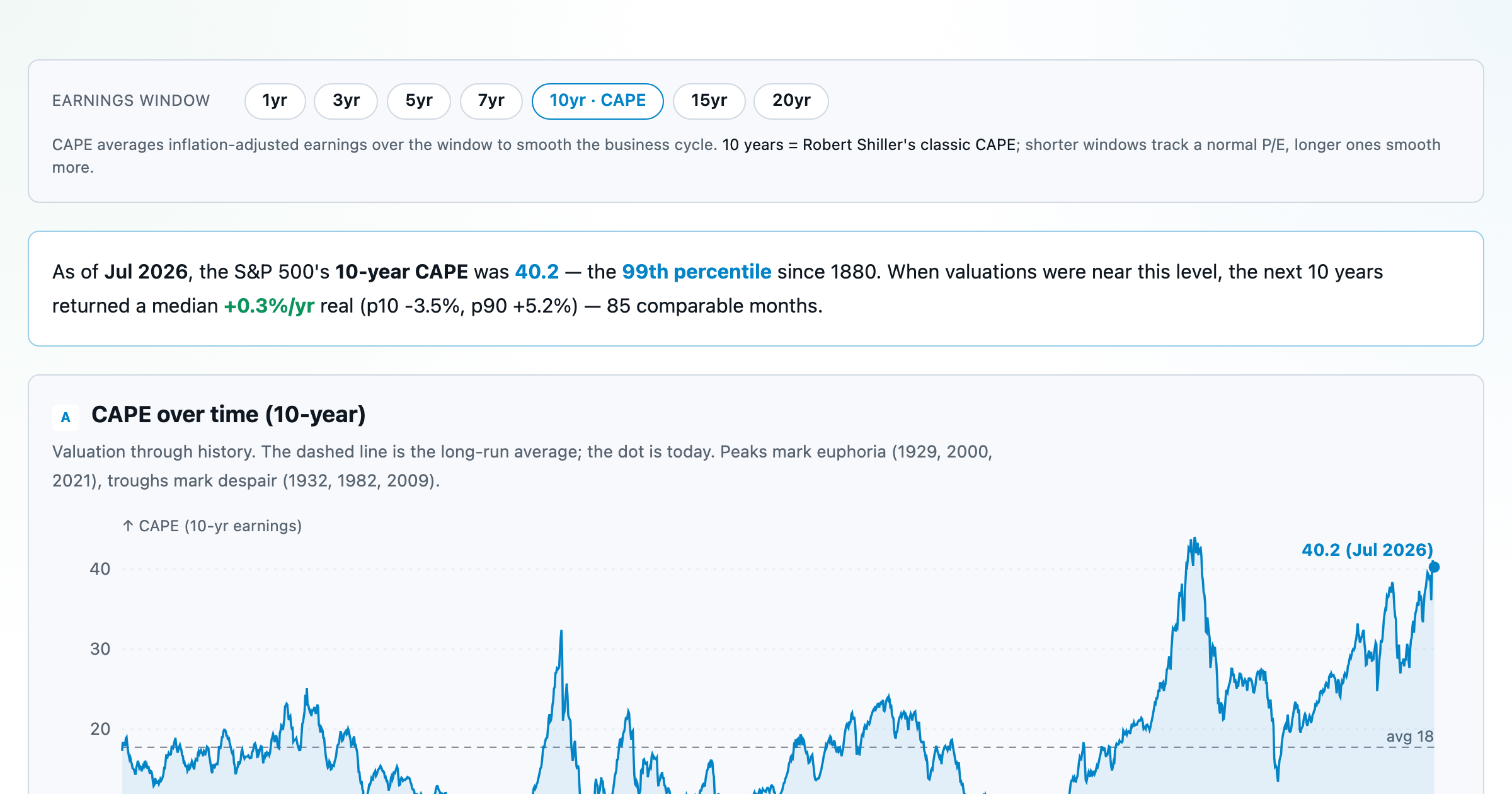
Is the market expensive? The Shiller CAPE back to 1871 and what valuations have meant for the next decade.
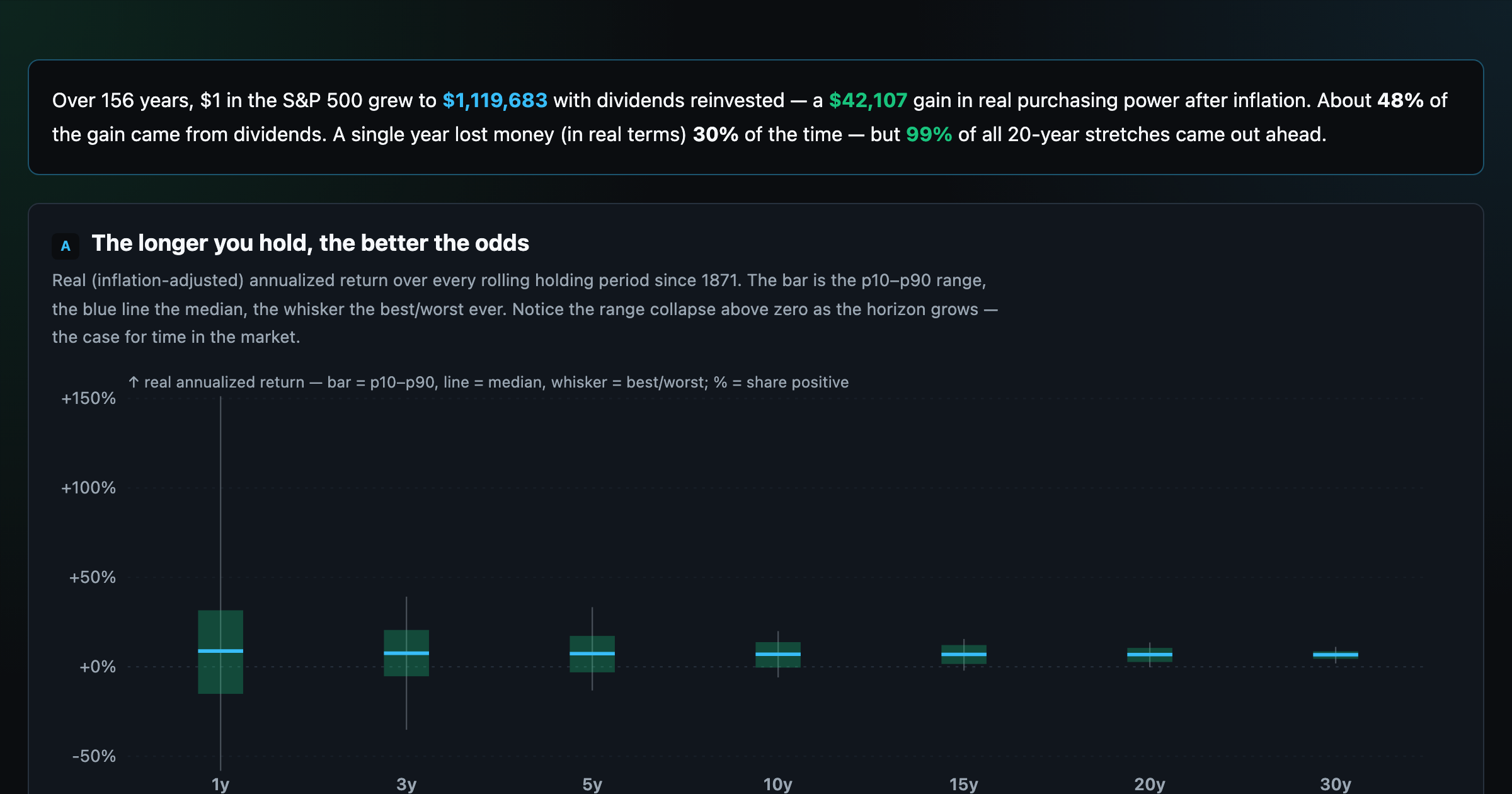
The S&P 500 since 1871 — odds of gain by holding period, real drawdowns, and the growth of $1.